The Maung Nu Massacre of 27 August 2017
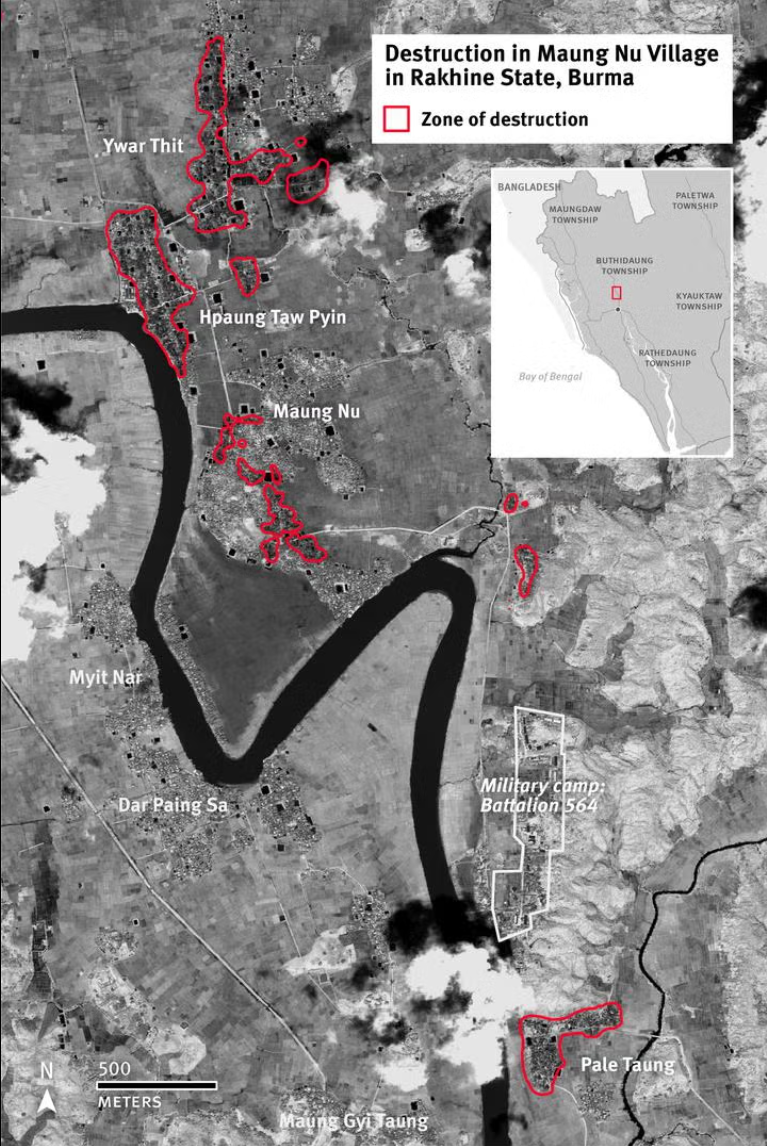
The evidence describes a massacre concentrated at a particular residential location rather than an indiscriminate attack across open fields or along a riverbank. Men and boys were detained within the compound, while women and girls were separated from them. Witnesses described beatings, interrogations, sexual violence and executions carried out by soldiers who exercised direct control over the civilians.
The distinctive circumstances of Maung Nu are important because they provide evidence of killings committed after victims had been gathered and placed under military control. The residential compound became a location where families who had sought collective safety were instead exposed to organised violence.
The Residential Compound Where Villagers Gathered
According to Human Rights Watch, the compound contained a large two-storey residence belonging to a prominent Rohingya family. As security conditions deteriorated, residents from surrounding houses entered the property, hoping that the building and the presence of neighbours would provide some protection.
Women and girls gathered primarily in downstairs rooms, while men and boys remained upstairs. The separation initially reflected the way frightened families organised themselves within the building rather than an arrangement imposed by soldiers.
When Myanmar troops entered the compound, they took control of the people sheltering there. Witnesses described soldiers moving through the house, ordering residents into different areas and preventing them from leaving. The layout of the compound later became essential to reconstructing the massacre because witnesses observed events from rooms, windows and neighbouring buildings. Their accounts allowed investigators to establish the relationship between the detention of men, the movement of women and the killings outside.
The Detention and Execution of Men and Boys
Survivors described soldiers taking men and boys from the house, binding their hands and covering their eyes with cloth taken from women's head coverings. The detainees were beaten and interrogated before being forced to lie face down on the ground.
Human Rights Watch documented accounts of soldiers shooting victims and cutting their throats with long knives. Witnesses described executions occurring in groups, while other civilians remained confined nearby. The evidence is particularly significant because the victims were under military control when they were killed. Their restraint and detention distinguish the killings from deaths occurring during an armed confrontation.
The accounts also indicate that the soldiers exercised sufficient control over the compound to organise the detention and execution of civilians. This is relevant to examining individual responsibility and the actions of officers present during the operation.
Rohingya Estimates of the Number Killed
Survivors interviewed during the investigations estimated that at least 150 men and boys were killed at Maung Nu. The reported victims ranged in age from approximately twelve to ninety years. These figures reflect the community's assessment of the massacre rather than a complete forensic identification of every person killed.
Human Rights Watch concluded that soldiers had summarily executed several dozen Rohingya civilians, while acknowledging that it could not independently verify the larger survivor estimates.
The distinction between these figures is important. The independently documented cases establish that a massacre occurred, while the higher estimate reflects the scale of loss reported by residents familiar with the people who had gathered in the compound.
A complete victim register would require the names, ages and family relationships of those killed, together with evidence concerning the circumstances of each death. The survivor estimate should remain part of Rohipedia's historical record without being presented as a final verified total.
Mohammad Usman's Testimony
Mohammad Usman, a fifteen-year-old Rohingya survivor from neighbouring Hpaung Taw Pyin, described being wounded as residents fled gunfire and burning houses. His testimony was documented by Human Rights Watch during its investigation of the events surrounding Maung Nu. Usman reported hearing heavy shooting during the early hours and attempting to escape as violence spread. He sustained injuries to his arm and back and lost consciousness before being assisted by other villagers.
His account is important because it documents violence affecting neighbouring residents outside the principal Maung Nu execution site. It demonstrates that the massacre at the residential compound occurred within a wider local emergency in which civilians were also being wounded while escaping their homes.
The medical and eyewitness evidence concerning Usman's injuries should be considered separately from the number of people executed at Maung Nu. His experience illustrates the geographical reach of the violence without establishing that he was present inside the compound.
Sexual Violence Reported at Maung Nu
Human Rights Watch collected testimony alleging sexual violence against Rohingya women and girls during the Maung Nu operation. Witnesses described soldiers separating women from detained men and taking some into nearby areas where they were assaulted. In testimony submitted to a British parliamentary inquiry, Human Rights Watch reported a survivor's account of soldiers taking groups of women into bushes while executions were being carried out.
The available evidence indicates that sexual violence formed part of the attack, although the published investigations did not establish a complete number of victims. The identities and experiences of survivors require careful handling because disclosure can expose them to stigma and further harm.
The significance of this testimony lies in documenting the different forms of violence committed against civilians within the same operation. The reported sexual assaults should neither be omitted from the historical record nor described through unnecessary graphic detail.
The Destruction of Maung Nu and Hpaung Taw Pyin
Human Rights Watch examined satellite imagery showing extensive destruction in Maung Nu and neighbouring Hpaung Taw Pyin, known locally as Pondu Para. The images indicated that both Rohingya settlements had been almost entirely destroyed by fire.
The physical destruction provides independent evidence of the devastation described by residents. However, satellite imagery cannot establish how many people were killed inside the residential compound or identify the soldiers responsible for particular acts.
The evidence from Maung Nu therefore combines different forms of documentation. Eyewitness testimony establishes the circumstances of the executions, while satellite observations demonstrate the destruction of the surrounding communities. The relationship between these sources strengthens the historical reconstruction without requiring either form of evidence to establish facts beyond its capabilities.
Hpaung Taw Pyin: Violence Beyond the Compound
Hpaung Taw Pyin was affected by violence that differed from the concentrated executions at Maung Nu. Residents described gunfire near a security checkpoint, houses catching fire and families fleeing during the early hours of 25 August.
The testimony collected by Human Rights Watch indicates that civilians were wounded as they attempted to escape. The experiences of residents such as Mohammad Usman demonstrate that the local population faced serious danger even before the later massacre at the Maung Nu compound.
The evidence does not justify treating every death or injury at Hpaung Taw Pyin as part of the same execution event. The incidents occurred at different locations and under different circumstances, although they affected neighbouring Rohingya communities.
For Rohipedia, maintaining this distinction is essential. Maung Nu should be documented as a concentrated massacre of detained civilians, while Hpaung Taw Pyin requires attention to shootings, flight and destruction affecting residents across the settlement.
The Significance of the Buthidaung Evidence
The Maung Nu investigation demonstrates how Rohingya survivor testimony can reconstruct a massacre occurring within a confined residential compound. Witnesses identified where people had gathered, how soldiers separated civilians and the locations where executions occurred.
The neighbouring evidence from Hpaung Taw Pyin adds a different perspective by documenting violence against residents attempting to escape gunfire and burning houses. Together, the two cases establish that civilians experienced distinct forms of violence within a closely connected area.
The available evidence also illustrates the importance of maintaining separate casualty categories. People executed in the compound, residents shot during flight and individuals missing after the destruction of their homes should not automatically be combined into a single unverified death toll.
Part B examines additional documented killings in Rathedaung and Maungdaw, including cases in which elderly people and residents with disabilities were unable to escape burning homes. These incidents are treated separately from the Maung Nu massacre because the available testimony describes different circumstances and methods of violence.
Chein Kar Li: Civilians Attacked During Flight
Chein Kar Li, in Rathedaung Township, was among the Rohingya settlements where security forces and participating armed civilians carried out attacks during the opening days of the 2017 campaign. Amnesty International interviewed survivors who described soldiers approaching the village, opening fire and setting houses alight while residents attempted to escape.
The evidence differs from the Maung Nu massacre because witnesses primarily described attacks on people fleeing their homes rather than the detention and execution of a large group within a single compound. Some residents were killed or injured while attempting to reach surrounding hills, while others remained trapped inside the settlement.
Amnesty International documented at least several dozen reported killings in Chein Kar Li. Its findings were based on eyewitness interviews and the broader investigation of attacks affecting neighbouring villages. The precise number of victims remained difficult to establish because many families fled before they could account for missing relatives. The case demonstrates the importance of distinguishing between direct executions, shootings during flight and deaths caused by the burning of occupied houses.
Koe Tan Kauk: The Death of Rayna Khatun
Koe Tan Kauk, another Rohingya settlement in Rathedaung Township, was the location of a particularly well-documented account concerning a resident with a disability. Amnesty International interviewed Sona Mia, a seventy-seven-year-old Rohingya man whose twenty-year-old daughter Rayna Khatun could neither walk nor speak.
When soldiers approached the village on 27 August, Sona Mia's family attempted to carry Rayna toward the surrounding hills. As gunfire moved closer, they realised that they could not continue carrying her while escaping. They left her temporarily inside an abandoned Rohingya house, intending to return when the immediate danger had passed.
From the hillside, the family watched houses burning in the settlement. After the soldiers departed, Sona Mia's sons returned and found Rayna's burned body inside the house. They buried her in the courtyard. The testimony provides a specific account of how an attack involving the burning of homes could kill residents who were unable to escape. It also preserves Rayna's identity rather than reducing her death to an anonymous casualty.
The Vulnerability of Elderly and Disabled Residents
The testimony from Koe Tan Kauk illustrates a recurring problem during attacks on Rohingya villages: residents who could not move quickly were at particular risk when armed personnel entered settlements and houses were burned.
Amnesty International documented cases in which elderly people and persons with disabilities were unable to reach surrounding hills or agricultural areas. Families sometimes faced impossible choices between remaining together and risking death or separating in an attempt to save other relatives.
These circumstances distinguish certain village attacks from massacres involving the direct execution of detained civilians. The deaths occurred within a wider operation involving shooting and arson, but the immediate cause could be the destruction of a house occupied by someone unable to flee.
The historical record should therefore identify both the attack on the community and the particular circumstances of individual victims. The experience of Rayna Khatun provides an example of why detailed family testimony is essential.
The Displaced Rohingya Camp Near Chein Kar Li
Amnesty International's investigation also identified an internally displaced Rohingya settlement near Chein Kar Li that was attacked during the same period. The camp was associated with Rohingya residents who had already experienced displacement before the 2017 campaign.
The attack on an existing displaced community is significant because its residents had limited security and fewer resources for escaping renewed violence. Families who had already lost homes or livelihoods were exposed to further danger when military operations reached the area.
Amnesty International documented the camp alongside the attacks on Chein Kar Li and Koe Tan Kauk, describing a sequence of violence affecting neighbouring Rohingya settlements over several days. The available material does not provide a complete independent casualty register for the camp. It should therefore be documented as a distinct affected location without assigning an unsupported death toll.
Kyet Yoe Pyin: Reports of Killings With Bladed Weapons
Fortify Rights collected testimony from Rohingya survivors of Kyet Yoe Pyin in Maungdaw Township concerning killings committed during the 2017 operations. Witnesses described armed personnel and participating civilians using bladed weapons against Rohingya residents.
The organisation reported allegations of beheadings and throat-cutting in Kyet Yoe Pyin and other affected settlements. These accounts were gathered from survivors who had escaped to Bangladesh and formed part of Fortify Rights' early documentation of atrocities.
The available public material establishes that such allegations were reported by Rohingya witnesses. However, the cited summary does not provide a complete victim-by-victim reconstruction of the killings in Kyet Yoe Pyin. Rohipedia should therefore preserve the reported methods of violence while avoiding a precise casualty figure that the available evidence does not support.
Ba Da Kha Ywa Thit: Further Rohingya Testimony
Fortify Rights also recorded testimony from Ba Da Kha Ywa Thit, another Rohingya settlement in Maungdaw Township. Survivors described killings involving bladed weapons and attacks against civilians during the military campaign.
These reports are important because they document violence in locations that received less international attention than Tula Toli or Inn Din. Their inclusion helps preserve the wider Rohingya historical record without suggesting that all incidents had identical circumstances.
The published Fortify Rights material does not establish a complete chronology, list of victims or independently verified death toll for Ba Da Kha Ywa Thit. Those limitations should remain explicit. Further Rohingya community statements and village-level documentation would be necessary to reconstruct the events in greater detail.
Why the Incidents Must Be Documented Separately
The cases examined in this chapter reveal distinct forms of violence against Rohingya civilians. At Maung Nu, witnesses described the execution of people detained within a residential compound. At Chein Kar Li, residents reported shootings during flight and the burning of homes. At Koe Tan Kauk, a young woman with a disability died after her family was forced to leave her behind.
Other communities provided testimony concerning killings with bladed weapons and attacks on people who could not escape. The evidence varies considerably in detail, ranging from extensive survivor investigations to shorter reports preserving allegations from particular villages.
These differences do not diminish the seriousness of the reported crimes. They demonstrate why historical documentation must preserve the identity of each settlement, the experiences of its residents and the limitations of the available evidence. Treating every incident as interchangeable would obscure important facts concerning the victims, perpetrators and methods of violence.
Conclusion: A Wider Record of Rohingya Massacres
The evidence from Maung Nu, Hpaung Taw Pyin, Chein Kar Li, Koe Tan Kauk and other affected communities demonstrates that the major massacres already examined in this series were not the only atrocities reported during the 2017 military campaign.
Rohingya survivor testimony identifies killings in residential compounds, shootings during flight, deaths in burning homes and attacks involving bladed weapons. Independent investigations corroborated important elements of these accounts, although the precision of casualty figures and the availability of physical evidence differed between locations.
The Maung Nu massacre is particularly well documented through detailed testimony concerning the detention and execution of civilians. Other settlements require further village-level research, including the collection of original Rohingya statements and named victim records. The chapter preserves these incidents as separate historical cases rather than reducing them to a general account of violence across northern Arakan.