Rohingya Civilians Seeking Refuge Near the Beach
By the beginning of September 2017, Rohingya residents of Inn Din were facing the destruction of their homes and the loss of security within their community. Many families gathered near the coast, hoping to avoid armed personnel and find an opportunity to escape. Among those seeking refuge were ten men who would subsequently be detained and executed by Myanmar soldiers and participating local Rakhine civilians.
The Reuters investigation, published on 8 February 2018, reconstructed the fate of these men through interviews with Rohingya relatives, local Rakhine residents and individuals involved in the killings. Their families described them as ordinary villagers, including fishermen, shopkeepers, labourers and a religious teacher. Independent investigators found no credible evidence establishing that the ten had participated in an armed attack.
The men were not captured during a documented battle. Rohingya witnesses described security personnel selecting them from a larger group of displaced civilians sheltering near the beach. This distinction is fundamental to understanding the massacre because the victims were taken into custody before being deliberately killed.
The Detention on 1 September 2017
Amnesty International interviewed six witnesses who were relatives of the detained men. Their accounts supported the finding that the victims had been taken from a civilian gathering rather than captured during an armed confrontation. The testimony also contradicted the military's subsequent description of the men as members of a group that had attacked security forces.
Once detained, the ten men were under the control of armed personnel. Their treatment could no longer be explained as casualties of fighting, regardless of the wider military operations taking place in northern Arakan. The obligation to protect people in custody applied irrespective of their alleged political affiliations or previous activities.
The Photograph of the Ten Captives
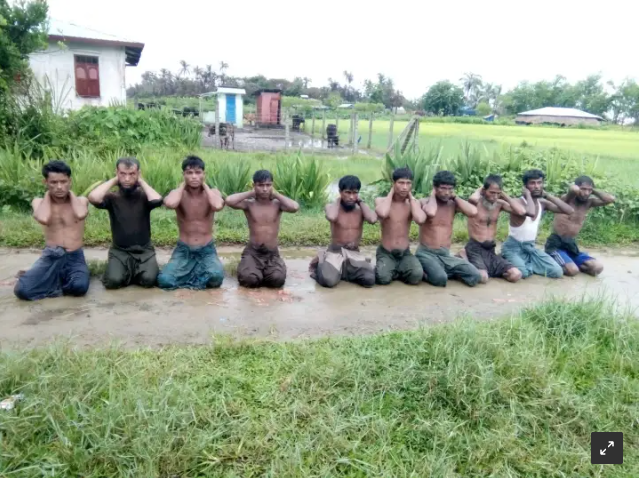
One of the most important pieces of evidence obtained by Reuters was a photograph showing the ten Rohingya men kneeling in a row, with their hands tied behind their backs. Armed security personnel stood nearby. The image was provided to Reuters by a local Rakhine village elder and became central to the investigation.
The photograph established that the ten men were alive while restrained and under armed supervision. It directly contradicted any suggestion that all ten died during an uncontrolled exchange of fire. Their captivity was visible, and the image could be compared with subsequent testimony concerning their execution.
For the victims' families, the photograph also became a painful record of their relatives' final hours. Some families had lost their possessions during the destruction of Inn Din, leaving them without personal photographs of the men. The Reuters image consequently served both as evidence of a crime and as a record of individuals whose lives had been taken.
The Morning of 2 September 2017
On the morning of 2 September, the ten captives were taken to a location where a grave had been prepared. Reuters interviewed local residents who described participating in the digging and witnessing the executions. The killings occurred while the men were restrained and unable to defend themselves.
According to the investigation, local Rakhine civilians killed at least two of the men with bladed weapons, while Myanmar soldiers shot the others. Reuters reported that the executions took place shortly after 10 a.m. The sequence was reconstructed through photographs and testimony from individuals who witnessed or participated in the killings.
The involvement of both soldiers and local civilians is historically significant. It demonstrates that the execution was not simply the act of one individual soldier but involved cooperation between armed state personnel and people outside the formal military structure. The victims remained under the control of security personnel throughout the operation.
The Killing of Abdul Malik
Among the ten victims was Abdul Malik, a Rohingya religious teacher. Reuters reported that he was attacked with a blade by a local Rakhine participant before Myanmar soldiers shot the remaining captives. His killing was part of the same organised execution that claimed the lives of the other nine men.
Amnesty International subsequently examined testimony concerning the incident and reported that relatives of a missing Rakhine resident had been permitted to participate in the initial violence against the detainees. The evidence raised questions about the role of local civilians and the responsibility of security personnel who controlled the captives.
Abdul Malik's occupation as a religious teacher was an important part of his identity within the Rohingya community. His death, like those of the other victims, must be documented through his individual circumstances rather than reduced to the military's collective description of the men as alleged insurgents.
The Burial of the Ten Victims
After the executions, the bodies were placed together in a grave. A second photograph obtained by Reuters showed the ten men's bodies lying in the burial pit. The images of the captives before their deaths and their bodies afterward provided unusually direct evidence of the same group of victims.
Reuters combined the photographs with interviews involving witnesses who had participated in digging the grave and observing the killings. The resulting investigation established a connection between the detention, execution and disposal of the bodies that was difficult for Myanmar's authorities to dismiss.
The grave represented only the ten men whose execution became internationally known. Rohingya residents reported other killings in Inn Din during the same period, and their accounts require separate documentation. The existence of the photographed grave should therefore not be treated as a complete record of all Rohingya victims in the village.
Myanmar's Claim That the Victims Were Terrorists
Myanmar's military alleged that the ten men belonged to a group of approximately 200 Rohingya attackers who had confronted security forces. Its official account presented the executions as connected to a security operation against alleged militants.
Reuters found substantial contradictions in this explanation. Local Rakhine villagers interviewed by the agency did not describe the large insurgent assault claimed by the military. Rohingya witnesses instead reported that the ten men had been selected from civilians sheltering near the beach.
Amnesty International reached a similar conclusion after examining testimony from relatives and other witnesses. Its findings indicated that the circumstances of the detention were inconsistent with the official account of an armed confrontation. Even if any detainee had previously participated in hostilities, executing a restrained person in custody would remain unlawful.
The Rohingya Community's Wider Record of Victims
The ten executions became internationally recognised because Reuters obtained photographs and direct testimony from people involved. However, Rohingya residents documented additional killings in Inn Din during the same period. Their records provide a broader picture of the violence experienced by the community.
Amnesty International obtained a list prepared by Rohingya activists and community leaders containing the names and biographical information of 35 people allegedly killed in Inn Din, including the ten executed men. The organisation could not independently verify every entry but established the identities of at least 17 victims, including the ten men.
A local Rakhine resident also told Amnesty International that more than thirty Rohingya had been killed in the area. These findings demonstrate why the Inn Din massacre should not be understood solely through the ten photographed victims. Their execution was unusually well documented, but other Rohingya families also reported deaths requiring investigation.
The Importance of the Victims' Families
The families of the ten men provided evidence essential to reconstructing their detention and identifying them as members of the civilian community. Their accounts described the men's occupations, family relationships and circumstances before they were taken away. Such testimony helped restore the identities of individuals whom military statements had described collectively as alleged attackers.
Reuters later interviewed relatives living in refugee camps in Bangladesh. Among them was Rehana Khatun, whose husband Nur Mohammed was one of the executed men. She described the continuing absence of her husband and the circumstances in which she learned that he would never return.
Other relatives preserved family memories, photographs and information about the men's lives. Their testimony demonstrates the importance of recording individual histories alongside forensic and photographic evidence. Each victim belonged to a family and community whose loss continued long after the execution.
What the Evidence Establishes
The available evidence establishes that ten Rohingya men were detained by Myanmar security personnel on 1 September 2017 and executed the following morning. Photographs obtained by Reuters show the men restrained before their deaths and their bodies afterward. Witnesses described the participation of soldiers and local civilians in the killings.
The investigation also contradicted Myanmar's attempt to justify the executions through claims of a large insurgent attack. Independent reporting and testimony from Rohingya relatives did not substantiate the military's portrayal of the ten men as armed combatants captured during battle.
The wider Rohingya community's victim documentation indicates that the ten executions were not the only killings associated with Inn Din. Their case provides unusually direct evidence of unlawful execution, while the additional reported victims demonstrate the need for further historical documentation.
Part B will examine how Reuters uncovered the massacre, the arrest of journalists Wa Lone and Kyaw Soe Oo, Myanmar's admission of responsibility, the subsequent treatment of convicted soldiers and the continuing demands of Rohingya families for accountability.
How the Inn Din Massacre Came to International Attention
The killing of ten Rohingya men at Inn Din became internationally known through an investigation by Reuters journalists Wa Lone, Kyaw Soe Oo, Simon Lewis and Antoni Slodkowski. Their work brought together testimony from Rohingya families, local Rakhine residents, security personnel and individuals who had direct knowledge of the killings. The resulting report, published on 8 February 2018 under the title Massacre in Myanmar, provided unusually detailed evidence of crimes committed during the 2017 military campaign.
For Rohingya families, the investigation provided international recognition of events they had already reported. The journalists did not discover the suffering of Inn Din's residents; they assembled evidence that enabled the wider world to examine the killings and the responsibility of those involved.
The Importance of Testimony From Different Communities
An unusual feature of the Reuters investigation was its access to witnesses from both the Rohingya and Rakhine communities. Rohingya relatives described the circumstances in which the victims disappeared, while local Rakhine residents provided information concerning the participation of civilians and security personnel.
Some individuals interviewed by Reuters acknowledged involvement in activities connected to the killings. Their testimony was especially important because it could be compared with the accounts of victims' relatives and other witnesses who had not participated in the violence.
The investigation demonstrated that evidence of atrocities could emerge even from communities whose members had been involved in the events. It also showed the importance of distinguishing individual responsibility from collective ethnic identity. The actions of particular armed civilians did not establish responsibility on the part of an entire community.
For Rohipedia, the value of this evidence lies in the convergence of independent accounts. Rohingya testimony remained central to identifying the victims and reconstructing their circumstances, while statements from other witnesses supplied additional information about the perpetrators.
The Arrest of Wa Lone and Kyaw Soe Oo
On 12 December 2017, Myanmar police arrested Reuters journalists Wa Lone and Kyaw Soe Oo in Yangon. The arrests occurred while they were investigating the Inn Din killings and gathering information concerning military operations in northern Arakan.
The journalists had been invited to meet police officers at a restaurant. Shortly afterward, they were detained and accused of possessing confidential government documents. Myanmar's authorities charged them under the colonial-era Official Secrets Act, which carried a possible sentence of fourteen years' imprisonment.
Their detention interrupted the investigation and generated international concern about the suppression of reporting on atrocities against the Rohingya. Human rights organisations and press-freedom advocates questioned the circumstances of the arrests and called for the journalists' release. The case became closely associated with the Inn Din massacre because the reporters were detained while investigating a crime that Myanmar's authorities had not yet publicly acknowledged.
Allegations That the Journalists Were Entrapped
During the subsequent court proceedings, police captain Moe Yan Naing testified that a senior officer had instructed police personnel to arrange a meeting and provide documents to the journalists. His testimony supported allegations that the arrests had been deliberately engineered.
The circumstances of the meeting became an important issue in the trial. Defence lawyers argued that the journalists had been carrying out legitimate investigative reporting and had been improperly targeted by the authorities. The prosecution maintained that the journalists had unlawfully obtained official documents. Despite the allegations of entrapment and international criticism of the proceedings, the court ultimately convicted them.
The testimony concerning the arrests is historically important because it raised questions about whether the authorities were seeking to punish the journalists for their investigation rather than protect legitimate state secrets.
Myanmar's Admission of the Inn Din Killings
On 10 January 2018, Myanmar's military publicly acknowledged that security personnel and local villagers had killed ten Rohingya men and buried them in a mass grave at Inn Din. The admission was unusual because military authorities had repeatedly rejected allegations of widespread atrocities against Rohingya civilians.
The statement followed the discovery of evidence concerning the grave and preceded publication of the full Reuters investigation. Although the military acknowledged unlawful killings, it continued to characterise the victims as terrorists and presented the incident as an isolated case of misconduct.
Amnesty International responded by emphasising that the admission warranted a broader independent investigation. The organisation argued that the acknowledged killings represented only a small part of the violations reported throughout northern Arakan.
For Rohingya survivors, the admission was important because it confirmed that security personnel had participated in the killings. Nevertheless, the military's continued portrayal of the victims as alleged militants remained inconsistent with testimony from their relatives and the circumstances documented by independent investigators.
The Publication of Massacre in Myanmar
Reuters published its investigation on 8 February 2018 while Wa Lone and Kyaw Soe Oo remained in detention. The report presented the findings of months of investigative work, including accounts from individuals connected to the killings and evidence obtained from Inn Din.
The publication drew international attention because it documented direct participation by Myanmar soldiers and local armed civilians in the killing of restrained Rohingya men. It also provided detailed information about the victims and the circumstances surrounding their deaths.
The investigation became an important example of how journalism could contribute to documenting international crimes. Its findings were subsequently cited by human rights organisations and used in wider discussions concerning accountability for atrocities committed during the 2017 campaign. The report's importance should not obscure the role of Rohingya witnesses. The identities and personal histories of the victims were preserved largely through their relatives and other members of the displaced community.
The Sentencing of Seven Soldiers
On 10 April 2018, Myanmar's military announced that seven soldiers had been sentenced to ten years' imprisonment with hard labour for their involvement in the Inn Din killings. The military also reported that the soldiers had been dismissed from service, with three officers demoted before their dismissal.
The sentences represented a rare official acknowledgment that military personnel had committed unlawful killings during the 2017 operations. However, the proceedings were conducted within Myanmar's military justice system rather than through an independent civilian or international court.
The military's announcement did not establish accountability for the wider violence reported at Inn Din. Amnesty International's investigation identified additional Rohingya victims whose deaths were not addressed by the prosecution of the seven soldiers. The case therefore raised questions about whether the proceedings represented a meaningful attempt to establish responsibility or a limited response to evidence that had become impossible to deny.
The Conviction of the Reuters Journalists
On 3 September 2018, a Myanmar court sentenced Wa Lone and Kyaw Soe Oo to seven years' imprisonment under the Official Secrets Act. The judgment followed proceedings criticised by international human rights organisations, journalists' associations and foreign governments.
The conviction created a striking contrast with the military's treatment of the soldiers implicated in the killings. The journalists had investigated the deaths of Rohingya civilians, yet they faced lengthy imprisonment for possessing documents obtained during their reporting. The case attracted international attention as an example of restrictions on press freedom and the obstacles confronting efforts to investigate military abuses in Myanmar. The journalists continued to challenge their convictions while remaining in prison.
Their imprisonment also demonstrated the difficulties of obtaining independent evidence about the genocide. When journalists investigating a documented massacre were prosecuted, the possibility of exposing other crimes became more uncertain.
International Recognition of the Investigation
The Reuters investigation received significant international recognition for its contribution to documenting atrocities against the Rohingya. In April 2019, the Reuters team was awarded the Pulitzer Prize for International Reporting for its work exposing the Inn Din massacre and the wider campaign against Rohingya civilians.
The award recognised the importance of investigative journalism in revealing crimes committed in a region where independent access had been severely restricted. It also drew renewed attention to the continued imprisonment of Wa Lone and Kyaw Soe Oo.
The international recognition did not resolve the suffering of the victims' families or establish criminal responsibility for all those involved. Nevertheless, it ensured that the evidence concerning Inn Din remained prominent in discussions of the Rohingya genocide. For Rohipedia, the investigation is important not because it replaced Rohingya testimony, but because it helped bring survivor accounts and corroborating evidence into the international historical record.
The Release of the Journalists
Wa Lone and Kyaw Soe Oo were released from prison on 7 May 2019 as part of a presidential amnesty. They had spent more than sixteen months in detention following their arrests in December 2017.
Their release followed sustained international criticism of the prosecution and repeated calls from human rights organisations and press-freedom advocates. By that time, their investigation had become one of the most widely recognised accounts of atrocities committed during the 2017 campaign.
The release ended their imprisonment but did not erase the consequences of the prosecution. Their case remained an important example of the risks faced by journalists attempting to document violations committed by powerful state institutions. The two reporters had spent considerably longer in prison than the soldiers whose actions they had helped expose, a disparity that became even more apparent when information emerged about the soldiers' early release.
The Secret Early Release of the Convicted Soldiers
On 27 May 2019, Reuters reported that the seven soldiers convicted for the Inn Din killings had already been released from prison. According to prison officials, former inmates and one of the soldiers, the men had been freed in November 2018.
The soldiers had therefore served less than one year of their ten-year sentences. Their release had not been publicly announced when it occurred, and the authorities provided no detailed public explanation establishing why the sentences had been reduced so substantially.
The revelation attracted criticism because the soldiers had been convicted of participating in the killing of ten restrained civilians. Their early release stood in sharp contrast to the prolonged imprisonment of the journalists who had documented the crime. The case illustrated a serious failure of accountability. Even where Myanmar's military acknowledged killings and imposed sentences, the punishment was not carried out as publicly announced.
The Continuing Importance of Rohingya Family Testimony
The Inn Din investigation would not have been possible without information preserved by Rohingya survivors and relatives of the victims. Their testimony identified the men, established their civilian occupations and provided details concerning their detention.
The families continued to live with the consequences of the killings after the international attention surrounding the Reuters investigation had diminished. The publication of photographs and the admission of responsibility did not restore their relatives or provide comprehensive remedies for their losses.
Rohingya community documentation also identified other people reportedly killed at Inn Din. These cases demonstrate the limitations of an accountability process focused exclusively on the ten victims whose execution was photographed. For Rohipedia, preserving the names, occupations and family histories of the victims remains essential. Their identities should not disappear behind the international recognition received by the journalists who investigated their deaths.
The Limits of Myanmar's Internal Accountability
The Inn Din case provides an unusually clear example of the limitations of Myanmar's military justice system during the period following the 2017 atrocities. The military acknowledged the killings, prosecuted seven soldiers and announced substantial prison sentences, but those sentences were not served in full.
The proceedings also failed to address the wider body of evidence concerning other killings in Inn Din. Amnesty International's documentation of additional victims indicated that the ten executions were part of a broader pattern of violence against Rohingya residents.
The early release of the convicted soldiers raised further questions about the military's willingness to punish personnel responsible for serious crimes. The absence of transparent explanations concerning their release weakened confidence in the proceedings.
These developments demonstrate why the existence of a military prosecution should not automatically be treated as evidence of effective accountability. The independence of the proceedings, their scope and the actual enforcement of sentences are all relevant to evaluating their significance.
The Historical Significance of the Inn Din Investigation
The Inn Din massacre became one of the most thoroughly documented executions of Rohingya civilians during the 2017 genocide. Its significance lies in the combination of Rohingya family testimony, photographic evidence, statements from participants and Myanmar's subsequent admission of responsibility.
The Reuters investigation demonstrated that the killings could be reconstructed despite restrictions on independent access to northern Arakan. It also exposed the risks faced by journalists investigating military crimes and the limitations of Myanmar's response when direct evidence became public.
The case remains important because it reveals both the possibility of documenting atrocities and the obstacles to obtaining justice. The ten men were identified, their deaths were acknowledged and soldiers were convicted, yet the sentences were substantially curtailed and other reported victims received little attention.
For the Rohingya community, the historical record must preserve the lives and identities of those killed, not merely the circumstances in which their deaths became internationally known. The Inn Din case therefore stands as evidence of unlawful execution, the courage of witnesses and journalists, and the continuing need for credible accountability.
Continue reading → Chapter 7: The Gu Dar Pyin Massacre and Allegations of Mass Graves