Chut Pyin Before Its Destruction
Chut Pyin was a village in Rathedaung Township, northern Arakan, where approximately 1,400 Rohingya lived alongside a smaller Rakhine Buddhist population. The communities occupied adjoining residential areas, with Rohingya households concentrated toward the southwest. Most Rohingya families depended on rice cultivation, vegetable farming and small-scale local economic activities. Their homes, fields, ponds and village paths formed a familiar landscape in which neighbours maintained close relationships across generations.
The village's geography later became important in reconstructing the massacre. Its residential areas were separated by a pond and open ground, while surrounding agricultural fields provided possible escape routes. The local school and nearby houses became identifiable locations in survivor testimony. These details enabled investigators to compare accounts from people who had witnessed different stages of the attack.
Chut Pyin was not merely a location on an administrative map. It was an established Rohingya community whose residents knew individual families, local leaders and the places where neighbours lived. Their knowledge later became essential in identifying missing villagers and distinguishing those known to have been killed from those whose fate remained uncertain.
The Village's Rejection of National Verification Cards
Physicians for Human Rights documented testimony concerning a meeting held on 22 August 2017, five days before the massacre. According to survivors, Myanmar security personnel and local Rakhine Buddhist leaders summoned Rohingya representatives to discuss acceptance of National Verification Cards, commonly known as NVCs. The authorities sought the community's agreement to participate in the citizenship verification process.
The cards were deeply controversial among Rohingya residents because the process did not recognise their ethnic identity and required them to establish eligibility for citizenship rather than acknowledging rights they believed they already possessed. Witnesses reported that village representatives were pressured to sign a document and return with a decision. They also described warnings of severe consequences if the community refused.
On 23 August, Rohingya villagers reportedly decided collectively not to accept the cards. According to the testimony collected by Physicians for Human Rights, local authorities subsequently restricted movement and warned residents against leaving their houses. These accounts provide an important local context for the massacre and suggest that coercive pressure had intensified immediately before the attack.
The Afternoon of 27 August 2017
Survivors interviewed by Physicians for Human Rights described the main assault beginning at approximately 1:30–2:00 p.m. on Sunday, 27 August 2017, as men returned from afternoon prayers. Myanmar security personnel and armed Rakhine civilians entered the Rohingya residential area carrying firearms and other weapons. Witnesses described armed groups approaching from different directions and surrounding parts of the settlement.
Residents were ordered out of their houses as shooting began. Some were attacked while attempting to escape, while others were assaulted inside or near their homes. The sudden arrival of armed personnel left families little time to gather belongings or determine where they might find safety. People fled toward surrounding fields, while others remained trapped within the residential area.
The accounts collected from survivors were consistent on several important points, including the approximate time of the assault, the participation of armed personnel and the separation of villagers. Witnesses described an attack continuing for several hours rather than a brief exchange of fire. Their testimony provided the basis for reconstructing the sequence of violence inside the settlement.
The Separation of Men and Women
A distinctive feature of the Chut Pyin massacre was the deliberate separation of residents. Survivors described armed personnel dividing men and boys from women and girls after forcing people out of their houses. Some men were detained or moved away from their families, while others were shot or attacked with bladed weapons. Witnesses described men being ordered to kneel before being killed.
Women and girls were also separated into groups. Some were reportedly taken toward a school building in the Rakhine section of the village, while others were attacked near their homes. The testimony concerning sexual violence and the experiences of women and girls will be examined in Part B alongside the medical evidence collected from survivors.
The separation of residents is historically significant because it indicates purposeful control over civilians. Witnesses did not describe only indiscriminate shooting during a chaotic confrontation. They identified a sequence in which armed personnel directed different groups toward particular locations before carrying out acts of violence.
The Disappearance of Fifty Rohingya Men
One of the most serious unresolved elements of the massacre concerns approximately fifty Rohingya men who were reportedly taken away and never seen again. Physicians for Human Rights documented survivor accounts describing their removal during the attack. Their disappearance became an important part of the community's assessment of the number of people killed or missing.
The published investigation did not establish the fate of these men through the recovery and identification of their bodies. Their disappearance must therefore be distinguished from cases in which witnesses directly observed a killing. Nevertheless, the reported removal of civilians by armed personnel, followed by their continued disappearance, raises grave questions about unlawful detention, killing and the concealment of victims.
For the families concerned, the absence of confirmed information created continuing uncertainty. Relatives could not establish whether the missing men had died, where their remains might be located or whether any official record existed of their detention. The preservation of their identities remains important to future historical documentation and accountability efforts.
Families Attacked While Fleeing Through the Fields
As violence spread through Chut Pyin, many residents attempted to escape across the agricultural fields surrounding the village. The fields offered temporary concealment, but survivors described armed personnel shooting at people who were running away and searching for those who had hidden. Families became separated as people fled in different directions.
Physicians for Human Rights documented numerous cases of gunshot injuries sustained during flight. Several survivors described being struck from behind while attempting to escape, indicating that they were moving away from the attackers. Some injured villagers remained concealed for hours because they feared being discovered by armed personnel.
Parents struggled to protect their children, while wounded relatives were sometimes unable to continue moving. Survivors described remaining in fields near injured family members and the bodies of neighbours. These accounts are important because they concern civilians attempting to escape an attack rather than people engaged in armed confrontation.
Abaeda Khatu and Her Daughter Ayaesha
The experience of Abaeda Khatu, approximately fifty years old, and her thirteen-year-old daughter Ayaesha provides a particularly well-documented account of the violence against fleeing families. According to Physicians for Human Rights, Abaeda lost her husband, son, daughter-in-law and grandson during the massacre. She and her daughter were wounded while attempting to escape toward the rice fields.
Both remained concealed in the fields for several hours before neighbours found them and carried them to another village. Physicians for Human Rights later examined their injuries. Investigators documented a scar on Abaeda's leg consistent with her account of being shot from behind, while medical imaging of Ayaesha's hip showed retained fragments consistent with a gunshot injury.
Their testimony combines personal knowledge of family losses with physical evidence of violence. It also demonstrates why the experiences of individual survivors are essential to the historical record. For Abaeda and Ayaesha, survival meant enduring serious injuries while confronting the loss of several members of their family.
The Number of People Killed or Missing
The total number of Rohingya killed during the Chut Pyin massacre remains an important question. Different investigations reported different figures because they relied upon different witnesses, categories of victims and methods of documentation. Amnesty International reported that more than 150 Rohingya were killed by soldiers, Border Guard Police personnel and participating armed civilians.
Physicians for Human Rights recorded a community estimate of approximately 400 people killed or missing, including 99 children. This larger figure included individuals whose deaths had not been independently confirmed, particularly those who disappeared during the attack. It therefore represents a different category from a count restricted to reported killings.
These figures should not be added together or presented as equivalent confirmed death totals. Nevertheless, the community estimate is an important part of the Rohingya historical record because it reflects the scale of loss reported by residents familiar with the families of Chut Pyin. Further victim-by-victim documentation could help establish the identities and circumstances of those included in the estimate.
Searching for Survivors After the Attack
According to testimony collected by Physicians for Human Rights, the attackers withdrew after sunset, at approximately 8:00 p.m. Survivors who had remained concealed in fields and surrounding areas began searching for relatives. The search was difficult because many people were wounded, houses had been destroyed and families had become separated during the violence.
Residents attempted to locate missing children, elderly relatives and injured neighbours while remaining uncertain whether armed personnel might return. Some survivors were carried to neighbouring villages, where they received limited assistance from relatives and other residents. Others were unable to establish what had happened to family members who had been taken away or last seen during the attack.
These immediate searches became important to the community's documentation of missing persons. Survivors shared information about who had escaped, who had been witnessed dying and whose whereabouts remained unknown. The full journey of displaced residents into Bangladesh belongs to the wider history of the refugee crisis and is not repeated here.
The Historical Importance of Chut Pyin's Survivor Testimony
The Chut Pyin massacre is particularly important because several investigations collected detailed Rohingya testimony and examined different forms of evidence. Physicians for Human Rights combined eyewitness interviews with medical examinations, while Amnesty International and Fortify Rights documented killings and the participation of armed personnel.
These investigations preserved details that might otherwise have disappeared, including the dispute over National Verification Cards, the separation of residents, the removal of men, the experiences of wounded families and the continuing uncertainty surrounding missing villagers. Such information could not have been reconstructed through satellite imagery or official military statements alone.
The testimony of Rohingya survivors therefore forms the foundation of the historical record. Their knowledge of the village, its inhabitants and the events of 27 August provides essential evidence of what occurred. Part B will examine sexual violence, forensic findings, the identification of alleged perpetrators and the destruction of the Rohingya residential area without repeating the chronology documented in this section.
Sexual Violence Against Rohingya Women and Girls
The Chut Pyin massacre involved sexual violence against Rohingya women and girls, documented through survivor interviews and medical investigations. Physicians for Human Rights collected accounts of women being separated from other villagers, assaulted and subjected to sexual violence during the attack. The testimony indicated that sexual crimes occurred alongside other acts of violence against civilians rather than as unrelated incidents.
Women who survived faced serious obstacles to disclosing their experiences. Some feared social stigma, retaliation or further humiliation, while others were reluctant to discuss intimate violence with investigators. The destruction of the village and subsequent displacement also made it difficult to obtain timely medical care or preserve physical evidence. These circumstances must be considered when assessing the completeness of the documented cases.
The available investigations establish that sexual violence formed part of the atrocities committed in Chut Pyin. However, the published medical evidence does not provide a complete count of every woman or girl assaulted. The absence of such a count must not be interpreted as evidence that the documented cases represented the full extent of the crimes.
Women Taken to the School Building
Survivor testimony collected by Physicians for Human Rights identified the village school as one of the locations associated with the assault on Rohingya women and girls. Witnesses described armed personnel taking groups of women toward the building after separating them from male residents. Accounts of what occurred there included sexual assault and other forms of violence. The testimony is significant because several survivors identified a common location rather than describing unrelated incidents scattered throughout the village. This geographical consistency helped investigators reconstruct aspects of the attack.
The school building's role also demonstrates how ordinary community infrastructure could become part of the violence. A place associated with children's education was described by witnesses as a location where civilians were subjected to abuse. Rohipedia should preserve these accounts without unnecessarily reproducing graphic details. The historical significance lies in identifying the acts, their locations, the circumstances of detention and the responsibility of those involved.
The Testimony of Sexual Violence Survivors
Physicians for Human Rights documented the experiences of women who survived sexual assault and other violence during the Chut Pyin massacre. Their testimony contributed to the investigation's assessment of the crimes committed against the village's Rohingya population. Survivors described armed personnel exercising control over women and girls, separating them from relatives and subjecting them to violence. Their accounts were examined in relation to the broader sequence of events and the experiences of other witnesses.
The documentation of sexual violence requires particular care. Some survivors may have agreed to speak only under conditions of confidentiality, while others may have been identified through pseudonyms. Their accounts should not be presented in ways that expose them to stigma or retaliation. The historical record must recognise these women as witnesses whose experiences are essential to understanding the massacre, while respecting their dignity and control over personal information.
Medical Examinations of Chut Pyin Survivors
One of the most important contributions of Physicians for Human Rights was its medical examination of survivors. The organisation conducted clinical assessments and documented physical injuries that could be compared with the circumstances described during interviews.
The investigation examined gunshot wounds, scars and other injuries. Medical professionals assessed whether the observed findings were consistent with the mechanisms of injury described by survivors. In several cases, clinical observations supported accounts of people being shot while escaping.
These examinations provided a form of evidence distinct from eyewitness testimony. A scar or retained projectile fragment could support an account of gunshot injury, although it could not independently identify the person who fired the weapon or establish the exact location where the injury occurred. The importance of the medical findings lies in their contribution to a wider evidentiary record. Testimony, clinical observations and geographical information could be assessed together, strengthening the reconstruction of individual experiences.
The Documentation of Gunshot Injuries
Physicians for Human Rights reported examining survivors with injuries consistent with gunfire. Some individuals had wounds affecting their limbs, while others had injuries requiring imaging or further medical assessment. The location and characteristics of these injuries were relevant to evaluating the accounts. Survivors who described being shot while running away sometimes possessed injuries consistent with projectiles entering from behind. Such findings supported their descriptions of attempting to escape armed personnel.
Medical professionals also documented retained fragments in certain cases. These findings provided evidence of penetrating injuries, although the published examinations did not necessarily establish the precise weapon or ammunition responsible. The medical evidence therefore helped substantiate accounts of violence against fleeing civilians without resolving every question concerning the identity of individual attackers.
The Limits of Forensic Evidence
Forensic evidence is particularly valuable in documenting atrocities, but its limitations must be understood. A clinical examination can establish the presence of an injury and assess its consistency with a reported event. It cannot always determine the exact date, location or perpetrator. Many Chut Pyin survivors were examined after substantial delays. By that time, wounds had begun to heal, and some physical evidence could no longer be recovered. Displacement also prevented investigators from examining the original locations where injuries occurred.
The absence of immediate access to the village restricted opportunities to collect physical evidence, inspect damaged buildings or recover and identify human remains. Investigators therefore relied heavily on survivor testimony and the medical findings available outside Myanmar. These limitations do not invalidate the evidence. They demonstrate why different investigative methods must be combined and why Rohingya eyewitness accounts remain essential to reconstructing events inaccessible to outside investigators.
The Destruction of Chut Pyin's Rohingya Residential Area
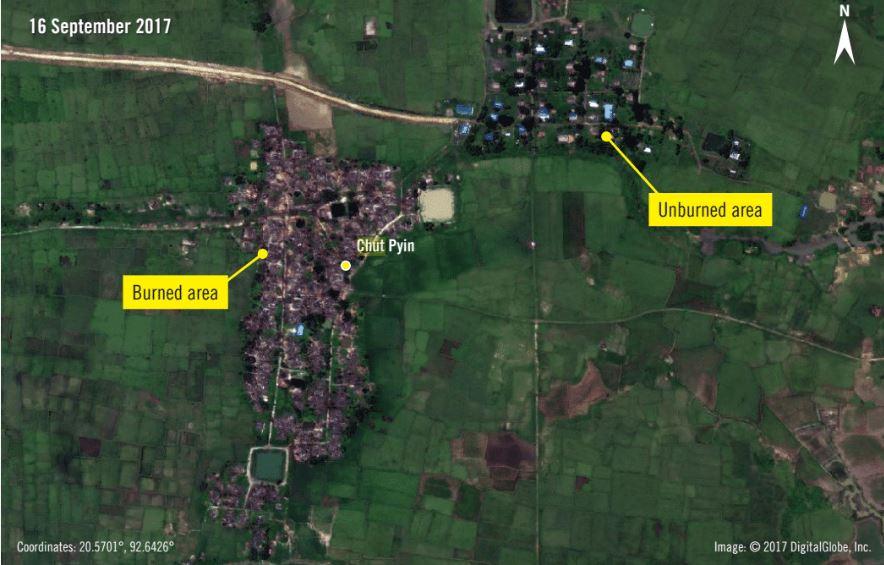
Satellite imagery provided independent evidence of the physical destruction of Chut Pyin. Investigators compared images recorded before and after the attack and identified extensive damage to the Rohingya residential section.
The destruction was concentrated in the area where Rohingya households had been located. This geographical pattern was important because it could be compared with the testimony of residents who described houses being set alight during the attack.
Satellite images could establish the location and extent of visible structural damage but could not independently determine every act that caused it. Witness testimony supplied information concerning the presence of armed personnel, the timing of fires and the circumstances in which residents abandoned their homes. The combination of satellite observations and Rohingya testimony therefore provided a stronger basis for understanding the village's destruction than either source could provide alone.
The Loss of Homes and Community Property
The destruction of Chut Pyin affected more than residential buildings. Families lost stored food, clothing, agricultural equipment, household possessions and materials necessary for their livelihoods. The burning of homes also destroyed records and objects associated with family and community life.
For residents whose livelihoods depended upon farming, the loss of a house could be accompanied by the loss of tools, livestock and access to agricultural land. Such destruction made immediate return difficult even for families who survived without serious physical injuries.
The loss of property also complicated future claims concerning ownership and residence. Where documents had been destroyed or residents could no longer access their land, establishing the history of a household could become increasingly difficult. These consequences demonstrate that the destruction of Chut Pyin was not limited to the immediate period of violence. It affected the ability of the surviving community to maintain its economic and social existence.
The Identification of Alleged Perpetrators
Survivor accounts collected by independent investigators attributed the Chut Pyin attack to Myanmar military personnel, Border Guard Police and participating armed Rakhine civilians. Witnesses described the presence of different categories of armed personnel and their involvement in the violence.
Amnesty International's wider investigation identified the 33rd Light Infantry Division as a significant military formation implicated in operations in Rathedaung Township. Its findings provided an institutional context for examining the conduct of soldiers associated with the campaign.
However, identifying a military formation operating in an area is not identical to proving that every member of that formation participated in a particular crime. Individual responsibility requires evidence concerning the person's presence, conduct, authority or role in directing others. The detailed command hierarchy has already been examined in Chapter 2. For Chut Pyin, the central issue is connecting identifiable perpetrators and participating organisations to the acts described by survivors.
The Role of Armed Local Civilians
Several investigations documented allegations that armed local Rakhine civilians participated alongside Myanmar security personnel during attacks against Rohingya communities. Chut Pyin was among the locations where survivors described such participation.
The involvement of local armed civilians is historically significant because witnesses sometimes recognised participants through earlier contact or familiarity with neighbouring settlements. This knowledge could assist investigators in identifying individuals who would otherwise remain unnamed in official military records.
Nevertheless, responsibility must be based upon identifiable actions. The participation of particular individuals cannot justify assigning collective responsibility to the wider Rakhine population. For Rohipedia, the appropriate approach is to preserve witness descriptions of particular perpetrators, examine whether their identities can be corroborated and distinguish direct participation from allegations concerning broader political or communal involvement.
Evidence Relevant to the Nature of the Attack
The Chut Pyin evidence includes several features relevant to understanding the nature of the violence: the separation of civilians, attacks on people attempting to escape, sexual violence, disappearances and the extensive destruction of Rohingya homes.
Considered together, these findings support the conclusion that the violence was directed against civilians and cannot adequately be explained as an ordinary confrontation between armed groups. Amnesty International examined Chut Pyin within its wider investigation of crimes against humanity committed against the Rohingya. Physicians for Human Rights documented evidence that supported survivor accounts of serious abuses.
These investigative findings do not constitute final criminal judgments against particular defendants. They nevertheless provide substantial grounds for examining individual and institutional responsibility. The importance of Chut Pyin lies in the convergence of different forms of evidence rather than dependence upon a single witness or one category of documentation.
Preserving the Names of Victims and Missing Persons
One of the continuing responsibilities of historical documentation is the preservation of the identities of those killed or missing during the massacre. Community estimates provide an indication of the scale of loss, but they cannot replace a carefully documented record of individual victims.
Such a record should identify names, ages, family relationships and places of residence where the information can be established and safely published. It should also distinguish people whose deaths were directly witnessed from those who disappeared and whose fate remains unknown.
Rohingya families and community representatives possess knowledge essential to this work. Their recollections can help reconstruct household membership and identify individuals who were absent from later refugee registrations. The protection of surviving relatives must remain a priority. Information concerning children, sexual violence survivors and witnesses at risk should not be published without appropriate safeguards and consent.
The Question of Accountability
The Chut Pyin massacre raises questions concerning the responsibility of those who carried out the violence and the commanders who possessed authority over participating forces. Investigations by Physicians for Human Rights and Amnesty International established a substantial body of testimony and supporting evidence. Their findings provide a foundation for examining unlawful killings, sexual violence, disappearances and the destruction of civilian property.
The available evidence also raises questions about the failure of Myanmar's authorities to conduct credible investigations and provide effective remedies to survivors. The broader institutional failures have been examined in earlier chapters and do not require repetition here. For Chut Pyin, accountability requires particular attention to identifying perpetrators, preserving victim testimony and establishing the relationship between individual acts and the military organisations involved.
The Historical Significance of the Chut Pyin Massacre
The medical investigations supported accounts of serious injuries, while satellite observations documented extensive physical destruction. Together, these sources established a record extending beyond the statements issued by Myanmar's authorities. The massacre also demonstrates the importance of preserving the experiences of individual families. The loss of relatives, injuries sustained during escape and uncertainty surrounding missing persons remain central to the community's history.
The next chapter examines the Tula Toli massacre of 30 August 2017, focusing on the distinct circumstances of that attack and the evidence preserved by Rohingya survivors.