1. Introduction: What Does “Origin” Mean?
The
question of the “origin” of the Rohingya is
frequently framed as though a people must have appeared at a particular moment,
migrated from a single place, or possessed an unchanged ethnic identity from
the beginning of their history. Such assumptions are problematic. Ethnic
communities are normally products of historical formation: populations settle,
migrate, intermarry, adopt languages and religions, develop attachments to
territory, experience common political institutions and conflicts, and
gradually construct collective identities through which they understand
themselves and are understood by others.
The history
of the Rohingya therefore
involves several distinct questions. How long have Muslim communities lived in Arakan? What
populations contributed to the ancestry of the Muslims of northern Arakan? What
movements occurred between Arakan and Bengal
before and during British rule? When did forms of the name Rohingya appear?
When did a recognizably modern Rohingya ethnic and
political identity develop? These questions are related, but they are not
identical.
This
distinction is necessary because much of the controversy surrounding Rohingya history
results from treating evidence concerning one question as though it
automatically answers all the others. Evidence that Muslims lived in
pre-colonial Arakan, for
example, establishes neither that every Muslim then living there identified as Rohingya nor that
the modern Rohingya community
originated only from those particular inhabitants. Conversely, evidence of
substantial migration from Bengal during British rule does not demonstrate that
no Muslim population existed in Arakan before
British annexation.
Modern
scholarship consequently offers several interpretations of Rohingya historical
formation. Jacques Leider emphasizes the comparatively modern consolidation of Rohingya
ethnonational identity and argues that its history must be examined through
pre-colonial Muslim presence, colonial demographic change, the Second World
War, postwar political mobilization and later state exclusion. Anthony Ware and
Costas Laoutides similarly distinguish between the historical presence of
Muslims and later Rohingya narratives
that integrate successive waves of Muslim settlement into a continuous
collective history.
Other
researchers place greater emphasis on long-term historical continuity.
Anthropologist Nasir Uddin, for example, situates the Rohingya within a
much longer history of Muslim settlement in Arakan and
explicitly discusses traditions of Muslim presence beginning with early
maritime contacts. Michael Charney approaches the problem differently again.
Rather than beginning with a fixed Rohingya or Rakhine ethnic
identity, his study of early-modern Arakan examines
how religious communities and communal boundaries themselves developed
historically.
These
approaches are not always mutually exclusive. A population may have deep
regional ancestry while the ethnic terminology, political institutions and
collective consciousness through which its descendants identify themselves
develop much later. Modern ethnic identities do not have to exist unchanged for
a thousand years in order for the ancestors of the people who hold those
identities to have lived in a region for centuries.
An
important example is Francis Buchanan's A Comparative Vocabulary of Some of
the Languages Spoken in the Burma Empire, published
in 1799. Buchanan recorded a language spoken by Muslims who had, in his
description, been “long settled in Arakan” and
reported that they called themselves “Rooinga,” which he explained as meaning
natives of Arakan. The
record is particularly significant because it predates the British annexation
of Arakan in 1826.
Buchanan's
evidence nevertheless requires careful interpretation. It establishes that a
form closely resembling Rohingya was
recorded as a self-designation among at least some Arakan Muslims by
the late eighteenth century. It does not by itself demonstrate that the social
and political meaning of Rooinga in 1799 was identical to that of the
modern Rohingya ethnonym.
The same
caution must be applied in the opposite direction. Colonial administrators
later classified populations using changing administrative categories, and the
absence of the word Rohingya from a
particular census classification cannot by itself demonstrate that the
ancestors of modern Rohingya were
absent. State classifications and community self-identification are different
kinds of historical evidence.
For these
reasons, this article uses the concept of historical formation rather
than searching for a single moment of ethnic creation. It distinguishes among
population history, migration, religion, language, territorial attachment,
administrative classification, self-identification and political organization.
The
objective is neither to project the modern Rohingya identity
indiscriminately backward onto every Muslim appearing in an Arakanese source
nor to assume that modern political consolidation implies recent population
origins. Instead, the article follows the evidence chronologically and asks how
successive communities and historical experiences contributed to the formation
of the population that eventually identified collectively as Rohingya.
The central
question is therefore broader than “When did the Rohingya arrive in Arakan?” It is: How
did the populations of the Arakan–Bengal
frontier, through centuries of settlement, movement, cultural interaction and
political transformation, contribute to the formation of the community now
known as the Rohingya?
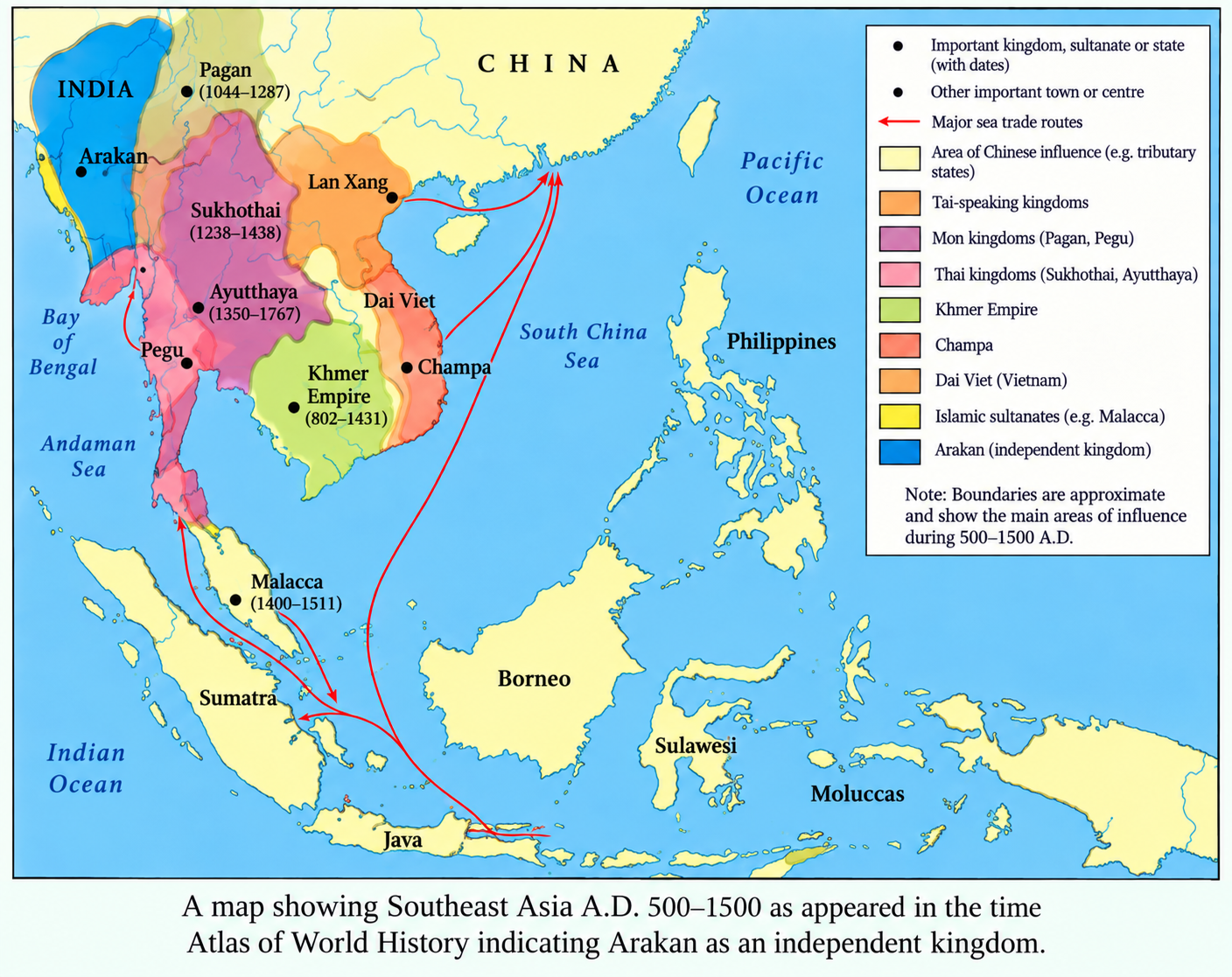
2. Arakan as a Historical Frontier and Independent Political Realm
Any investigation
of Rohingya origins must begin with the geography and historical character of
Arakan itself. Arakan, today largely corresponding to Myanmar's Rakhine State,
occupies a long coastal region along the eastern side of the Bay of Bengal. To its
west and northwest lie Bengal and the Chittagong region, while to its east the
Arakan Yoma mountain range separates the coastal country from the Irrawaddy
basin. These geographical conditions gave Arakan a distinctive position between
South and Southeast Asia. The mountains limited, although never eliminated,
interaction with the Burmese interior, while rivers, coastal routes and the Bay
of Bengal connected Arakan with Bengal, India and the wider maritime world.
Arakan should
therefore not be imagined simply as a western province of Burma projected
backward through history. For long periods before the Burmese conquest of
1784–85, Arakan possessed its own political centres, dynasties, royal
institutions and traditions of kingship. Ancient political centres developed at
Dhanyawadi and later Vesali or Waithali, followed by other dynastic centres. In
1430 Mrauk-U became the capital of the kingdom that would dominate the later
pre-colonial history of Arakan. The kingdom remained independent until its
conquest by the Burmese Konbaung dynasty under King Bodawpaya in 1784–85.
Pamela Gutman's
archaeological research demonstrates the antiquity of this regional
development. Her study of ancient Arakan documents inscriptions in Sanskrit,
Pali and Pyu, together with coinage, religious monuments and evidence of
political institutions. The material shows that organized political societies
existed in Arakan long before modern Myanmar. Sanskrit inscriptions, Buddhist
and Brahmanical imagery, architecture and numismatic evidence also demonstrate
extensive connections with the Indian subcontinent. Ancient Arakan was
therefore neither culturally isolated nor simply an extension of the political
world east of the Arakan Yoma.
The kingdom
centred at Vesali or Waithali is especially important. Archaeological and
epigraphic evidence associated with the Candra rulers shows significant
connections with northeastern Indian cultural and political traditions.
Scholars have identified relationships between Arakanese inscriptions and
scripts used in northeastern India, while early Arakanese coinage has been
compared with monetary traditions circulating through Bengal, Assam and
neighbouring regions. These connections demonstrate Arakan's participation in a
wider Bay of Bengal cultural environment. They do not, however, mean that
Arakan was simply part of Bengal or India, because the region developed its own
dynasties, political institutions and local traditions.
Influence from
the Burmese interior also became increasingly important over time. Gutman's
reconstruction suggests increasing Burman influence from around the beginning
of the second millennium, visible in royal names, titles and connections with
Pagan. Yet this eastward influence did not erase Arakan's older western
connections. Political and cultural influences from both sides interacted
within the region. Arakan consequently developed as a distinctive society
situated between the Indian subcontinent, the Bay of Bengal and mainland
Southeast Asia.
This position
became especially visible during the Mrauk-U period. Michael Charney describes
early-modern Arakan as a region where “Jambudipa and Islamdom converged,”
emphasizing the interaction of Theravada Buddhist, Indic, Bengali, Persianate
and Islamic cultural worlds. Mrauk-U remained an Arakanese kingdom while
participating extensively in Bay of Bengal political and commercial networks.
Its relationship with Bengal also changed over time. Although the restoration
of Min Saw Mon in 1430 was closely connected with the Bengal Sultanate, later
Arakanese rulers expanded westward and eventually exercised authority over
Chittagong for a substantial period.
The frontier
character of Arakan was demographic as well as political and cultural. Trade,
warfare, royal service, maritime commerce, agricultural settlement, enslavement
and political upheaval repeatedly moved people into and out of the kingdom.
Merchants, soldiers, officials, cultivators, religious figures, captives,
artisans and intellectuals travelled through the Bengal–Arakan region. The
political boundary itself shifted repeatedly as Arakanese, Bengali and later
Mughal power expanded or contracted. Population movement therefore occurred
within a changing regional environment rather than across a permanently fixed
international border.
Northern
Arakan—including the areas later known as Maungdaw, Buthidaung and
Rathedaung—formed an important part of this connected frontier. Rivers,
mountain passes, coastal routes and proximity to southeastern Bengal
facilitated interaction with Chittagong, while communities living within
northern Arakan developed local territorial attachments over generations.
Applying the modern Myanmar–Bangladesh border retrospectively to these earlier
populations can therefore produce misleading conclusions. The people who moved
through this region did not cross a border possessing the political meaning
that the modern international boundary has today.
Two historical
realities must consequently be understood together. Arakan possessed a long
political history of its own and existed for extended periods as an independent
kingdom before the Burmese conquest of 1784–85. At the same time, political
independence did not mean cultural or demographic isolation: Arakan remained
connected with Bengal, India, the Bay of Bengal and the societies east of the
Arakan Yoma. These connections contributed to the diversity of the kingdom
without eliminating its distinctive political character.
The historical
formation of the Rohingya must be understood within this setting. Their history
cannot be reconstructed by treating Burma and Bengal as permanently sealed
demographic worlds, nor by projecting the borders of modern Myanmar backward
into the medieval period. The populations from which the Rohingya developed
lived within Arakan, a distinct political and geographical region situated at a
major meeting point between South and Southeast Asia. This background provides
the foundation for examining the early maritime connections through which Islam
reached the Bay of Bengal world and the subsequent development of Muslim
communities within Arakan.
3. Early Contacts Across the Bay of Bengal
Long before the
rise of the Mrauk-U kingdom and long before European colonial rule, the Bay of
Bengal functioned as a major zone of communication linking South Asia with
mainland and maritime Southeast Asia. Arakan occupied a strategic position on
its eastern shore, with rivers providing routes from the coast into inland
settlements and maritime routes connecting its ports with Bengal, India, Sri
Lanka and the wider Indian Ocean. These connections were not created by Islam
or by later Muslim migration. Archaeological evidence demonstrates that Arakan
had participated in commercial and cultural networks extending toward the
Indian subcontinent for centuries before the beginning of the Islamic era.
Pamela Gutman's
research on ancient Arakan provides important evidence for these early
connections. The urban centres, inscriptions, coinage and religious art
documented in her work demonstrate sustained interaction with the Indian
subcontinent. The Candra kingdom centred at Vesali participated in a cultural
environment that included southeastern Bengal, while archaeological studies
have identified parallels in inscriptions, scripts and coinage between Arakan
and neighbouring regions of northeastern India. The importance of this evidence
for Rohingya history is structural: it demonstrates that the geographical and
commercial routes through which Muslims later reached Arakan already existed
long before Islam appeared around the Bay of Bengal.
The expansion of
Islam from the seventh century introduced a new religious and commercial
element into these established maritime networks. Arab and Persian Muslim
merchants became increasingly active throughout the Indian Ocean, travelling
between the Middle East, India, Southeast Asia and China. Ports around the Bay
of Bengal formed part of this commercial system, and the Arakan coast lay close
to important maritime routes connecting Bengal with destinations farther east.
Muslim contact with the Arakan coast during the early Islamic centuries is
therefore historically plausible within the wider pattern of Indian Ocean
commerce.
Rohingya
historical writing places considerable importance on this early period.
Mohammed Yunus, in A History of Arakan: Past and Present, presents the
advent of Islam in Arakan around the beginning of the ninth century as an early
stage in the eventual development of the Muslim community from which the
Rohingya emerged. Other Rohingya historians similarly describe Arab and Persian
merchants, sailors and religious figures reaching the coast during the early
Islamic centuries. Nasir Uddin also discusses a historical trajectory in which
Arab traders reached Arakan and Muslim settlement traditions developed from
these maritime contacts.
One of the most
persistent traditions concerns Muslim sailors shipwrecked near Ramree Island.
Later Arakanese historical accounts, subsequently reproduced in British-era
gazetteer literature and Rohingya histories, associate the episode with the
reign of Maha Taing Candra, usually dated to approximately 788–810 CE.
According to this tradition, several ships were wrecked near Ramree, their
Muslim crews survived, and the ruler settled them in villages within Arakan.
Later Rohingya historians have interpreted these settlers as one of the
earliest components of the Muslim population that developed within the country.
This account
deserves serious attention because it was not created solely in recent Rohingya
political literature. Versions of the shipwreck tradition entered older
historical and gazetteer writing concerning Arakan. Nevertheless, the nature of
the evidence must be stated precisely. The surviving accounts are later records
describing an earlier event rather than contemporary eighth- or ninth-century
documents produced by the settlers themselves. They therefore constitute
historical tradition preserved in later sources, not direct archaeological
proof that allows the precise size, location and continuity of the settlement
to be reconstructed.
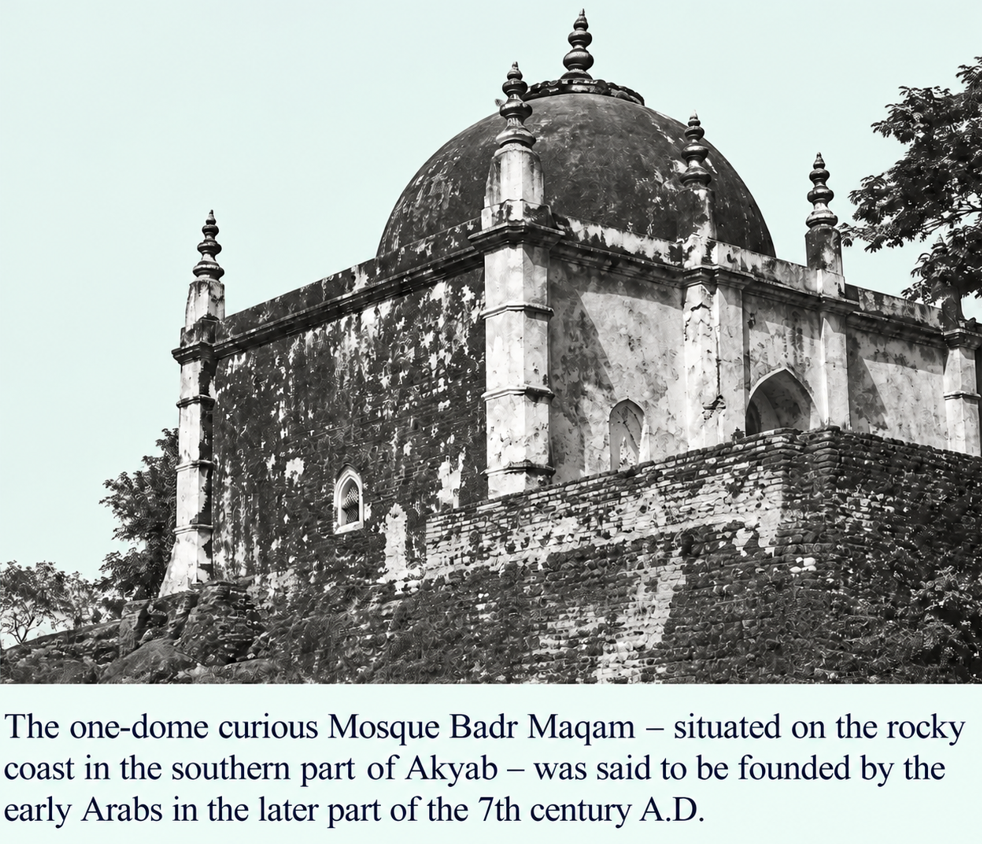
Another important
element in Rohingya historiography is the Badr Maqam of Akyab. Yunus reproduces
a photograph of the structure as Plate No. 1 of A History of Arakan: Past
and Present and describes the one-domed Badr Maqam on the rocky coast of
southern Akyab as traditionally founded by early Arabs in the later seventh
century. The existence of the historical structure is significant to the study
of Muslim religious heritage in Arakan, while the early date attributed to its
foundation belongs to the historical tradition presented by Yunus. Until
archaeological or contemporary documentary evidence establishes that
construction date independently, Rohipedia should distinguish the existence of
Badr Maqam from the precise seventh-century chronology attributed to its
foundation.
The distinction
between contact, settlement and later historical memory is therefore important.
The widespread activity of Muslim merchants throughout the Indian Ocean
provides a strong regional context for early contact with Arakan. The Ramree
shipwreck tradition provides a more specific account of Muslim settlement
around the eighth or ninth century, while Badr Maqam and traditions concerning
early Muslim saints preserve another strand of community memory. Taken
together, these materials demonstrate that the idea of an early Muslim
connection with Arakan rests upon a substantial historical tradition rather
than upon a modern claim created without antecedents. They do not, however,
provide the same kind of evidence as dated inscriptions, contemporary administrative
documents or securely excavated archaeological remains.
This distinction
should not be used to dismiss the early Muslim tradition altogether. Historical
societies often preserve events through chronicles and later written traditions
when contemporary documentation has disappeared, particularly in regions repeatedly
affected by warfare, conquest and environmental destruction. Absence of
surviving eighth-century Muslim documentation cannot by itself demonstrate that
Muslim settlement did not occur. At the same time, responsible historical
writing should avoid transforming a plausible and longstanding tradition into a
precisely proven archaeological chronology when the surviving evidence does not
permit that conclusion.
The evidence
becomes progressively stronger as Arakan approaches the later medieval and
early-modern periods. Increasing political interaction with Bengal, changing
control of Chittagong, maritime commerce, royal service, warfare and migration
created multiple channels through which Muslims entered and settled in Arakan.
By the fifteenth century, the restoration of Min Saw Mon and the establishment
of Mrauk-U brought Arakan into particularly close interaction with the
Muslim-ruled Bengal Sultanate. During the sixteenth and seventeenth centuries,
evidence for Muslim officials, soldiers, communities, religious institutions
and Bengali-speaking intellectual life becomes considerably richer.
The significance
of the early Bay of Bengal period therefore does not depend upon identifying a
single shipwreck or migration as the exclusive origin of the Rohingya. Its
greater importance lies in demonstrating the historical environment within
which successive Muslim populations became connected with Arakan. The coast was
not sealed from the Muslim maritime world until British colonialism, nor did
contact between Arakan and populations west of the modern Myanmar boundary
begin in the nineteenth century. Arakan had participated in Bay of Bengal
networks for centuries, and Muslim merchants and sailors became part of those
networks after the expansion of Islam.
The early history
should consequently be understood as the beginning of a longer process rather
than as a single founding event. Muslim maritime contact, traditions of Arab
settlement, religious memories associated with sites such as Badr Maqam, later
political connections with Bengal and increasingly documented Muslim
communities formed successive layers of Arakan's history. Determining how these
early contacts developed into locally established Muslim communities requires
examining the evidence more closely. That is the subject of the next section.
4. Evidence for Early Muslim Communities
The history of
Muslim communities in Arakan before the fifteenth century is difficult to
reconstruct because the surviving evidence is uneven and comes from different
kinds of sources. Chronicles, archaeological remains, religious sites, oral
traditions, later historical writing and modern scholarship do not always
provide the same chronology. Rohingya historians have generally argued for a
long Muslim presence beginning with early maritime contacts, while some modern
scholars place greater weight on periods for which contemporary written
documentation is more abundant. These approaches need not be treated as though
one completely cancels the other. The historical task is to distinguish between
evidence of contact, traditions of settlement, surviving physical remains and
securely dated documentation.
As discussed in
the previous section, Muslim contact with the Arakan coast was possible within
the wider expansion of Arab and Persian maritime activity across the Indian
Ocean from the seventh century onward. Rohingya historical traditions preserve
accounts of merchants, sailors and shipwreck survivors settling in Arakan,
particularly the tradition associated with Ramree Island. Mohammed Yunus
incorporates these traditions into a longer history in which successive Muslim
populations became established in Arakan over many centuries. Moshe Yegar
likewise treats the Muslim population of Arakan as the result of several
different periods and sources of settlement rather than a single migration. The
historical question is therefore not simply whether Muslims came to Arakan, but
when temporary maritime contact developed into permanent communities.
Physical and
religious heritage forms an important part of the Rohingya interpretation of
this early history. Yunus reproduces several photographs of historic Muslim
religious structures in A History of Arakan: Past and Present. Among
them is Badr Maqam in Akyab, which he associates with traditions of early Arab
Muslim presence. More importantly for the medieval period, his Plate No. 4
shows the ruined structure of Musa Mosque at Patthari Qillah in Mrohaung,
present-day Mrauk-U, which he identifies as having been built in the
fourteenth century. If this dating is correct, the mosque would provide
important evidence of an established Muslim religious presence in Arakan before
the foundation of the Mrauk-U dynasty in 1430.
The Musa Mosque
evidence should nevertheless be presented with precision. The ruined structure
and Yunus's identification of it form part of the documented Rohingya
historical record, but the fourteenth-century date should be attributed to
Yunus unless independent archaeological dating can be established. A photograph
of an old ruin can demonstrate the existence of the structure but cannot by
itself determine its construction date. Rohipedia can therefore reproduce the
image with a caption explaining that Mohammed Yunus identifies the remains as
Musa Mosque at Patthari Qillah and dates them to the fourteenth century. This
preserves an important Rohingya historical source without presenting an
attribution as though it were an uncontested archaeological determination.
The location
itself is significant. Mrohaung, now Mrauk-U, later became the capital of the
Arakanese kingdom, but Patthari Qillah appears in Rohingya historical writing
in connection with Muslim religious remains predating or belonging to the early
period of that political centre. Yunus's photographic plates also include other
mosques and Islamic remains associated with Arakan, demonstrating the
importance he assigns to architecture alongside chronicles and literary
traditions. Such material deserves greater attention because the history of
Muslim communities cannot be reconstructed exclusively from royal chronicles.
Mosques, shrines, inscriptions, cemeteries, waqf traditions and other religious
remains can preserve evidence of communities that political chronicles mention
only briefly.
At the same time,
architectural evidence must be dated carefully. Buildings can be repaired,
rebuilt, enlarged or reconstructed over centuries, while community traditions
may preserve dates that are difficult to verify archaeologically. The
historical value of a mosque is therefore not eliminated merely because its
exact founding year remains uncertain. A surviving or photographed Muslim
religious structure still provides evidence about Muslim religious life, but
claims concerning its original construction should be distinguished according
to whether they derive from inscriptions, archaeology, contemporary documents
or later historical tradition. This distinction will allow Rohipedia to
document Rohingya religious heritage without either dismissing community
evidence or overstating what particular remains can prove.
The surviving
written record becomes clearer as the history approaches the fifteenth and
sixteenth centuries. Yegar places considerable importance on the restoration of
Narameikhla, or Min Saw Mon, after his exile in Bengal. According to the
historical tradition he discusses, Muslim soldiers accompanied the restored
ruler and some subsequently settled near the new capital. Accounts also
associate Muslim military commanders and the establishment of mosques with this
period. Although individual details of these traditions cannot always be
independently reconstructed from contemporary fifteenth-century documents, the
larger political transformation is much better established: the foundation of
Mrauk-U occurred within an environment of exceptionally close interaction
between Arakan and the Muslim-ruled Bengal Sultanate.
This interaction
created conditions favourable to further Muslim settlement. Soldiers and
military retainers could remain after campaigns, officials could enter royal
service, merchants could establish themselves around ports and commercial
centres, and religious teachers could serve growing communities. Political
connections with Bengal also exposed the Arakanese court to Persianate
administrative and royal traditions. These processes did not suddenly create
Islam in a region where no Muslim contact had previously existed. Rather, they
intensified older maritime and regional connections and made Muslim
participation in Arakanese political and social life increasingly visible in
the surviving historical record.
Michael Charney
approaches this evidence more cautiously. He distinguishes between the presence
of Islamicate political culture and evidence for the numerical strength of
Muslim communities. Islamic titles, Persianate administrative forms and symbols
associated with Muslim courts could be adopted by rulers for political purposes
without demonstrating conversion of the ruler or majority population. Charney
therefore warns against treating every sign of Islamic influence at court as
direct evidence of large-scale religious Islamization. This is an important
methodological caution, but it addresses a different question from whether
Muslims themselves were present and becoming established within Arakan.
Charney notes
that the Arakanese chronicles provide particularly clear evidence by the later
sixteenth century, including the enumeration of Mussalaman among the
subjects of King Min Palaung in 1571. This is significant because Muslims
appear not merely as visiting merchants, foreign envoys or temporary soldiers
but as a recognized category among the inhabitants of the kingdom. By this
period, the argument is therefore no longer dependent solely upon traditions of
early Arab contact. Written evidence identifies Muslims within Arakanese
society, while subsequent seventeenth-century material reveals a much richer
world of Muslim officials, soldiers, merchants, poets, religious communities
and Bengali-speaking intellectuals.
The difference
between Yunus and Charney should therefore be understood partly as a difference
in evidentiary emphasis. Yunus constructs a longer history by combining
maritime traditions, religious monuments, Muslim settlement narratives,
political developments and later documentary evidence. Charney places greater
methodological emphasis on what surviving contemporary chronicles allow
historians to establish securely about particular periods. Rohipedia should
preserve both approaches while making clear what kind of evidence supports each
claim. The existence of uncertainty concerning an early date does not
demonstrate that the event or community did not exist; equally, historical
tradition should not automatically be presented as contemporary documentary proof.
By the beginning
of the Mrauk-U period, several historical processes were therefore converging.
Arakan had long participated in Bay of Bengal maritime networks; traditions
recorded Muslim settlement from the early Islamic centuries; Rohingya
historical writing identifies religious remains associated with medieval Muslim
communities; political relations with Bengal brought further soldiers,
officials and cultural influences; and the surviving documentary record becomes
increasingly explicit about Muslim inhabitants during the sixteenth century.
Rather than searching for a single year in which “Muslims arrived,” the
evidence points toward a gradual accumulation of Muslim presence through
different historical channels.
This layered
development is fundamental to understanding the later Rohingya population. The
Muslims of pre-colonial Arakan did not necessarily share one place of origin,
occupation or political identity. They included populations associated with
maritime trade, military service, administration, religious life, agricultural
settlement and later population movements from Bengal and elsewhere. Over
generations, however, communities that remained in Arakan could become locally
rooted, establish religious institutions, form families and develop attachments
to the country in which their descendants were born. The next stage of the
history—the rise of Mrauk-U—provides much stronger evidence for the depth of
Muslim participation in Arakanese political and cultural life and for the
remarkable Muslim and Persianate elements visible in the kingdom's royal
titles, coinage, administration and intellectual culture.
5. The Mrauk-U Period, Muslim-Titled Rulers and the Bengal–Arakan World
The
establishment of Mrauk-U in the fifteenth century marked one of the most
important transformations in the political and cultural history of Arakan.
During the following centuries, Arakan developed into a powerful independent
kingdom deeply connected with the political, commercial and cultural world of
the Bay of Bengal. The kingdom maintained relations with Bengal, the Burmese
kingdoms, Mughal India and maritime powers operating throughout the eastern
Indian Ocean. For Rohingya history, this period is particularly significant
because evidence of Muslim political, cultural and social participation becomes
considerably richer and includes royal titles, coinage, court language,
officials, religious institutions and literary culture.
The traditional
account begins with Narameikhla, commonly known as Min Saw Mon, who was driven
from Arakan and spent years in Bengal before recovering his kingdom. His
restoration occurred within the political world of the Bengal Sultanate,
although historians disagree about the precise circumstances and degree of
dependency involved. Mohammed Yunus identifies the restored ruler by the Muslim
royal name Solaiman Shah and places his restoration in 1430. According
to Yunus, the political transformation accompanying the restoration brought
Arakan into particularly close contact with the institutions, political culture
and Islamic civilization of Bengal.
Yunus gives
particular importance to the succession of rulers who followed the restoration.
In his account, the kings possessed Arakanese or Pali royal names alongside
Muslim names or titles. He argues that these names were not isolated ceremonial
additions but formed part of a sustained political development extending across
successive reigns. His chronology for the first eleven rulers of the restored
dynasty is therefore important to understanding the Rohingya interpretation of
Mrauk-U.
According to
Mohammed Yunus, the succession from 1430 to 1531 was:
Solaiman Shah —
Narameikhla (1430–1434)
Ali Khan — Meng Khari (1434–1459)
Kalima Shah — Ba Saw Phyu (1459–1482)
Mathu Shah — Doulya (1482–1492)
Mohammed Shah — Ba Saw Nyo (1492–1493)
Nori Shah — Ran Aung (1493–1494)
Sheikh Modullah Shah — Salingathu (1494–1501)
Ili Shah — Meng Raza (1501–1523)
Ilias Shah — Kasabadi (1523–1525)
Jalal Shah — Meng Saw Oo (1525)
Ali Shah — Thatasa (1525–1531)
This sequence is reproduced here specifically as Yunus's reconstruction, including his spellings and chronology. It is significant because his argument does not rest merely upon Min Saw Mon having adopted one Muslim title following assistance from Bengal. Yunus presents a succession extending across approximately a century in which rulers continued to use Muslim royal names alongside their Arakanese names. He interprets this continuity as evidence of a much deeper transformation in the political and religious culture of the Mrauk-U monarchy.
The coinage is
particularly important because it provides material evidence that can be
examined separately from later narrative traditions. Yunus draws attention
especially to coins associated with Ilias Shah (Kasabadi) and Ali
Shah (Thatasa) found at Mrauk-U. He uses these coins to challenge
interpretations claiming that some rulers in this sequence did not actually use
Muslim names. The existence of coins bearing Persian or Islamicate inscriptions
demonstrates that Muslim royal titulature was expressed through official
instruments of sovereignty rather than existing only in later historical
writing.
The coin of Sultan
Ali Shah (Thatasa) occupies a particularly important place in Yunus's
argument. Yunus reports that the coin bears a Persian profession of Islamic
faith on one side and identifies the ruler as Sultan Ali Shah on the other. On
this basis, he argues that the ruler responsible for issuing such a coin should
be understood as Muslim rather than simply as a Buddhist king compelled to
place Islamic language on his currency. This is Yunus's interpretation of the
numismatic evidence and represents one of the clearest points at which his
reading differs from historians who understand the Muslim titulature primarily
as a political convention.
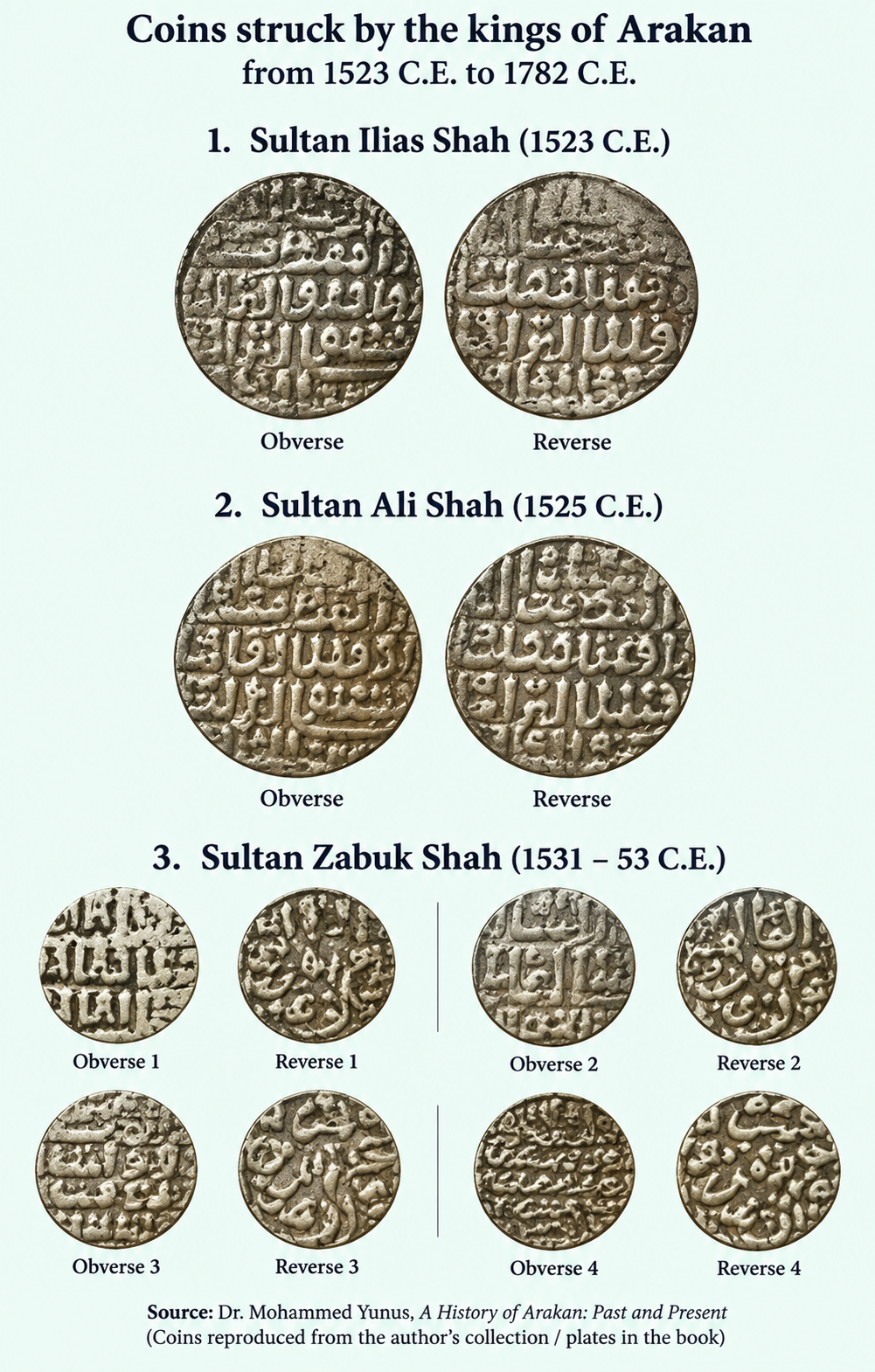
A major new
phase began with Min Bin, whom Yunus calls Zabuk Shah, who ascended the
throne in 1531 and ruled until 1553. Yunus regards Zabuk Shah as one of the
strongest rulers in Arakanese history and describes his reign as the beginning
of the Arakanese empire. He explicitly characterizes Zabuk Shah as Muslim by
faith and argues that by his reign the political and cultural transformation
begun during the preceding century had matured. Under Zabuk Shah, Mrauk-U
became a heavily fortified capital, Portuguese military expertise was
incorporated into the kingdom's armed forces, and Arakan developed a powerful
army and navy.
Yunus also associates Zabuk Shah's reign with a distinctive architectural and cultural synthesis. He describes Mrauk-U as containing mosques, pagodas and monuments and argues that its architecture reflected the interaction of Arakanese and Bengali Muslim forms. His interpretation of the reign is therefore broader than a discussion of the king's name. Zabuk Shah represents, in Yunus's reconstruction, a period in which political power, Muslim cultural influence and the independent ambitions of Arakan came together.
Yunus also
discusses a period of renewed Bengali intervention during the middle of the
sixteenth century. He argues that the Bengal Sultan Shamsuddin Abu Muzaffar
Mohammad Shah conquered Arakan in 1554 and ordered coins to be struck
there, and that his successor Ghiyathuddin Bahadur Shah also issued
coins in Arakan. Yunus interprets this numismatic evidence as indicating a
period of effective Bengal Sultanate control. This episode should be presented
as Yunus's reconstruction because the political extent and duration of Bengali
authority during these years require careful comparison with Arakanese
chronicles and other sources.
After the
mid-sixteenth-century disruptions, Muslim royal titulature again appears
prominently in Yunus's account of later Arakanese rulers. He identifies Min
Phalaung as Sikandar Shah, ruling from 1571 to 1593, followed by Min
Raza Gyi as Salim Shah, from 1593 to 1612. Salim Shah's reign is
particularly important because Arakan reached one of the greatest periods of
its political and territorial power. Yunus describes the kingdom during this
period as commanding an extensive coastal domain supported by the military and
naval system developed under earlier rulers.
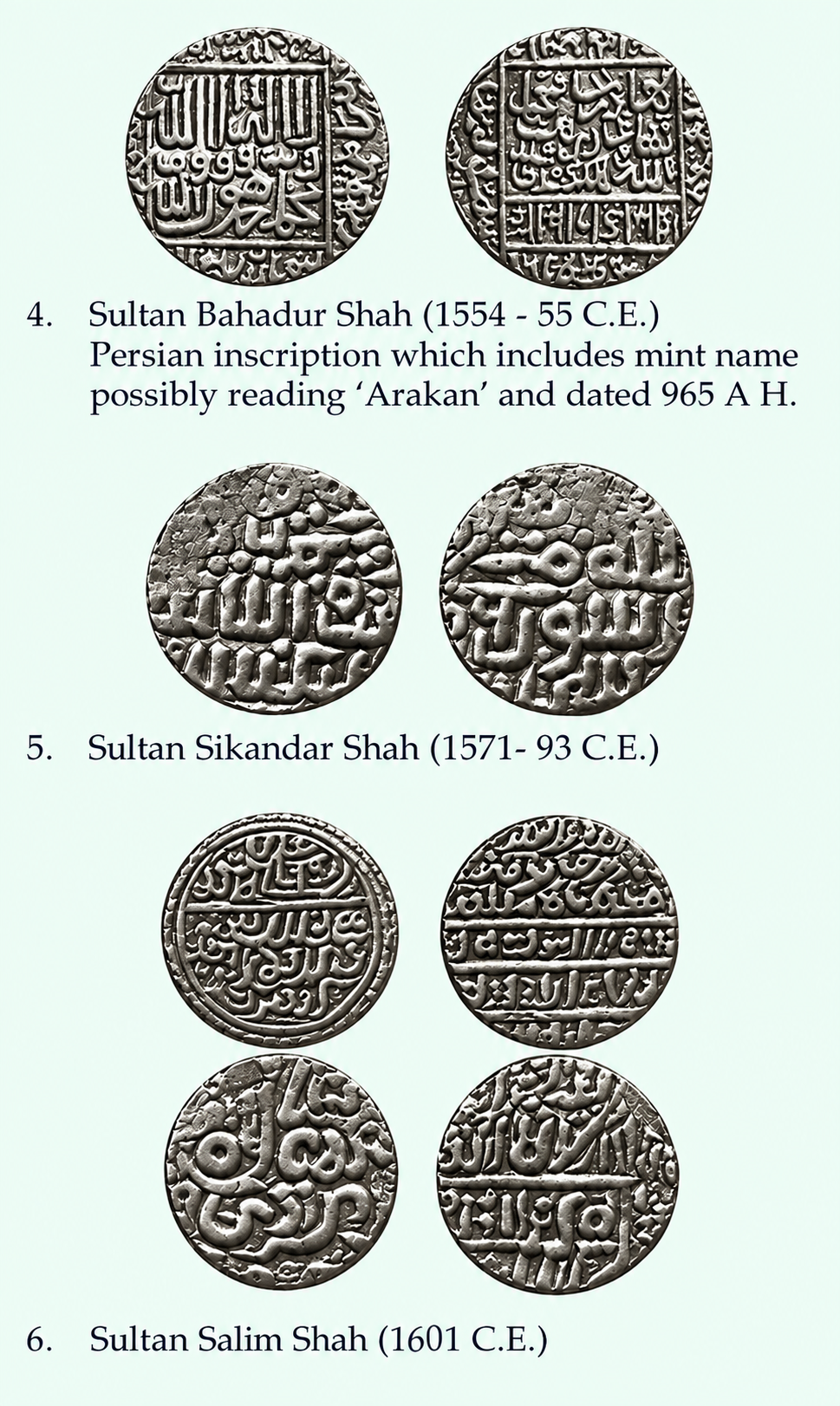
Salim Shah was followed by Min Khamaung, whom Yunus identifies as Hussein Shah, ruling from 1612 to 1622. The continuation of Muslim royal names into the seventeenth century is important because it demonstrates that such titulature had survived long beyond the circumstances surrounding Min Saw Mon's restoration. Other numismatic research also recognizes trilingual coinage associated with Min Raza Gyi and Min Khamaung, including forms of the names Salim Shah and Hussein Shah. The existence of this later coinage therefore provides important material evidence for the persistence of Islamicate royal vocabulary within Arakanese sovereignty.
Yunus further identifies Thiri Thudhamma as Salim Shah II, ruling from 1622 until 1638. This particular attribution deserves especially careful wording because other numismatic scholarship has questioned whether Salim Shah II can be securely read from the surviving coins. The historical source should therefore be presented precisely: Yunus identifies Thiri Thudhamma as Salim Shah II, while the attribution is not universally accepted. This is a good example of why Rohipedia should preserve Rohingya historiography without turning every disputed identification into an uncontested statement.
Taken together,
Yunus presents a remarkable sequence extending from Solaiman Shah in 1430
through the Muslim-titled rulers of the sixteenth and early seventeenth
centuries. His interpretation goes beyond saying that Buddhist kings
occasionally borrowed Muslim names for diplomatic convenience. He argues that
the titles, Islamic inscriptions on coins, Persian court culture, Muslim
officials, religious institutions and the broader relationship with Bengal
demonstrate a much deeper Muslim political presence within the kingdom. This
interpretation forms a central component of Rohingya historiography and should
be represented fully when explaining how Rohingya historians understand the
Mrauk-U period.
Michael Charney
and other historians interpret important parts of this evidence differently.
Charney emphasizes the distinction between the adoption of Islamicate political
forms and religious conversion of the monarchy. From this perspective,
Persianate titles and Muslim-style coinage demonstrate Arakan's participation
in the political culture of the Bay of Bengal but do not automatically
establish the personal religion of every ruler. This interpretation should be
presented alongside Yunus's rather than used to erase it. The historical
disagreement concerns what the material evidence means, not whether the Muslim
titles and Islamicate coinage existed.
Thibaut
d'Hubert's research provides another perspective that demonstrates how deeply
the Bengal connection penetrated Mrauk-U society. His work identifies an
Islamicate idiom within official Arakanese culture and reconstructs a broader Bengal–Arakan
continuum involving language, administration, literature and patronage.
Bengali-speaking Muslim dignitaries operated within networks associated with
the royal court, while Bengali literary production flourished inside the
kingdom. This evidence demonstrates that the Muslim dimension of Mrauk-U
extended well beyond the names appearing on royal coins.
The celebrated
poet Alaol is one of the clearest examples. Originally from Bengal,
Alaol reached Arakan after being captured during maritime violence and
eventually entered the circles of Muslim dignitaries connected with the Mrauk-U
court. His works became major contributions to Middle Bengali literature.
Alaol's career demonstrates the existence of patrons, educated audiences and
Muslim intellectual networks sufficiently established to sustain sophisticated
literary production within Arakan.
Muslim
participation was also not confined to royal or intellectual elites. Historical
sources describe Muslims functioning as administrators, soldiers, merchants,
sailors, cultivators, religious figures and other inhabitants of the kingdom.
Mosques and religious institutions provided centres for worship, education and
community life. These populations entered Arakan through different historical
pathways and at different times, but communities that remained could establish
families and produce generations born within the country.
The Mrauk-U
evidence should therefore not be reduced to a simple choice between calling the
kingdom “Buddhist” or “Muslim.” The historical record demonstrates a complex
Arakanese political civilization in which Buddhist institutions existed
alongside a substantial and persistent Islamicate political vocabulary, Muslim
royal titles, Persian-language coinage and administration, Muslim officials,
Bengali Muslim literary culture and established Muslim communities. Different
historians disagree about how this combination should be characterized, and
that disagreement should remain visible.
For Rohingya
history, the central significance is clear even without resolving every
question about the personal religion of individual kings. Centuries before
British annexation, Muslim political, religious and cultural life had become
embedded within the independent kingdom of Arakan. The royal coinage provides
physical evidence of this connection; literary sources reveal Muslim
intellectual and administrative networks; religious remains preserve the
material heritage of Muslim communities; and successive generations of
settlement created populations rooted within Arakan.
The Mrauk-U
period therefore represents one of the most important stages in the historical
formation of the Muslim society from which the later Rohingya emerged. It does
not require the unsupported assumption that every inhabitant of the kingdom was
Rohingya or that every Muslim-titled ruler necessarily possessed a modern
Rohingya ethnic identity. It demonstrates something historically more secure
and still highly significant: Muslim presence and Islamicate political
culture were deeply established within Arakan centuries before British colonial
rule, and Rohingya historiography—particularly the work of Mohammed
Yunus—preserves a substantial body of evidence and interpretation concerning
that history.
6. Muslims in the Arakanese Court and Society
By the sixteenth
and seventeenth centuries, evidence for Muslim participation in the political,
cultural, economic and social life of Arakan becomes considerably richer.
Muslims were no longer visible only through traditions of early maritime
settlement or the political relationship between Mrauk-U and Bengal. They
appear in royal service, military activity, commerce, literature and religious
life, while Muslim and Persianate elements were incorporated into aspects of
court culture. The evidence points to communities operating at several levels
of Arakanese society rather than to a small group of temporary foreign
visitors. This period is therefore particularly important for understanding how
a Muslim population became increasingly rooted within pre-colonial Arakan.
The royal court
provides some of the clearest evidence. As discussed in the previous section,
successive Arakanese rulers employed Muslim or Persianate royal titles and
issued coins bearing such titulature and inscriptions. These coins demonstrate
that Islamicate political forms had become part of the public representation of
royal authority. At the same time, Muslim officials and military personnel
participated in networks associated with the monarchy. The significance of
these developments lies not merely in the personal religion of individual kings
but in the presence of Muslim political and cultural institutions within the
functioning of the kingdom.
Mohammed Yunus
places considerable emphasis on this combination of evidence. In his
interpretation, royal Muslim titles, coinage, Muslim officials, mosques,
inscriptions and Bengali Muslim cultural activity collectively demonstrate the
depth of Islamic influence in Arakan. Rather than treating each element
separately, Yunus presents them as parts of a longer historical development in
which Muslims became integrated into the political and social structure of the
country. Other historians interpret the religious character of the monarchy
differently, but the underlying evidence of sustained Muslim participation
remains important. Rohipedia should therefore distinguish disagreements about
the character of the monarchy from the better-supported question of whether
Muslims formed an established part of Arakanese society.
Written evidence
from the later sixteenth century is especially significant. Michael Charney
draws attention to an Arakanese chronicle account from 1571 that
enumerates Mussalaman among the subjects of King Min Palaung. This
reference is important because Muslims appear as inhabitants under the king's
authority rather than merely as merchants visiting a port, soldiers temporarily
serving in a campaign or diplomats from another state. By this period, Muslim
presence can therefore be identified within the population of the kingdom
itself. The reference does not tell us the total number or geographical
distribution of Muslims, but it provides important evidence that they
constituted a recognized component of Arakanese society.
The evidence
becomes even more substantial during the seventeenth century. Mrauk-U's
political influence, control of Chittagong for much of the period before 1666
and participation in Bay of Bengal commerce produced extensive movement of
people between Arakan and Bengal. Muslim officials, soldiers, merchants,
sailors, religious figures, artisans and cultivators entered or lived within
the kingdom through different historical processes. Some came voluntarily
through trade, royal employment or migration, while others arrived through
warfare and captivity. Their origins and circumstances were diverse, but
populations that remained in Arakan could establish families and become locally
rooted over succeeding generations.
Bengali literary
culture provides particularly rich evidence for Muslim participation in the
social world surrounding the royal court. Thibaut d'Hubert's research
demonstrates that Bengali-speaking Muslim dignitaries served within
administrative and elite networks connected with the Arakanese monarchy. These
officials participated in Persianate cultural traditions and supported Bengali
literary production. Their patronage indicates that Muslim cultural life in
Mrauk-U was not confined to private religious practice. It had sufficient
resources and institutional connections to sustain poets, manuscripts and
sophisticated literary activity.
The celebrated
poet Alaol is the best-known representative of this environment.
According to autobiographical material contained in his writings, Alaol
originated in Bengal and reached Arakan after being captured during a maritime
attack. In Mrauk-U he entered the circles of Muslim dignitaries associated with
the court and produced works that later became classics of Middle Bengali
literature. His career demonstrates several historical processes at once:
movement from Bengal into Arakan, captivity, incorporation of newcomers into Arakanese
society, Muslim participation in elite networks and the existence of a
Bengali-speaking intellectual environment capable of sustaining a major
literary figure.
Alaol was not an
isolated exception. Other Bengali Muslim poets and patrons were associated with
the kingdom, and their works became part of the wider history of Bengali
literature. Literary culture of this scale requires more than the presence of a
few individuals. It requires patrons possessing wealth and political influence,
audiences capable of understanding the language and literary conventions,
networks through which manuscripts circulated and communities within which
writers could live and work. The flourishing of Bengali literature in Mrauk-U
therefore provides indirect but substantial evidence for an established
Bengali-speaking Muslim social and cultural presence.
Muslim
participation was not limited to officials and intellectuals. Historical
sources and later scholarship describe Muslims occupying a range of positions
as merchants, sailors, soldiers, administrators, cultivators, captives and
religious figures. Ports and commercial centres attracted merchants, while
royal armies and administration created opportunities for military and
governmental service. Agricultural communities developed in fertile areas,
particularly in northern and western Arakan. The Muslim population was
therefore socially diverse and cannot be explained through a single occupation,
migration or moment of settlement.
Religious
institutions were essential to the development of these communities. Mosques
provided places of worship but also functioned as centres of religious
instruction and community life. Religious scholars and teachers transmitted
Qur'anic learning and Islamic traditions, while family and community networks
helped maintain religious identity across generations. Mohammed Yunus's
photographic record of historic mosques and Muslim sites—including the remains
he identifies as Musa Mosque at Patthari Qillah—forms part of this history of
Muslim religious presence. Although individual construction dates require
separate verification, the broader existence of Muslim religious institutions
is consistent with the increasingly substantial evidence for established communities.
The Muslim
population itself should not be imagined as homogeneous. Some inhabitants may
have descended from much earlier settlers, while others arrived during the
Mrauk-U period through Bengal, maritime commerce, military service or
population transfer. Bengali captives brought into Arakan during warfare
constituted another population stream, while Muslim officials and soldiers
could enter through royal employment. Differences in ancestry, language,
occupation and length of residence therefore existed within the Muslim
population. Over generations, however, such differences could become less
significant as descendants were born and raised within Arakan.
This process of
localization is crucial to understanding the later Rohingya population. A
merchant, soldier or captive who entered Arakan from elsewhere and his
descendants born several generations later occupied very different historical
positions. Later generations might know no homeland other than Arakan while
continuing to practice Islam and speak an eastern Indo-Aryan language connected
with the Bengal frontier. Religious continuity and linguistic connections with
Bengal did not necessarily prevent the development of strong territorial
attachment to Arakan. Such combinations are characteristic of populations
living in long-established frontier regions.
Northern Arakan
was especially important in this process. Its geographical proximity to
southeastern Bengal encouraged continuing interaction, while its villages and
agricultural areas allowed communities to become locally established. Movement
across the frontier could continue even after families had lived in Arakan for
generations. The result was not a simple division between completely isolated
“native” populations and permanently foreign migrants. Instead, Arakan
contained communities whose ancestry reflected centuries of regional movement
but whose descendants became rooted in particular villages and localities
within the kingdom.
It would
nevertheless be anachronistic to label every Muslim official, soldier, poet,
merchant or captive documented in sixteenth- or seventeenth-century Arakan
individually as Rohingya without evidence that the person used that name.
Modern ethnic terminology cannot simply be imposed retrospectively on every
earlier Muslim population. But the opposite approach is equally problematic.
The absence of the modern ethnonym in a particular source does not make these
established Muslim populations irrelevant to the demographic, cultural and
religious history from which the later Rohingya community developed.
The appropriate
historical question is therefore one of continuity and formation rather
than simple naming. Muslim communities were demonstrably present in
pre-colonial Arakan, participated in its institutions, established religious
and cultural life and produced locally born descendants. Later populations were
added through further migration and political change. The precise genealogical
contribution of each historical group to today's Rohingya cannot be calculated
from the surviving evidence, but neither is there evidence that these earlier
Muslim communities simply disappeared without descendants.
By the
seventeenth century, Muslim presence in Arakan had therefore acquired several
mutually reinforcing dimensions: royal and administrative participation,
military service, trade, literary patronage, religious institutions,
agricultural settlement and family reproduction. These developments occurred
within the independent kingdom of Arakan centuries before British annexation.
They provide the social background necessary for understanding how populations
of different origins could gradually become established inhabitants of the
country.
The next question
is how these populations changed through migration, settlement, intermarriage
and generational assimilation before the Burmese conquest of 1784–85. Examining
those processes is essential because the historical formation of a community cannot
be understood merely by identifying when different groups first arrived. It
also requires asking what happened to them after they settled and how
successive generations became connected to Arakan as their homeland.
7. Migration, Settlement and Assimilation Before 1784
The Muslim
population of pre-colonial Arakan developed through a long process of
settlement, population movement and local incorporation rather than through a
single migration. By the time of the Mrauk-U kingdom, Muslims were already
visible in several areas of political and social life, while Rohingya
historical traditions place some Muslim settlement considerably earlier.
Subsequent centuries brought additional merchants, soldiers, officials,
religious figures, cultivators, captives and other populations into the
kingdom. These different historical layers are important because the ancestry
of Arakan's Muslims cannot be reduced either to one ancient migration or to
later population movement from Bengal.
Migration in
pre-colonial Arakan also occurred under political conditions very different
from those created by modern international borders. Arakan was an independent
kingdom whose territorial relationships with Bengal changed repeatedly.
Chittagong and the northern coastal region passed through different political
systems, and for substantial periods during the sixteenth and seventeenth
centuries Chittagong was under the authority of Mrauk-U. Movement between these
territories therefore did not always represent migration between two
nation-states in the modern sense. Soldiers, officials, merchants, religious
figures and ordinary inhabitants could move within a changing political region
whose boundaries expanded and contracted with the power of different kingdoms.
Voluntary
migration formed one part of this process. Arakan's commercial connections with
Bengal and the wider Bay of Bengal attracted merchants, sailors and artisans,
while royal service provided opportunities for soldiers and officials. Muslim
religious scholars and teachers could move through networks connecting
established communities, mosques and centres of learning. Agricultural
opportunities also encouraged settlement in fertile river valleys and coastal
plains. People who originally entered for commerce, employment or royal service
could remain, establish households and produce descendants born within Arakan.
Military service
constituted another important channel of settlement. The political relationship
established between Mrauk-U and Bengal in the fifteenth century created
opportunities for Muslim soldiers to enter Arakan, and historical traditions
describe soldiers associated with the restoration of Min Saw Mon remaining in
the kingdom. Later Arakanese rulers also employed military personnel from
different backgrounds. Soldiers who settled permanently did not remain
temporary military visitors indefinitely. Marriage, family formation and local
residence could transform military settlers into established inhabitants over
succeeding generations.
Warfare produced
a different and often involuntary form of population movement. During the
sixteenth and especially seventeenth centuries, Arakanese and Portuguese forces
conducted extensive maritime and riverine raids in Bengal. Large numbers of
people were captured during these operations, some of whom were sold through
wider slave-trading networks while others were transported into Arakan.
Contemporary Mughal sources regarded these raids as a major security problem,
and the struggle against Arakanese-Portuguese raiding became one element in
Mughal expansion toward Chittagong.
The populations
carried into Arakan through captivity were themselves diverse and should not
automatically be classified as Muslim. Bengal contained Muslims, Hindus and
other communities, and surviving records do not always identify the religion of
individual captives. Nevertheless, given the substantial Muslim population of
Bengal, Muslims undoubtedly formed part of these population transfers. Some
captives were incorporated into agriculture, domestic service, military
activity or other areas of Arakanese society. Over generations, their
descendants could become part of locally established populations even though
their ancestors had originally entered the kingdom involuntarily.
Captivity,
however, should not be treated as the origin of Arakan's entire Muslim
population. Evidence discussed in the preceding sections points to several
other pathways of Muslim presence, including maritime contact, settlement
traditions, military service, royal administration, commerce and religious
institutions. The Mussalaman recorded among the subjects of Min Palaung
in 1571 cannot automatically be explained as descendants of the later
large-scale seventeenth-century raiding system. Likewise, the Muslim
dignitaries, religious communities and other inhabitants of Mrauk-U belonged to
different historical streams. The Muslim population of Arakan was therefore
already internally layered before the period of the most extensive
Arakanese-Portuguese raids.
Agricultural
settlement was especially important in transforming mobile populations into
locally rooted communities. Arakan contained fertile valleys and lowlands in
which rulers had strong incentives to encourage cultivation and population
growth. Warfare periodically depopulated areas, while later settlement could
introduce or redistribute inhabitants. Families established on agricultural
land could remain in the same localities for generations, developing
connections with particular villages, waterways, mosques, markets and
surrounding communities. Territorial attachment was therefore produced not only
through political identity but through everyday life on the land.
This generational
dimension is fundamental to understanding historical belonging. A merchant
arriving from another port, a soldier entering royal service or a captive
brought from Bengal represented a first generation of movement. Their children
might be born in Arakan, while grandchildren and great-grandchildren could know
no other homeland. After several generations, describing such descendants
solely according to the geographical origin of a distant ancestor obscures the
historical process through which migrant populations become local populations.
This process occurred throughout the pre-modern world and was especially
characteristic of frontier societies such as Arakan.
Localization did
not require communities to abandon Islam or all linguistic connections with
Bengal. Families could become deeply rooted in Arakan while preserving
religious traditions, maintaining mosques and religious education, and speaking
languages belonging to the eastern Indo-Aryan linguistic environment. Cultural
continuity across the Bengal–Arakan frontier could coexist with territorial
attachment to Arakan. The presence of linguistic or religious connections with
neighbouring Bengal therefore cannot by itself determine whether a family was
newly arrived or had lived within Arakan for generations.
Northern Arakan
was particularly conducive to this pattern. The territories later organized as
Maungdaw, Buthidaung and Rathedaung lay close to southeastern Bengal and were
connected with the wider frontier through rivers, mountain routes and coastal
communication. Families could maintain commercial, linguistic or kinship
relationships across this region while remaining established inhabitants of
Arakan. Such interaction should not be confused automatically with continuous
replacement of the local population by newcomers. Borderland societies often
preserve cross-regional relationships precisely because their populations have
developed historically on both sides of later political boundaries.
Intermarriage and
social incorporation further complicated distinctions between populations of
different origins. Muslim communities themselves were not necessarily divided
permanently according to whether an ancestor had been a merchant, soldier,
official, captive or cultivator. Shared religion, locality, marriage, occupation
and participation in community institutions could gradually create common
social networks. Mosques and religious teachers provided important centres of
continuity, while villages and agricultural settlements created territorial
communities. Over time, differences in the original circumstances of migration
could become less socially significant than shared residence and community
life.
Political change
could subsequently alter how these established populations were classified. A
family living for generations within the independent kingdom of Arakan could
later find itself under Burmese rule after 1784–85 and under British rule after
1826 without having moved at all. Similarly, populations related through
language or kinship could later be divided by political boundaries that had not
existed when their communities developed. Categories such as foreigner,
immigrant and native therefore need to be used carefully when describing
populations whose settlement preceded the modern states that later classified
them.
By the eighteenth
century, Arakan's Muslim population had consequently developed through multiple
historical pathways. Some communities may have descended partly from early
maritime settlers described in historical traditions. Others were connected
with the political transformation surrounding the establishment of Mrauk-U,
Muslim military service, royal administration or commerce. Still others
incorporated people brought from Bengal through warfare or those who entered
through later agricultural and economic movement. These populations were not
necessarily separate forever; settlement, intermarriage and generations of
local birth increasingly connected them.
The surviving
evidence does not allow historians to trace every one of these populations
through an uninterrupted genealogical chain into every modern Rohingya family.
Such documentation rarely survives for pre-modern rural populations anywhere.
But the absence of complete genealogies does not demonstrate that established
Muslim communities disappeared without descendants. The more defensible
conclusion is that a locally rooted Muslim society existed within Arakan before
British rule and that this society had developed through successive layers of
settlement, reproduction, incorporation and cultural interaction.
This conclusion
is important because it changes how later migration must be interpreted.
British colonial rule undoubtedly encouraged substantial new migration from
Chittagong after 1826, but those migrants did not enter a region in which
Muslim society had never previously existed. They encountered older Muslim
populations whose history belonged to the pre-colonial kingdom of Arakan. Later
intermarriage and common political experience would make distinctions between
different historical layers increasingly difficult to reconstruct at the level
of individual families.
The decisive
rupture came in 1784–85, when the forces of the Burmese Konbaung king
Bodawpaya invaded and conquered Arakan. The fall of Mrauk-U ended centuries of
Arakanese political independence and disrupted the society within which Muslim
and Buddhist populations had developed. Warfare, forced relocation,
conscription, repression and insecurity drove large numbers of inhabitants
westward toward Bengal. Population movement across the frontier therefore
occurred not only from Bengal into Arakan but also from Arakan into Bengal,
even before British annexation.
This upheaval
provides an important bridge to the next stage of Rohingya history. Only about
fifteen years after the Burmese conquest, Francis Buchanan encountered Muslims
associated with the conquered country and recorded that they had been “long
settled in Arakan.” He also recorded the name by which they identified
themselves: “Rooinga.” His 1799 evidence becomes particularly
significant when read against the centuries of Muslim settlement and social
incorporation that preceded it, because it provides a documented pre-British
connection between an Arakan Muslim population, territorial belonging and a
self-designation recognizably related to the modern Rohingya name.
8. The Burmese Conquest of Arakan, 1784–85
The Burmese
conquest of Arakan in 1784–85
represented one of the greatest ruptures in the region's pre-colonial history.
It ended the independent kingdom centred at Mrauk-U, brought Arakan under the
Konbaung dynasty and initiated a period of warfare, forced relocation, flight
and political instability that profoundly affected the population of the
region. By the eighteenth century, Mrauk-U had declined
considerably from the height of its power in the sixteenth and seventeenth
centuries. Court instability, struggles among competing elites and weakening
central authority contributed to political fragmentation. Nevertheless, Arakan remained
an independent kingdom until the reign of the Burmese king Bodawpaya, who
launched an invasion across the Arakan Yoma in 1784.
Burmese
forces, commanded by the crown prince Thado Minsaw, crossed the mountains and
defeated the Arakanese kingdom. Mrauk-U fell, and Arakan was
incorporated into the Burmese empire. The conquest was much more than a change
of rulers. Important institutions and symbols of Arakanese sovereignty were
dismantled or removed. The most famous example was the Mahamuni Buddha image,
one of the most revered religious objects associated with Arakan. After the
conquest it was taken across the mountains into the Burmese royal heartland.
For generations of Arakanese Buddhists, the removal of the Mahamuni became a
powerful symbol of the destruction of their kingdom and the loss of political
independence.
The
conquest also produced major demographic disruption. Warfare, repression,
forced labour, conscription and insecurity contributed to movements of
population both within Arakan and across
its western frontier. Large numbers of inhabitants fled toward Chittagong and
territories controlled by the British East India Company. These displaced
populations were not exclusively Buddhist or Muslim; the collapse of the
kingdom affected the diverse communities that had lived under Mrauk-U. Some
people remained under Burmese administration, others were relocated, and still
others joined refugee communities west of the frontier. The resulting
displacement is important because it demonstrates that population movement
between Arakan and Bengal
occurred in both directions. The history of the region cannot therefore be
reduced to a later narrative in which people moved only from Bengal into Arakan.
The
frontier between Arakan and Bengal
became increasingly unstable after the conquest. Arakanese resistance to
Burmese rule continued, and refugee communities in the borderlands became
politically important. Burmese attempts to pursue opponents and assert control
near territories administered by the East India Company contributed to growing
tensions between the Konbaung kingdom and British India. The frontier that had
historically connected Arakan and Bengal
was increasingly becoming a boundary between expanding imperial states. This
transformation would eventually have major consequences for both the political
history of Arakan and the
classification of its inhabitants.
For the Muslim
communities of Arakan, the
destruction of Mrauk-U also
represented the end of the political system within which successive generations
had lived. The kingdom had maintained centuries of connections with Bengal and
the Bay of Bengal. Muslim
officials had served within its administration, Bengali literary culture had
flourished under courtly patronage, merchants and soldiers had participated in
its economy and political life, and repeated movements of settlers, captives
and other populations had contributed to the formation of locally rooted Muslim
communities. The Burmese conquest did not make these communities disappear.
Instead, it divided them among those who remained in Arakan, those who
were displaced internally, and those who fled toward Bengal.
This
sequence is particularly important for understanding what happened next. Only
about fifteen years after the conquest, Francis Buchanan published a linguistic
record describing Muslims associated with Arakan. His
observations belonged to the immediate post-conquest world, before British
annexation and before the large-scale colonial economic transformations of the
nineteenth century. Buchanan described these Muslims as people who had been
“long settled in Arakan” and
recorded a name they used for themselves. That name was “Rooinga.”
9. Francis Buchanan and the “Rooinga,” 1799
Francis
Buchanan's 1799 publication A Comparative Vocabulary of Some of the
Languages Spoken in the Burma Empire occupies
an important position in the historiography of the Rohingya. Its
significance does not arise because Buchanan attempted to write a history of
the Rohingya—he did
not—but because his linguistic survey contains one of the earliest known
published records of a self-designation closely corresponding to the modern
name. Buchanan was a Scottish physician, naturalist and surveyor associated
with the British East India Company. During Michael Symes's diplomatic mission
to the Burmese court in the 1790s, Buchanan collected information about
languages and populations connected with the Burmese empire. His comparative
vocabulary was subsequently published in Asiatic Researches in 1799.
While
discussing languages related to those of the Indian subcontinent, Buchanan
referred to a language spoken by Muslims associated with Arakan. His
wording is historically important. He described the speakers as Mohammedans who
had “long settled in Arakan” and wrote
that they called themselves “Rooinga,” which he explained as meaning
natives of Arakan. Several
aspects of this passage deserve careful attention. The document was published
in 1799, twenty-seven years before Arakan became
British territory following the First Anglo-Burmese War. The recorded
designation therefore existed before British annexation. Buchanan also did not
describe these people merely as recent migrants; his description explicitly
characterized them as having been long settled in the country.
The wording
also indicates that Rooinga was presented as a name used by the speakers
themselves rather than simply as a classification created by Buchanan. This
makes the passage particularly relevant to later disputes over whether a Rohingya-like
self-designation existed before the twentieth century. The linguistic
similarity between Rooinga and modern forms of Rohingya has
consequently received considerable attention from Rohingya historians
and from scholars examining the historical development of Rohingya identity.
At the same
time, Buchanan's evidence must not be made to establish more than the document
itself can support. His article was primarily a comparative linguistic study,
not a census or comprehensive ethnographic survey of Arakan. It does
not establish how many people used the designation, the exact geographical
distribution of all its speakers, or whether every Muslim community in Arakan identified
by the same name. Nor does the appearance of Rooinga in 1799 by itself
prove that all of the political, ethnic and national meanings associated with
the modern Rohingya identity
were already fully developed in the eighteenth century.
This
distinction has produced different interpretations among researchers. Rohingya historical
narratives generally regard Buchanan's record as important documentary evidence
that a Rohingya
self-designation existed before British colonial rule. The argument is
particularly relevant because one modern claim against Rohingya historical
identity has been that the term was invented only in the twentieth century.
Buchanan's text makes such an absolute claim difficult to sustain: a closely
corresponding name was clearly recorded in 1799 among Muslims connected with Arakan.
Other
researchers urge greater caution. Derek Tonkin, for example, accepts the
existence of Buchanan's Rooinga but questions whether the passage can by
itself demonstrate a fully formed modern ethnic identity. Buchanan's
explanation of the term as meaning natives of Arakan may
indicate that the designation had a geographical component. Jacques Leider
similarly distinguishes evidence for historical Muslim populations and older
regional terminology from the later consolidation of Rohingya
ethnonational identity. From this perspective, the importance of Buchanan lies
in documenting an earlier self-designation without requiring the
eighteenth-century meaning of that designation to be identical in every respect
to its twentieth- and twenty-first-century meaning.
These
interpretations need not be reduced to a choice between whether Buchanan
“proves” or “disproves” Rohingya history.
Ethnic names frequently change in meaning over time. A regional designation can
become an ethnic designation, while an existing community can develop new forms
of political consciousness without its population having recently appeared. The
relevant historical questions are therefore how the word was used, who used it,
what community it described, and how that usage related to later forms of Rohingya identity.
Buchanan's
evidence should also be placed within the historical circumstances in which it
was collected. The Mrauk-U kingdom
had been destroyed only fifteen years earlier. Refugees from Arakan had moved
into the Bengal frontier, while other inhabitants remained under Burmese rule.
Buchanan's observations thus belong to a period of displacement immediately
following the conquest rather than to the later British colonial society that
developed after 1826. This chronology makes the source particularly valuable
when evaluating arguments that connect the Rohingya population
entirely to immigration occurring after British annexation.
The
linguistic environment recorded by Buchanan was itself complex. Historical
sources used several related names for Arakan, and forms
such as Rohang, Roang and similar regional terms appear in
discussions of the historical nomenclature of the country. Researchers have consequently
debated whether Rooinga developed from one of these geographical names
and originally conveyed a meaning comparable to “Arakanese” or “inhabitant of Arakan.” The
precise etymological history remains debated and should be distinguished from
the separate question of whether Buchanan actually recorded the word. The
existence of his 1799 record is not in dispute; the interpretation of its
social and ethnic significance is.
The most
defensible conclusion therefore lies between two extreme positions. Buchanan's
short linguistic notice cannot establish that every component of modern Rohingya ethnicity
and political nationalism existed unchanged in 1799. But neither is it
consistent with the evidence to claim that no Rohingya-like name
or Muslim self-designation connected with Arakan existed
before the twentieth century. What Buchanan establishes directly is that,
before British annexation, he recorded Muslims whom he described as long
settled in Arakan and
reported that they called themselves Rooinga.
This
evidence represents an important chronological marker in the historical
formation of the Rohingya. Earlier
periods must largely be reconstructed through political history, chronicles,
inscriptions, literature, court culture, migration and settlement. With
Buchanan, the historical record contains an explicit linguistic observation
connecting an Arakan Muslim
population with a self-designation recognizably related to the modern name. The
evidence should neither be exaggerated nor minimized; it should be incorporated
alongside the broader demographic and political history of Arakan.
Less than
three decades later, another major transformation occurred. The First
Anglo-Burmese War ended Burmese rule in Arakan, and under
the Treaty of Yandabo in 1826 the region passed to British control. Arakan's
incorporation into British India fundamentally altered administration,
agriculture, labour movement and migration across the Bengal–Arakan frontier.
Those changes would later become central to competing interpretations of Rohingya population
history.
10. British Annexation and Colonial Transformation After 1826
The British
annexation of Arakan in 1826
initiated another fundamental transformation in the region's political,
economic and demographic history. The First Anglo-Burmese War, fought between
the British East India Company and the Konbaung kingdom from 1824 to 1826,
ended with the Treaty of Yandabo. Under the treaty, the Burmese monarchy ceded Arakan to the
British along with other territories. Arakan
consequently ceased to be governed from the Burmese royal centre and entered
the administrative system of British India. The change was particularly
significant because the frontier separating Arakan from
Chittagong no longer divided territories controlled by competing kingdoms. Both
sides were now incorporated into the expanding British Indian imperial system.
The British
inherited a region that had experienced decades of disruption following the
Burmese conquest of 1784–85. Warfare, forced population movement, flight into
Bengal, rebellion and the First Anglo-Burmese War had substantially affected
settlement. Early British officials consequently described Arakan as thinly
populated compared with the agricultural potential of the country. One of the
earliest post-conquest descriptions was produced by Charles Paton, a British
sub-commissioner in Arakan. In his Historical
and Statistical Sketch of Aracan, published in 1828, Paton estimated the
population of Arakan and its
dependencies at no more than about 100,000. He classified approximately
six-tenths as “Mugs,” three-tenths as “Musselmans,” and one-tenth as Burmese.
The terminology reflects early nineteenth-century colonial classifications and
should not be converted directly into modern ethnic categories, but the report
is nevertheless important because it documents a substantial Muslim population
at the beginning of British administration.
Paton's
estimate was made only about two years after the formal British acquisition of Arakan. It
therefore provides a useful chronological reference point when evaluating later
claims that the Muslim population of the region originated entirely through
immigration occurring after annexation. The document does not identify those
Muslims as Rohingya, nor does
it provide the detailed geographical and genealogical information necessary to
connect every person enumerated with later communities. What it does establish
is that British officials recorded a sizeable Muslim population immediately
after conquest, before decades of colonial agricultural expansion had
transformed the province.
British
rule nevertheless changed the conditions of population movement dramatically.
Under the pre-colonial political order, movement between Bengal and Arakan had
occurred through trade, warfare, royal service, captivity, agricultural
settlement and ordinary frontier interaction. After 1826, movement took place
within a single imperial framework. Administrative barriers between Chittagong
and Arakan were
reduced, labour could move more freely, and British economic policies
encouraged the cultivation of land that officials regarded as underpopulated or
insufficiently productive.
Rice became
increasingly important to the colonial economy of Arakan. The
fertile plains of Akyab District
offered substantial opportunities for agricultural expansion, but colonial
officials repeatedly complained of shortages of labour. Land was available,
while the local population was considered insufficient to cultivate all of it.
British revenue policy encouraged expansion of cultivation because greater
agricultural production generated both exports and land revenue. This created a
strong demand for seasonal and permanent labour.
The
demographic effects were substantial. Contemporary summaries show the
population of Arakan increasing
rapidly during the nineteenth century. The population estimated at roughly
100,000 around the beginning of British rule rose markedly over subsequent
decades. Such growth cannot be explained by one factor alone. It reflected the
return of some people who had fled during Burmese rule, natural population
increase, internal migration and immigration from neighbouring regions,
particularly Chittagong.
The
distinction between returning populations and new migrants is historically
important. The Burmese conquest had driven inhabitants westward before British
annexation. Once political conditions changed, some families could return to Arakan from
territories in Bengal where they or their parents had taken refuge. At the same
time, people with no previous residence in Arakan also
migrated there because of employment and agricultural opportunities. Colonial
records do not always allow historians to distinguish neatly between these
categories.
The British
administration increasingly integrated Arakan into
commercial networks centred on the export of rice. Akyab developed
into an important port, while cultivated acreage expanded through the
nineteenth century. The economic transformation altered landholding, labour
relations and settlement patterns. Areas that had previously been sparsely
cultivated could now attract labourers from nearby Chittagong, where population
density and geographical proximity made seasonal movement relatively easy.
Colonial
rule also introduced new ways of categorizing the population. British censuses,
gazetteers and administrative reports attempted to classify inhabitants by
religion, birthplace, language, race, caste or other categories. These
classifications changed from one census to another and were influenced by
evolving colonial theories of race and ethnicity. Consequently, terms appearing
in nineteenth- and twentieth-century census records cannot always be treated as
stable ethnic identities extending unchanged across the entire colonial period.
The
earliest census evidence is particularly revealing. The 1872 Report on the Census
of British Burma documented
substantial annual migration into Akyab from
India, noting information from the Collector of Chittagong that nearly 15,000
migrants came annually from Cox's Bazar alone. Many of these migrants were
able-bodied men seeking employment. Yet the same census explicitly
distinguished this migrant labour population from the longer-established Muslim
inhabitants of Akyab. It stated
that the Muslim population of Akyab was not,
as elsewhere in the province, an alien population, because most had been
settled in the province for many generations. The census further observed that
these established Muslims generally lived with wives and families, whereas the
temporary migrant population was disproportionately male.
This distinction
is of major importance for the historiography of the Rohingya. The
British officials responsible for the 1872 census simultaneously recognized two
realities: an established Muslim population rooted in Arakan for
generations and a significant new stream of labour migration from neighbouring
Bengal. Colonial Arakan therefore
cannot accurately be described either as a region without Muslims before
British rule or as a society unaffected by substantial immigration during
British rule.
Later
colonial classifications became more complicated. Administrators increasingly
distinguished populations described as Arakanese Muslims, Chittagonians,
Indians and by other labels. These categories reflected birthplace, language,
administrative assumptions and changing ideas about race as much as they
reflected the ways communities necessarily understood themselves. The history
of these census classifications will be examined separately below, because they
later became central to political arguments over who was considered indigenous
and who was considered immigrant.
The most
important transformation introduced after 1826 was therefore structural.
British annexation placed Arakan and
Chittagong within a common imperial economy, expanded commercial agriculture,
increased demand for labour and made cross-frontier migration easier. These
conditions produced substantial demographic change over the following century.
Understanding that change requires distinguishing the established Muslim
population documented at the beginning of British rule from the later migration
that colonial economic development encouraged.
11. Migration from Chittagong Under British Rule
Migration
from Chittagong into Arakan during
British rule is one of the most important—and most politically
contested—elements in the modern history of northern Arakan. The
migration itself is not seriously in doubt. British censuses, revenue
settlement reports, gazetteers and administrative correspondence repeatedly
document labourers and cultivators moving from Chittagong and Cox's Bazar into Akyab District.
The historical dispute concerns the scale and permanence of that migration, its
relationship to the pre-existing Muslim population, and the extent to which
descendants of colonial-era migrants contributed to the community that later
identified collectively as Rohingya.
Geography
made northern Arakan
particularly accessible from Chittagong. The Naf River marked
part of the frontier, while Maungdaw lay
immediately east of the Chittagong-Cox's Bazar region. Under British rule the
frontier became an internal boundary within British India rather than an
international border in the modern sense. Agricultural labourers could
therefore move seasonally between neighbouring districts without encountering
the immigration regime that would later separate Burma from
British India and, eventually, Myanmar from East
Pakistan and Bangladesh.
The
expansion of rice cultivation created the principal economic incentive. British
settlement reports repeatedly described labour shortages in Arakan and the
availability of cultivable land. A revealing report from the 1867–68 revenue
settlement operations in Akyab described
Chittagong labourers arriving in their hundreds during the reaping season and
performing much of the agricultural work in northern areas. The official observed
that after harvesting many of these labourers returned across the frontier to
their homes in Chittagong. This evidence shows that an important component of
early colonial migration was seasonal rather than immediately permanent.
The same
report demonstrates why migration occurred. Labour was scarce in Arakan,
cultivable land was abundant and wages could therefore attract workers from
neighbouring Chittagong. British officials wanted a larger agricultural
population because uncultivated land represented unrealized revenue. In 1869
the Commissioner of Arakan summarized
the problem directly: the province lacked population while possessing abundant
land capable of rewarding cultivators.
Migration
was therefore encouraged by colonial economic conditions, although it should
not be imagined simply as a centrally organized British programme transporting
the entire population of Chittagong into Arakan. Much
movement was voluntary and economically motivated. Landowners and merchants
employed labourers, cultivators sought opportunities, and seasonal workers
crossed a geographically accessible frontier. Over time, some migrants who
initially came temporarily remained and established families.
The 1872
census provides unusually useful evidence for distinguishing these migrants
from established Muslims. It recorded heavy annual immigration into Akyab and cited
an estimate of nearly 15,000 migrants per year from Cox's Bazar alone. The
census noticed a pronounced imbalance between adult Muslim men and women, which
it attributed to able-bodied male immigrants arriving for employment without
families. Yet the census simultaneously reported that most Muslims of Akyab had been settled
in the province for many generations. Among the longer-established population,
the sex ratio was much more balanced because families were present.
This
contemporary distinction is important. It demonstrates that colonial officials
themselves did not regard every Muslim living in Akyab as a
recent Chittagonian immigrant. The Muslim population observed by British
administrators consisted of both older locally established communities and
newer migrants.
Migration
nevertheless continued and increasingly altered the demographic character of
northern Akyab District.
The economic attraction of rice cultivation and proximity to Chittagong
encouraged repeated movement across the frontier. Seasonal labour could become
permanent settlement when workers acquired land, established households or
found continuing employment. Migration networks also became self-reinforcing:
once relatives or people from the same locality established themselves in Arakan,
subsequent migrants could rely on existing social connections.
By the late
nineteenth and early twentieth centuries, colonial records increasingly
identified a substantial Chittagonian population in Akyab District.
The distinction between earlier Arakan Muslims
and migrants from Chittagong became an important feature of administrative
descriptions. Yet the categories were not always straightforward. Children born
in Arakan to migrant
parents could be locally born while retaining the language and cultural
practices of their families. After several generations, the distinction between
immigrant ancestry and local birth became increasingly complex.
The 1931
Census of India provides important evidence for the later colonial period. It
recorded considerable migration between Chittagong and Akyab District
and noted particularly strong population growth in Maungdaw and Buthidaung. During
the preceding decade, Maungdaw's
population increased by approximately 18 per cent and Buthidaung's by
approximately 16 per cent, compared with much lower growth in some other
townships of Akyab District.
The census associated northern Akyab with a substantial
population classified administratively as Indian and explicitly recognized
migration between the Akyab and
Chittagong districts.
These
figures demonstrate that colonial-era migration had become demographically
significant, particularly in northern Arakan. Any
historical account that denies substantial migration from Chittagong during
British rule would therefore conflict with the colonial evidence.
The
opposite conclusion, however—that this migration explains the entire Muslim
population of northern Arakan—is also
inconsistent with earlier colonial records. The 1872 census had already
distinguished new migrants from Muslims who had been settled in Akyab for many
generations. Charles Paton's 1828 account likewise recorded a substantial
Muslim population immediately after annexation, before the major agricultural
expansion of later colonial decades.
Moshe Yegar
consequently distinguishes between older Arakanese Muslim populations and
Chittagonian migrants who entered during British rule. He acknowledges that
many Chittagonians settled permanently while also treating Muslims in Arakan as a
community with a pre-colonial history. Derek Tonkin, who places considerably
greater emphasis on colonial migration when interpreting modern Rohingya
demography, likewise bases his analysis on settlement reports and census
records documenting substantial movement from Bengal.
The
disagreement is therefore not principally about whether migration occurred. It
concerns how that migration should be incorporated into the longer history of
the population.
A useful
distinction can be made among at least three overlapping groups: Muslims whose
families had been established in Arakan before
British annexation; people who had fled Arakan during the
upheavals following the Burmese conquest and later returned from Bengal; and
new migrants from Chittagong who entered during British rule, some seasonally
and others permanently. The available records do not always allow individual
families to be assigned confidently to one of these categories, and
intermarriage increasingly blurred such distinctions over generations.
The
colonial state's categories further complicated the picture. A person might be
classified according to birthplace in one census, language in another, religion
in another administrative context and a supposed racial category elsewhere.
Terms such as “Chittagonian,” “Arakan
Mahomedan,” “Indian,” “Burmese Muslim” and other designations consequently need
to be interpreted within the particular census or administrative system that
produced them.
Colonial
migration therefore became one component of the historical formation of the
modern Rohingya population
rather than a satisfactory explanation for the population's entire origin. It
substantially increased and reshaped the Muslim population of northern Arakan,
particularly in Maungdaw and Buthidaung, while
interacting with communities that colonial officials themselves had earlier
described as long established.
This
distinction later became politically explosive. When Burma was administratively
separated from British India in 1937 and eventually became independent in 1948,
movements that had taken place within one imperial system were retrospectively
reinterpreted through new national boundaries. People whose parents or grandparents
had moved between neighbouring British Indian districts could now be
characterized through the politically charged categories of citizen, immigrant,
indigenous population or foreigner.
The
colonial censuses played a major role in constructing and preserving these
distinctions. Understanding how those censuses classified Arakan's
Muslims—and how those classifications changed between 1872 and 1931—is
therefore essential to the next stage of the history.
12. Colonial Censuses and Changing Classifications
British
colonial censuses are among the most frequently cited sources in debates about
the history of the Rohingya, but they
are also among the most easily misinterpreted. Census tables appear to provide
precise numbers and clearly defined population categories, yet the categories
used by British administrators changed repeatedly between the first census of
British Burma in 1872
and the final pre-war census in 1931. Religion, birthplace, language, supposed
race, caste and administrative judgments were used in different combinations at
different times. Consequently, a population appearing under one label in one
census could appear under another label in the next without the population
itself having disappeared or been replaced.
The problem
is especially important in Arakan because
the Muslim population was internally diverse. Some Muslim families had been
established in the region for generations, while others arrived from Chittagong
during British rule. Some migrants came seasonally for agricultural employment
and returned home, while others settled permanently. Children of migrants could
be born in Arakan, and
subsequent generations could possess both local territorial attachment and
linguistic or family connections with Chittagong. Colonial officials attempted
to fit these overlapping populations into administrative categories that were
never entirely consistent.
The 1872 Report
on the Census of British Burma provides
an important starting point. It recorded 58,255 Muslims in Akyab District
and noted substantial annual immigration from India, including an estimate from
the Collector of Chittagong that nearly 15,000 people migrated annually from
Cox's Bazar alone. Many of these migrants were able-bodied men who came seeking
employment without bringing families. This migration produced a noticeable
imbalance between adult Muslim men and women in the census statistics.
Yet the
same census made an equally important observation about the established Muslim
population. It stated that the Muslims of Akyab were not,
as Muslims elsewhere in the province often were considered, an “alien”
population. According to the report, most had been settled in the province for
many generations and had little distinguishing them from the Arakanese apart
from religion. The census estimated that these established families probably
constituted more than three-quarters of the Muslims in the district. Unlike the
migrant labourers, they generally lived with wives and families. The 1872 census
therefore distinguished within the Muslim population between a locally
established community and a newer, predominantly male migrant stream from
neighbouring Bengal.
This
distinction is important because later political arguments sometimes treat colonial
census terminology as though British officials classified all Muslims in Arakan in a
single way. They did not. Even within the earliest census, officials recognized
different histories of residence. At the same time, the terminology used in
1872 was imprecise by later census standards. Religious categories such as
“Mahomedan” could encompass people of different languages, places of birth and
family histories, while descriptions such as “Arakanese” could refer to
territorial association rather than a precisely defined ethnicity.
The
classification system changed further in subsequent censuses. The 1891 census
report itself explained that the 1872 and 1881 censuses had not used the same
criteria. In 1872, classification as “Arakanese” had been determined according
to birth, whereas in 1881 classification relied more heavily on language. As a
result, people recorded as Arakanese by birth in 1872 could subsequently be
recorded as speakers of Burmese, Hindustani or Bengali. This demonstrates a
fundamental problem with interpreting colonial statistics as straightforward
evidence of ethnic continuity or replacement: the administrative definition of
the category could change even when the individual being counted had not.
During the
late nineteenth and early twentieth centuries, colonial census-making became
increasingly influenced by attempts to classify the population into supposedly
distinct racial and linguistic communities. British administrators throughout
India and Burma sought to
transform complicated local identities into standardized statistical
categories. These categories were partly descriptive but also reflected
contemporary colonial assumptions about race, caste, language and nationality.
Modern scholarship on the British Asian census emphasizes that such
classifications did not merely record identities; they could also reshape and
harden them.
The Muslim population
of Burma
illustrates this process particularly clearly. Muslims might be classified
according to religion in one table, according to language in another, according
to birthplace elsewhere, and eventually according to supposed racial origin.
Categories used for Muslims included terms such as “Arakan
Mahomedan,” “Chittagonian,” “Bengali,” “Indian,” “Zerbadi” and broader
Indo-Burman classifications. These labels did not necessarily correspond to
mutually exclusive communities in everyday life.
The 1911
census continued to recognize a distinction between locally rooted Muslims and
newer populations. Its discussion of Islam in Burma described
indigenous Muslims in districts including Akyab who were
scarcely differentiated from neighbouring Arakanese or Burmese in dress, speech
and customs and whose ancestors had entered the province many generations
earlier while retaining their Muslim religion. This description is consistent
with the earlier 1872 observation that a substantial Muslim population had long
been established in Arakan.
The 1921
census introduced still more detailed classifications. Muslims in Arakan could be
recorded as “Arakan
Mahomedans,” while Chittagonian and Bengali Muslims were divided further
according to whether they had been born inside or outside Burma. This
represented an attempt to distinguish locally established Muslims from
populations associated with more recent migration from Bengal. Yet the
resulting numbers were not necessarily straightforward measures of ancestry.
Jacques Leider has pointed out that the recorded number of “Arakan
Mahomedans” in 1921 raises methodological problems when compared with earlier
estimates, illustrating how changes in census categories can produce apparent
demographic changes that cannot be explained simply through births, deaths or
migration.
The 1921
census also placed Arakanese Muslims and Zerbadis within what it described as
mixed “Indo-Burman” populations. Modern research on British Asian censuses has
emphasized the ambiguity of this classification. Arakanese Muslims could be
distinguished from Arakanese Buddhists while simultaneously being distinguished
from Chittagonian and Bengali Muslims. In other words, the census recognized a
locally associated Muslim population but struggled to place it within
increasingly racialized administrative categories.
By 1931,
the colonial classification system had again changed. The census employed broad
racial groupings that included Burmese, other indigenous populations, Indian
Hindus, Indian Muslims and Indo-Burman groups. The report itself acknowledged
that religion and race did not correspond neatly: Muslims such as Zerbadis and Arakan Mahomedans
were not simply “Indians,” just as not all Indians were Hindu or Muslim.
The 1931
census also demonstrates the difficulty of using language as a direct measure
of ethnic origin. In Akyab District,
some people identified as Arakan Mahomedans
returned Bengali as their mother tongue. This could be interpreted in different
ways. Bengali linguistic affiliation might reflect historical connections with
southeastern Bengal, continuing cultural interaction across the frontier,
ancestry from earlier migrants, or the linguistic environment of northern Arakan itself.
Language alone could not establish when a family had entered the region.
At the same
time, the 1931 census clearly documents substantial colonial-era migration. It
recorded significant movement between Chittagong and Akyab and
particularly strong population growth in Maungdaw and Buthidaung. The
existence of locally established Arakan Muslims
therefore cannot be used to deny immigration from Bengal, just as evidence of
Chittagonian immigration cannot be used to erase the established Muslim
population documented in earlier censuses.
This
distinction is essential because later historical arguments often select only
one part of the colonial record. A migration-centred interpretation may
emphasize the rapid growth of the Muslim population, the Chittagonian category
and the large number of people moving from Bengal. A continuity-centred
interpretation may emphasize the 1872 description of Muslims settled for
generations, the recognition of Arakan Mahomedans
and the evidence of Muslim communities before British annexation. Both sets of
evidence exist within the colonial archive.
The more
difficult historical task is to explain how they fit together.
The
available evidence indicates that colonial Arakan contained
overlapping Muslim populations with different migration histories. There were
families whose presence predated British rule; descendants or relatives of
people displaced during earlier wars and political upheavals; migrants who
entered from Chittagong during the nineteenth and early twentieth centuries;
seasonal workers who returned across the frontier; and locally born descendants
of colonial-era migrants. Intermarriage, settlement and generational change
increasingly complicated these distinctions.
The term Rohingya itself was
not adopted as a standard racial category by the British census administration.
This fact has become central to modern political controversy. Critics of Rohingya historical
claims sometimes cite the absence of a Rohingya census
category as evidence that the identity did not exist. That conclusion, however,
goes beyond what census silence can establish. Buchanan had already recorded Rooinga
as a self-designation among Arakan Muslims in
1799, demonstrating that the absence of the term from later official census
tables cannot by itself establish that no comparable community designation
existed outside the administrative classification system.
Conversely,
Buchanan's record does not mean that everyone later classified as Arakan Mahomedan,
Chittagonian or Bengali should automatically be retrospectively classified as Rohingya. The
relationship between colonial categories and later Rohingya identity
must be reconstructed historically rather than assumed.
Colonial
census records are therefore most useful when treated as evidence of how the
state attempted to classify populations at particular moments, rather than as a
timeless map of fixed ethnic groups. They provide indispensable information
about population size, migration, language, religion and administrative
perceptions, but the meaning of their categories must be reconstructed from the
instructions and assumptions used in each census.
The
classifications also had consequences beyond statistics. By distinguishing
populations according to supposed race, origin and indigeneity, colonial
administration contributed to the development of sharper communal boundaries.
Categories that had initially been tools of bureaucratic enumeration could
later acquire political significance when questions of representation,
immigration, territory and citizenship became increasingly contested.
These
tensions became especially dangerous during the final decade of colonial rule.
The Second World War destroyed British authority in Arakan, Japanese
forces invaded Burma, communal
violence spread across the region, and Muslim and Buddhist populations became
increasingly concentrated in different geographical areas.
The
violence of 1942 would become one of the decisive events in the
historical separation of northern Arakan's Muslim
population from neighbouring Rakhine Buddhist
communities.
13. The 1942 Massacres and the Geographical Division of Arakan
For the Rohingya, the
violence of 1942 represents one of the most consequential ruptures in their
modern history. It is remembered not merely as an episode of wartime communal
disorder but as the destruction of long-established Muslim communities across
substantial areas of central Arakan, the loss
of villages, homes and agricultural land, the flight of survivors toward
northern Arakan and
Bengal, and the beginning of a territorial separation whose consequences remain
visible generations later. In Rohingya historical
memory, 1942 marks the point at which communities that had previously lived
across a much broader geography of Arakan were
violently compressed toward the northern townships, particularly Maungdaw and Buthidaung.
The
immediate setting was the collapse of British colonial authority during the
Japanese invasion of Burma. After
Japanese forces advanced into Burma in early
1942, British administration disintegrated rapidly. Rangoon fell in March,
Japanese aircraft attacked Akyab, and
colonial officials and military forces withdrew or lost effective control over
large areas. Arakan was
transformed into a frontier of the wider war. Political loyalties were divided:
sections of the Burmese nationalist movement and the Burma
Independence Army cooperated initially with Japan in the expectation that
British colonial rule would be overthrown, while many Muslims in northern Arakan remained
associated with the British side. Existing economic, political and communal
tensions were therefore suddenly combined with military collapse, competing
wartime allegiances and the disappearance of effective civil authority.
Rohingya accounts
emphasize that anti-Muslim violence began in central Arakan during
this breakdown. One of the most important Rohingya-associated
testimonies comes from Sultan Mahmud, a Muslim political leader from Arakan who later
served in Burma's
parliament and became Minister of Health under Prime Minister U Nu. Writing
after independence, Mahmud rejected the description of the events simply as a
spontaneous “communal riot.” He described the initial attacks as organized
violence against Muslim communities and identified Letma in Myebon Township
as an early centre from which killing and destruction spread into neighbouring
areas. His account described attacks moving through Myebon, Minbya, Pauktaw, Mrauk-U, Kyauktaw, Ponnagyun, Rathedaung and parts
of Buthidaung. Later Rohingya histories,
including the writings of A.F.K. Jilani, incorporated Mahmud's testimony into a
broader account of the 1942 Muslim massacres.
Independent
scholarship confirms important elements of this geographical sequence even
where interpretations of responsibility and casualty figures differ. Research
by Jacques P. Leider identifies attacks against Muslim communities in central Arakan during the
collapse of British administration and records violence spreading through Minbya, Myebon, Pauktaw, Mrauk-U, Kyauktaw and Rathedaung. Muslim
survivors fled toward Akyab and
farther north, while attacks also reached Muslim villages in Buthidaung. Leider's
examination of Rohingya, Rakhine and other
sources confirms that the violence was not confined to a single locality but
developed into a major regional upheaval.
The
destruction of villages occupies a central place in Rohingya historical
memory because the losses were territorial as well as human. Sultan Mahmud
later listed hundreds of Muslim villages as destroyed across the affected
townships. Rohingya accounts
commonly identify Myebon, Minbya, Pauktaw, Mrauk-U, Kyauktaw, Ponnagyun, Rathedaung and Buthidaung among the
principal areas of destruction. ARNC's contemporary historical account
similarly presents 1942 as a decisive moment when Muslim communities were
removed from areas of central Arakan where they
had previously lived, describing the destruction of hundreds of Rohingya villages
and the permanent disappearance of Muslim-majority or substantial Muslim
settlements from several townships.
The exact
number of people killed remains disputed and should not be presented as a
securely established statistic. Rohingya historical
accounts frequently cite figures of approximately 140,000 Muslims killed and
around 80,000 displaced toward Bengal, while other accounts give different
totals. Contemporary records are incomplete, wartime administration had
collapsed, and no comprehensive enumeration of the dead was conducted. Later
researchers, including Leider, have cautioned that the largest casualty figures
cannot presently be verified from surviving primary documentation. Rohipedia
should therefore preserve the figures as part of Rohingya historical
testimony while distinguishing them from independently established casualty
totals.
What is
considerably better established is the scale of displacement. Tens of thousands
of Muslims fled violence, with survivors moving toward northern Arakan and across
the frontier into British India. Rohingya accounts
describe refugees travelling through difficult terrain toward Maungdaw and Buthidaung and others
reaching camps in Bengal. Communities arrived after losing relatives, houses,
livestock, farmland and other property. The displacement concentrated an
already substantial Muslim population in northern Arakan and
created a large body of survivors with direct memories of attacks in the
central and southern townships from which they had fled.
Acknowledging
these retaliatory crimes is necessary for an accurate Rohingya history.
It does not require accepting an interpretation in which the preceding
destruction and displacement of Muslim communities disappears into a
symmetrical description of “communal riots.” Rohingya testimony
emphasizes chronology: Muslim communities in central Arakan were
attacked and displaced first; survivors and northern Muslims subsequently
carried out retaliatory violence against Rakhine
communities. Sultan Mahmud himself acknowledged the later retaliation,
describing refugees who had lost relatives and property turning against Rakhine
communities after reaching the north. He also recalled that some Muslims
protected Buddhists from retaliatory violence and Japanese brutality, just as
some Rakhine
individuals had attempted to protect Muslims during the earlier attacks. The
history therefore contains perpetrators, victims and rescuers within both
communities, even though the geographical sequence of violence remains
important.
The
Japanese occupation added another dimension of persecution. Japanese forces
committed killings, rape, torture and other abuses against Muslim civilians,
while wartime military operations repeatedly exposed communities to
displacement. Muslim cooperation with British forces also developed in northern
Arakan. The
British later organized local intelligence and resistance networks, including
the V Force, drawing significantly on Muslim communities in areas where British
forces sought to resist Japanese penetration. This wartime alignment deepened
the political separation between many northern Muslims and Rakhine
nationalists who had initially viewed the Japanese advance and Burma
Independence Army through the anti-colonial struggle against Britain.
The most
enduring consequence of 1942 was geographical. Before the war, Muslim
communities were distributed across a wider range of Arakanese townships. The
massacres, expulsions and subsequent retaliatory violence contributed to a much
sharper territorial division. Muslims expelled from central and southern areas
became concentrated in northern Arakan,
particularly Maungdaw and Buthidaung, while
many Rakhine Buddhists
fled or were expelled from Muslim-dominated northern localities. By the end of
the wartime upheaval, the communal geography of Arakan had been
profoundly altered.
This
transformation is fundamental to understanding later Rohingya political
demands. The concentration of Muslims in northern Arakan was not
simply the product of colonial immigration from Chittagong. It was also shaped
by the internal displacement of Muslims from other parts of Arakan during
1942. Rohingya political
memory consequently preserved the names of lost villages and townships outside
the later Muslim-majority northern zone. The belief that Rohingya once
inhabited a wider territorial space in Arakan became an
important component of collective historical consciousness.
The
destruction also affected property ownership and possibilities of return.
Families displaced from villages in central Arakan frequently
could not recover their homes and agricultural land after the war. Rohingya narratives
consequently interpret 1942 as an early episode of territorial dispossession:
violence removed Muslim inhabitants, demographic patterns changed, and the
postwar political order did not fully restore displaced communities to their
former localities. ARNC's contemporary historical position explicitly places
1942 at the beginning of a longer history of demographic alteration and
dispossession, arguing that Muslim-majority communities in several central Arakan townships
disappeared permanently as a consequence of the violence.
Rakhine historical
narratives remember the same year differently. They emphasize Buddhist
civilians killed in northern Arakan, the
destruction of Rakhine villages
in Maungdaw and Buthidaung and the
role of armed Muslims associated with the British. Some Rakhine-oriented
accounts portray the northern violence as evidence of an organized Muslim
territorial project. Historians therefore encounter sharply competing
collective memories: Rohingya narratives
centre the initial massacres and dispossession of Muslims in central Arakan, while Rakhine narratives
centre the subsequent destruction of Buddhist communities in the north.
The
surviving historical evidence supports neither the erasure of Muslim suffering
nor the denial of later violence against Rakhine civilians.
It does, however, support treating 1942 as a sequence rather than a single
undifferentiated event. British authority collapsed; attacks against Muslims
spread through central Arakan; survivors
fled north and west; retaliatory violence struck Buddhist communities in
northern Arakan; Japanese
occupation and competing wartime alliances deepened the division; and both
communities emerged from the war with powerful memories of victimization.
From a Rohingya
perspective, the significance of 1942 lies especially in what was lost. The
massacres and displacement narrowed the geographical space in which Rohingya Muslims
could live securely, destroyed communities outside the northern frontier zone
and concentrated survivors in Maungdaw and Buthidaung. The
experience created a collective memory of vulnerability that profoundly
influenced the political thinking of the postwar generation.
When
British rule was restored, the pre-war social geography could not simply be
reconstructed. Muslims who had fought alongside or supported the British
expected protection and political recognition, while displaced Rakhine
communities carried their own grievances from the northern violence. Mutual
trust had been devastated. The question of who would control northern Arakan—and what
political protection its Muslim population required—became increasingly urgent.
The events
of 1942 therefore form a bridge between the colonial demographic history
discussed above and the emergence of organized Rohingya politics
after the Second World War. The Mujahid movement, demands for Muslim autonomy
or special administration, the consolidation of the name Rohingya in postwar
political organizations and later proposals concerning the Mayu frontier cannot
be understood fully without recognizing the trauma and territorial
transformation produced by 1942.
14. Independence, the Mujahid Movement and Rohingya Political Organization
The end of
the Second World War did not resolve the political insecurity created by the
violence of 1942. When British authority returned to Arakan, Muslim
communities in the north emerged from the war geographically concentrated,
heavily armed in some localities, politically mobilized and deeply distrustful
of a return to administration dominated by Rakhine officials.
Many Muslims had supported or cooperated with the British during the war, while
some had participated in intelligence and resistance networks against Japanese
forces. The destruction of Muslim settlements in central Arakan and the
concentration of survivors in Maungdaw and Buthidaung
strengthened demands for political protection. The central question facing
Muslim leaders was therefore not simply whether Burma would
become independent, but what constitutional position northern Arakan's Muslim
population would occupy within the new state.
Postwar
Muslim politics developed along several paths rather than through a single
unified movement. Religious leaders, landowners, professionals and elected
politicians attempted to obtain constitutional guarantees through negotiation
with British and Burmese authorities. Other activists advocated a separate or
specially administered Muslim territory in northern Arakan. Still
others eventually turned to armed rebellion. These approaches sometimes
overlapped, but they should not be treated as identical. The later Mujahid
insurgency represented one strand of Muslim politics, while parliamentary
participation and constitutional negotiation represented another.
An
important organization in this period was the Jam'iyyat ul-Ulama of North Arakan, which
emerged as a major political voice among Muslims in the Mayu region. In
February 1947 the organization submitted representations to British official
Arthur Bottomley concerning the future political status of northern Arakan. The
Jam'iyyat argued that the Muslim population required protection within the
constitutional arrangements being prepared for independent Burma and sought
recognition of North Arakan as a
distinct frontier area. The British authorities rejected the proposal, arguing
that there was insufficient historical or administrative basis for establishing
such a frontier territory. The surviving 1947 representation is nevertheless
important because it provides direct documentary evidence of organized Muslim
political demands before Burmese independence.
Another
issue concerned the possibility of joining the Muslim-majority areas of
northern Arakan with the
state of Pakistan that was about to emerge from the partition of British India.
Later accounts describe Muslim leaders approaching Muhammad Ali Jinnah and
proposing that Maungdaw and Buthidaung be
incorporated into East Bengal. The episode has acquired considerable symbolic
importance in later historical controversy. Available accounts agree that the
proposal did not receive Jinnah's support and produced no territorial change.
It should therefore be distinguished from the broader constitutional demands
made by Muslim political organizations within Burma. Whatever
hopes some activists may have entertained concerning Pakistan, other Muslim
leaders were simultaneously preparing to participate in the political
institutions of independent Burma.
The
elections and constitutional process of 1947 demonstrate this clearly. Muslim
candidates from Arakan
participated in the election to Burma's
Constituent Assembly, and four of the five Muslim representatives from Arakan were
associated with the Jam'iyyat ul-Ulama. Their participation in the body
responsible for framing Burma's
post-colonial political order demonstrates that Muslim political activity
cannot accurately be reduced to separatism. Parliamentary and constitutional
politics already constituted an important strategy before independence and
would continue throughout the democratic period.
Burma became
independent on 4 January 1948. Independence, however, occurred amid severe
instability throughout the country. Communist organizations took up arms,
ethnic insurgencies challenged the central government, armed Rakhine movements
operated in Arakan, and the
new administration struggled to exercise authority over large rural areas.
Northern Arakan was
therefore only one part of a much broader crisis confronting the government of
Prime Minister U Nu.
For many
Muslims in Maungdaw and Buthidaung,
independence also produced immediate grievances. Rohingya and Muslim
accounts describe the replacement of local Muslim officials by Burmese and Rakhine
administrators, disputes over land that had changed hands during the wartime
displacement, allegations of extortion and humiliation by local authorities,
and fear that communities displaced in 1942 would not recover their property or
political security. Jacques Leider's research similarly identifies grievances
concerning local militias, treatment by Arakanese administrators, land disputes
and economic conflicts among the conditions contributing to rebellion. These
problems interacted with the unresolved political demands of the postwar period
and the widespread availability of weapons left from the war.
Within this
environment, an armed Muslim movement emerged in northern Arakan. One of
its most prominent early leaders was Jafar Hussain, commonly known as Jafar
Kawal, a popular singer who became associated with demands for Muslim
political control or autonomy in northern Arakan. Rohingya accounts
place the organization of his Mujahid movement in the late 1940s, with armed
activity expanding after independence. The fighters adopted the term Mujahid,
meaning one who participates in jihad, and their movement subsequently became
known as the Mujahid rebellion.
The
political objectives of the Mujahids were not always expressed consistently.
Different leaders and factions operated at different times, and surviving
accounts attribute demands ranging from Muslim autonomy within Burma to a
separate Muslim administrative zone. Some sources portray early elements as
favouring attachment to Pakistan, while later statements emphasized autonomy
and protection within the Union of Burma. It is
therefore misleading to assign every Mujahid faction a single unchanged
programme throughout the entire insurgency.
The
movement nevertheless gained substantial influence in the countryside during
the first years after independence. Estimates of Mujahid strength vary
considerably. Pakistani observers cited in later research estimated
approximately 2,000 fighters in August 1948 and around 3,000 by December, while
Burmese sources sometimes reported much smaller numbers. The weakness of state
administration outside the towns allowed armed groups to establish influence
across many Muslim villages without necessarily requiring permanent military
occupation of every locality.
The
Mujahids financed themselves through contributions, taxation, smuggling and,
according to critical accounts, extortion. Their activities were not directed
solely against government forces. Historical research records intimidation and
violence against civilians, while government and Rakhine sources
accused Mujahid groups of expelling Buddhist inhabitants, facilitating
unauthorized migration from East Pakistan and participating in rice-smuggling
networks. Some of these accusations became part of a broader political
narrative portraying the entire Muslim population of northern Arakan as
disloyal. The actions of armed groups therefore had consequences far beyond
their membership and contributed to increasing suspicion toward Muslim
civilians.
The Burmese
government responded militarily. From late 1948 onward, army units conducted
operations in northern Maungdaw, Buthidaung and the
frontier region. The conflict became increasingly brutal. Jacques Leider's
research describes operations involving regular troops as well as the Burma
Territorial Forces, locally recruited paramilitary units whose actions
intensified Muslim perceptions that the new state was hostile to them. Rohingya accounts
describe villages burned during clearance operations, civilians displaced and
abuses committed by security forces. Government campaigns weakened the
insurgency but also reinforced the grievances from which it drew support.
Relations
with neighbouring Pakistan added an international dimension. The frontier was
difficult to control, and Mujahid fighters, refugees, traders and smugglers
moved across it. Some Pakistani officials and individuals in the border region
were sympathetic to Muslim demands in northern Arakan, although
the degree of official Pakistani support remains disputed. Burma and
Pakistan consequently had to negotiate border security and the problem of armed
groups operating across the frontier. The Pakistani authorities eventually
acted against important Mujahid leaders, helping reduce their ability to use
East Pakistan as a secure base.
The armed
movement also fragmented internally. Personal rivalries, disagreements over
strategy and government military pressure weakened the Mujahids during the
1950s. Government campaigns reduced their territorial influence, while groups
of fighters surrendered at different stages. By the middle and later 1950s, the
rebellion no longer represented the same military challenge it had posed during
the early years of independence.
At the same
time, Muslim political life inside Burma was
developing in a very different direction. Muslim representatives from northern Arakan contested
elections in 1951, 1956 and 1960 and served in the national parliament.
Their participation demonstrated that large sections of the community sought
recognition and protection through the institutions of the Union rather than
through armed rebellion. Political leaders repeatedly petitioned Rangoon for a
special administrative arrangement in the north and opposed proposals that
would place Maungdaw and Buthidaung under a Rakhine-dominated Arakan state.
The 1951
Charter of the Constitutional Demands of the Arakani Muslims represented
one attempt to formulate these aspirations. Muslim leaders reiterated claims
that their community possessed historical roots in Arakan and
required constitutional protection. Although their principal territorial
demands were not accepted, political participation continued. This combination
of demands for regional protection with participation in Burma's
parliament became characteristic of mainstream Muslim politics during the
democratic era.
One of the most
prominent figures was Sultan Mahmud, a Muslim politician from Arakan who became
president of the Arakan Muslim
Association and later served as Burma's Minister
of Health under Prime Minister U Nu. Mahmud
advocated recognition of the Muslim population of northern Arakan while
participating directly in the national government. His political career
demonstrates the difficulty of portraying the entire community as politically
alien to Burma. Muslim
leaders could demand special territorial safeguards while simultaneously
holding office within the Union government.
The
terminology of political identity was also changing. During the 1950s, the name
Rohingya became
increasingly prominent in organizations, publications and political activity
among Muslims of northern Arakan. Jacques
Leider identifies this period as particularly important in the consolidation
and widespread adoption of Rohingya as a common
ethnonational designation. From a Rohingya
perspective, this represented not the invention of a new people but the
political consolidation of a historical community whose earlier
self-designations included the Rooinga recorded by Buchanan in 1799. The
difference between these interpretations would later become one of the central
historiographical disputes surrounding Rohingya identity.
Rohingya political
organization expanded through student, cultural and political associations.
Educated members of the younger generation increasingly articulated a
collective identity extending beyond religious designation as simply “Arakan Muslims.”
The name Rohingya provided a
means of expressing a distinct historical and territorial relationship with Arakan while
differentiating the community from more recent migrants from Bengal and from
Muslim populations elsewhere in Burma.
This
political consolidation should not be confused with the Mujahid movement. Armed
rebels and parliamentary politicians operated in the same historical
environment and sometimes shared grievances concerning discrimination, land,
security and regional administration, but they pursued different strategies.
Mainstream Rohingya
politicians contested elections, negotiated with U Nu's
government and participated in state institutions, while the Mujahids
increasingly became a declining armed insurgency. Treating the two as
interchangeable obscures one of the most important features of the democratic
period: Rohingya political
claims were advanced simultaneously through constitutional politics, civil
organizations and, by a smaller armed element, rebellion.
By the end
of the 1950s, the government increasingly sought a political as well as
military solution to the northern Arakan problem. Burma and
Pakistan strengthened cooperation along the border, the remaining Mujahid
factions became isolated, and successive groups surrendered. Burma Army
material from 1961 documents the surrender of Mujahid forces in Buthidaung, while
other groups laid down their weapons during the same period. The government
combined these surrenders with negotiations over a new administrative
arrangement for the Muslim-majority frontier.
The
political effect of the decade was therefore paradoxical. The Mujahid
insurgency had strengthened government suspicions toward northern Arakan's Muslims,
but the failure to resolve Muslim grievances solely through military force also
contributed to recognition that the region required a different administrative
solution. At the same time, elected Rohingya
politicians had demonstrated their ability to participate in national
parliamentary politics and negotiate directly with the central government.
These
developments culminated in 1961, when the U Nu government
established the Mayu Frontier
Administration,
covering Maungdaw, Buthidaung and part
of western Rathedaung under
direct central administration rather than ordinary Arakanese provincial
authority. The creation of the Mayu administration coincided with the final
large-scale Mujahid surrenders and represented the closest the democratic
Burmese state came to meeting the long-standing Muslim demand for separate
administration of northern Arakan.
The history
of the Mujahid movement should therefore not be allowed to define the entire
post-independence history of the Rohingya. Armed rebellion
formed one part of a much broader political transformation. The same period
witnessed elections, parliamentary representation, cabinet participation,
constitutional petitions, cultural organization and the increasing public use
of the name Rohingya. Together
these developments established the political foundations for the Rohingya identity
that became increasingly visible during Burma's
parliamentary era.
15. Rohingya Identity in the Parliamentary Era
The
parliamentary period between independence in 1948 and the military coup of 1962
occupies a central place in the modern history of Rohingya identity.
During these years Muslims from northern Arakan participated
in national elections, sat in both chambers of Burma's
parliament, served in government positions, organized political and student
associations, published historical and political arguments about their
community, and increasingly used the name Rohingya in public
political life. The period is therefore important not only for understanding
the political status of the community before military rule, but also for
examining how the modern Rohingya ethnonym
became consolidated and publicly articulated.
Muslim
participation in parliamentary politics began immediately after independence
and continued throughout the democratic period. Representatives from northern Arakan contested
the national elections of 1951–52, 1956 and 1960. Rohingya historical
accounts identify five Muslim representatives elected in the first
parliamentary elections: Sultan Ahmed, Daw Aye Nyunt—also known as Zohora
Begum—Abul Bashar and U Poe Khine, also known as Nasir Uddin, in the Chamber of
Deputies, together with M. A. Gaffar in the Chamber of Nationalities. Muslim
representatives again won seats in the 1956 election, while Sultan Mahmud
entered parliament following a 1957 by-election in Buthidaung North. In
the 1960 election, Muslim representatives again won constituencies in northern Arakan. These
electoral successes demonstrate that the Muslim population of Maungdaw and Buthidaung
participated repeatedly in the constitutional political system of the Union of Burma rather
than existing outside it.
The
political careers of individual representatives are particularly significant. M.
A. Gaffar, who represented northern Arakan in the
Chamber of Nationalities and later served as Parliamentary Secretary for the
Ministry of Health, was among the earliest post-independence politicians to
promote Rohingya explicitly
as the collective name of the Muslim population of Arakan. In a
memorandum submitted to the Burmese government in the early post-independence
period, Gaffar asked that the community be recognized under the name Rohingya. His
argument was not simply religious: he presented Rohingya as a
people possessing a distinctive history, culture, language and territorial
relationship with Arakan. The
memorandum is important because it demonstrates that the name was being used
deliberately in formal political claims soon after independence.
Other
Muslim politicians pursued political participation within the Union government.
Sultan Ahmed served as Parliamentary Secretary to the Ministry of
Minorities and participated in official discussions concerning the
constitutional future of Arakan. Sultan
Mahmud, another prominent politician from northern Arakan, was
elected from Buthidaung and later
became Minister of Health in Prime Minister U Nu's
government. Mahmud's appointment to a cabinet position illustrates the degree
to which Muslim politicians from northern Arakan could
participate in the highest institutions of the parliamentary state. The
existence of elected Muslim MPs, parliamentary secretaries and a cabinet
minister is particularly relevant to later narratives portraying the entire Muslim
population of northern Arakan as
politically foreign to Burma.
Women also
participated in this parliamentary representation. Zohora Begum, also known as
Daw Aye Nyunt, was elected during the early parliamentary period and became one
of Burma's
pioneering female parliamentarians. Her election demonstrates that Muslim
political participation from northern Arakan was not
limited entirely to male religious or community leaders. It formed part of the
broader democratic experiment of post-independence Burma.
The
parliamentary period also witnessed the increasing public use of the name Rohingya outside
electoral politics. Organizations carrying the name appeared during the second
half of the 1950s and beginning of the 1960s. Sources identify organizations
such as the United Rohingya
Organization, Rohingya Youth
Organization, Rohingya Students
Organization, Rohingya Labour
Organization and Rangoon University Rohingya Students
Association. Contemporary newspaper evidence also records organizations using
variants such as Ruhangya. A 1960 report in The Guardian, for
example, referred to a meeting organized by the Ruhangya Youth League
concerning the proposed creation of an Arakan State.
The Rangoon
University Rohingya Students
Association
provides particularly important documentary evidence because its existence was
formally recognized within one of Burma's leading
state institutions. A surviving registration record identifies the association
as a registered organization of the University of Rangoon for the 1959–60
academic year, under registration number 113/59 dated 3 December 1959. A
subsequent university communication renewed the association's registration for
1960–61. This demonstrates that Rohingya was not
merely a private term circulating within remote villages of northern Arakan; it had
entered the institutional environment of the national university in Rangoon.
The
development of these organizations reflected a broader transformation in
collective identity. Earlier Muslim political organizations had frequently used
terms such as Arakan Muslim or
religious organizational names. During the 1950s, Rohingya
increasingly became the preferred ethnonym among activists who sought to define
the Muslims of northern Arakan as a
distinct historical community rather than simply as a religious minority or an
extension of the Muslim population of neighbouring East Pakistan. This
distinction was politically important. Identifying as Rohingya asserted
both a connection with Arakan and a
difference from newly arrived immigrants from Chittagong.
The
emergence of the ethnonym in organized politics did not mean that every Muslim
in northern Arakan
immediately used it or that older designations disappeared. Communities rarely
adopt a single collective name simultaneously. Religious, regional, linguistic
and administrative identities continued to coexist. Some people could describe
themselves as Arakan Muslims in
one context, Muslims in another and Rohingya in an
explicitly ethnic or political context. The development of a common ethnonym
should therefore be understood as a gradual process of collective consolidation
rather than a single declaration after which all earlier identities vanished.
This
distinction lies at the centre of the historiographical debate. Jacques Leider
argues that Rohingya became
part of public political discourse primarily during the late 1950s and that
this period should be understood as the foundational phase of a modern Rohingya
ethnonational movement. In his interpretation, Muslim political leaders drew
upon older Muslim history in Arakan, regional
traditions and the memory of earlier communities to construct a more unified
ethnic narrative capable of supporting claims for recognition and territorial
protection.
From a Rohingya
perspective, however, the increasing political use of the name during the 1950s
represents the modern organization of an older identity rather than the
creation of a new population. Rohingya writers
point to Buchanan's 1799 record of Rooinga as evidence that a closely
related self-designation existed long before the parliamentary period. They
therefore distinguish between the antiquity of a name and community on the one
hand and the development of modern political organizations using that name on
the other. Under this interpretation, the 1950s were formative because an older
regional identity was transformed into the vocabulary of modern ethnic politics
in an independent nation-state.
These
interpretations are not necessarily incompatible at every level. Buchanan
establishes that Rooinga was recorded among Muslims associated with Arakan in 1799.
The parliamentary-era evidence independently establishes that Rohingya became
increasingly visible as an organized political and ethnic designation during
the 1950s. The historical question is therefore not simply whether the word was
ancient or modern, but how its meaning, frequency and political function
changed over time.
Evidence of
usage by state officials is particularly important but requires careful
evaluation. Rohingya historical
sources preserve a transcript attributed to Prime Minister U Nu's radio
address of 25 September 1954, in which he reportedly referred to the Muslim
inhabitants of Maungdaw and Buthidaung as Rohingya nationals
and placed them among the peoples of the Union. Reproductions of the transcript
have been presented as originating from a government publication. Because the
original government document should be examined directly whenever possible,
Rohipedia should distinguish this documentary claim from less verifiable later
quotations. Nevertheless, the surviving material forms part of the evidence
cited for official use of the ethnonym during the parliamentary era.
Additional
evidence from the end of the parliamentary period is stronger in institutional
provenance. A 1961 Burma Army
publication
concerning the surrender of Mujahid forces in Buthidaung uses Rohingya in
material preserved and catalogued by the Online Burma/Myanmar Library,
which identifies the Burma Army as
the source and dates the publication to 18 July 1961. The document is important
because it shows the ethnonym appearing in material associated with the armed
forces before Ne Win's 1962
coup.
Radio
broadcasting provides another element of the debate. Historical accounts report
that Rohingya-language
programming was transmitted by the Burma
Broadcasting Service during the early 1960s. Leider acknowledges radio
broadcasting and the Rangoon University Rohingya student
association as evidence commonly cited for the effective public use of the name
during this period. These developments demonstrate that by the end of the
parliamentary era the designation had moved beyond individual political
memoranda into broader organizational and public communication.
Political
debates over Arakan statehood further
strengthened collective organization. Rakhine Buddhist
politicians sought the creation of an Arakan State,
while Muslim leaders in the north feared that incorporation into a Rakhine-controlled
state would leave their community politically vulnerable. Sultan Mahmud and
other Muslim leaders consequently proposed that the Muslim-majority northern
region either remain directly under the central government or receive a
separate administrative arrangement. These demands were rooted partly in
memories of the 1942 violence and in fears that local administration dominated
by Rakhine political
interests could reproduce earlier insecurity.
The Rohingya student
and political organizations similarly opposed inclusion of the Muslim-majority
north within an Arakan State without
safeguards. Their statements increasingly framed the question territorially:
northern Arakan was
presented as the historical homeland of the Rohingya and
therefore deserving of political protection. The ethnonym consequently became
connected not merely with religious identity but with territory, history and
demands for recognition.
These
political efforts did not result in the creation of an autonomous Rohingya state.
Instead, the U Nu government
developed a more limited administrative solution. On 1 May 1961, the
government established the Mayu Frontier
Administration,
covering Maungdaw, Buthidaung and part
of western Rathedaung. The area
was administered separately from ordinary Arakanese provincial structures and
placed under central authority. Rohingya leaders
generally welcomed the arrangement because it reduced their dependence on Rakhine-controlled
local administration, although it fell short of the autonomy that some
organizations had demanded.
The
creation of the Mayu Frontier
Administration
occurred at approximately the same time that the remaining Mujahid insurgents
surrendered. This combination of political accommodation and military
pacification represented an important turning point. The government was
attempting to stabilize northern Arakan while
recognizing, at least administratively, that its communal and political
circumstances differed from those of the rest of Arakan.
For Rohingya historical
memory, the parliamentary period consequently represents a time of political
recognition that contrasts sharply with later exclusion. Community members
voted in elections, stood as candidates, entered parliament, served in
government, formed registered associations and publicly articulated their
identity. The name Rohingya appeared
in political organizations, student associations and material connected with
government and military institutions. These facts later became especially
important after military governments increasingly rejected the ethnonym and
questioned the community's membership in Burma.
Historical
caution is nevertheless necessary when describing this period as one of formal
state recognition. Evidence that government officials used the term, that Rohingya
politicians held office and that Rohingya
organizations were registered does not necessarily establish that the Union
government had adopted a comprehensive legal doctrine recognizing Rohingya as one of
a fixed official list of national races. Burma's concepts
of ethnicity, nationality and taingyintha were themselves evolving, and
later political arguments have sometimes imposed contemporary legal categories
retrospectively on the 1950s.
The
stronger historical conclusion is more precise. During the parliamentary era,
Muslims from northern Arakan
participated substantially in Burma's
constitutional political system; prominent representatives publicly identified
their community as Rohingya;
organizations using the name operated openly; the ethnonym appeared within
recognized institutional settings; and central authorities negotiated directly
with Muslim political leaders over the administration of their region. At the
same time, the period witnessed the consolidation of Rohingya as the
dominant modern ethnopolitical designation among organized Muslims of northern Arakan.
The
parliamentary era therefore occupies a critical position in the historical
formation of Rohingya identity.
It linked the older history of Arakan's Muslim
communities and the Rooinga recorded in 1799 with the institutions of a
modern post-colonial state. The Rohingya identity
that emerged publicly in this period combined territorial memory, Muslim
religious affiliation, a distinctive regional language, historical narratives
of Arakan and
participation in Burmese national politics.
This
political opening proved short-lived. On 2 March 1962, General Ne Win seized
power in a military coup and ended Burma's
parliamentary system. The institutions through which Rohingya
politicians had pursued representation and negotiation were dismantled, and the
military state gradually developed very different policies toward citizenship,
ethnicity and border populations. Before examining that transition, however,
the Mayu Frontier
Administration
deserves separate attention because it represented the most significant
territorial-administrative accommodation granted to northern Arakan's Muslim
population during the parliamentary period.
16. The Mayu Frontier Administration
The
establishment of the Mayu Frontier
Administration in
1961
represented the most significant territorial-administrative arrangement granted
to the Muslim-majority population of northern Arakan during Burma's
parliamentary era. Its creation followed more than a decade of armed conflict,
parliamentary lobbying, competing proposals for the constitutional future of Arakan, and
persistent demands by Muslim leaders that Maungdaw and Buthidaung should not
be placed under an administration dominated by Rakhine Buddhist
political interests. For Rohingya political
memory, the Mayu Frontier
Administration
later became an important symbol of a period in which the central Burmese
government acknowledged the distinctive political and demographic circumstances
of northern Arakan. Yet its
historical character requires precise description: it was not an autonomous Rohingya state, nor did
it possess an elected Rohingya
government. It was a special frontier administrative area under the authority
of Burma's central
government and administered substantially through military and frontier
officials.
The origins
of the arrangement lay partly in the unresolved question of Arakan statehood. Rakhine Buddhist
political leaders had long demanded the creation of an Arakan State
within the Union of Burma. Prime
Minister U Nu, seeking
electoral support in the 1960 general election, promised to address this
demand. For many Muslims in Maungdaw and Buthidaung, however,
the prospect of an Arakan State
produced serious anxiety. Memories of the 1942 violence remained powerful, and
Muslim political leaders feared that placing the heavily Muslim northern
frontier under a Rakhine-majority
state government could leave their community vulnerable to local discrimination
and political domination. Muslim organizations therefore sought either special
constitutional safeguards or continued direct administration from Rangoon.
Muslim
leaders did not speak with one voice. The Jam'iyyat ul-Ulama strongly
opposed including the Muslim-majority northern region within a Rakhine-controlled
Arakan State.
Sultan Mahmud and his Arakan Muslim
Organisation adopted a more conditional position. Mahmud, who had represented Buthidaung and served
as Minister of Health, argued that Muslims could participate in a common Arakan State if
adequate political, economic and communal safeguards were guaranteed. If those
protections could not be secured, he advocated separating the Muslim-majority
northern region from the proposed state and administering it directly from
Rangoon. These debates demonstrate that the central issue was not simply Muslim
separatism; it concerned what institutional arrangement could provide security
and representation within the Union of Burma.
The U Nu government
eventually adopted a more limited administrative solution. On 1 May 1961,
the Mayu Frontier
Administration
was implemented in northern Arakan. The
district encompassed Maungdaw Township, Buthidaung Township
and the part of Rathedaung Township
lying west of the Mayu River. It was
named after the Mayu region and formed a geographically connected frontier
bordering East Pakistan across the Naf River. The
arrangement did not extend as far south or east as some Muslim political
proposals had demanded, and it did not create a constitutionally autonomous
ethnic territory. Instead, the Mayu region remained within the Union under
direct central supervision.
The
administrative structure is important because later descriptions sometimes call
the Mayu Frontier
Administration “Rohingya autonomy.”
That description goes beyond the institutional evidence. Jacques Leider's
detailed study describes the MFA as non-autonomous because it was ruled by
army officers. It developed from the wider Frontier Areas Administration
system used by the Burmese government to manage sensitive border regions. The
arrangement therefore combined political accommodation with security
administration. From Rangoon's perspective, northern Arakan was not
merely an ethnic question: it was also a difficult international frontier where
smuggling, unauthorized border crossing and the remnants of the Mujahid
insurgency remained serious concerns.
The
security context helps explain why the creation of the MFA coincided with the
final decline of the Mujahid rebellion. By the beginning of the 1960s, the
armed movement had already lost much of its earlier strength and political
support. Remaining insurgent groups had fragmented, and government military
pressure had reduced their operational capacity. The establishment of direct
frontier administration gave the government another mechanism for restoring
control while offering the Muslim population an alternative to both insurgency
and administration through Rakhine-dominated
local institutions. Hundreds of Mujahid fighters surrendered during this
period, and their surrender was publicly celebrated by the government.
The
relationship between the MFA and the Mujahid surrender is therefore
historically important. The frontier administration should not be described
simply as a reward granted to insurgents, nor simply as an unrelated
bureaucratic reform. It formed part of a broader political settlement in which
the government sought to end armed rebellion, strengthen the Pakistan frontier,
restore law and order and respond to longstanding Muslim demands for protection
from Rakhine-controlled
administration. Rohingya leaders
could consequently regard the arrangement as a political achievement even
though it fell short of the autonomy some organizations had sought.
Rohingya accounts
generally remember the Mayu period positively. A.F.K. Jilani describes the
administration as having gained Rohingya support
because the area was no longer subordinated to Rakhine
authorities. His account also credits the administration with improvements in
security, education, health and local administration and describes the
recruitment of local Muslims into a special police force. These claims form an
important part of Rohingya historical
memory, although individual claims about administrative performance should be
distinguished from the better-documented constitutional and territorial facts.
The period
also coincided with unusually visible public use of the name Rohingya.
Contemporary material connected with the Burmese government and military is
particularly important. In July 1961, the Ministry of Defence published a
special Mayu issue of Khit Yay (Current Affairs) containing
material on the frontier and the surrender of Mujahid insurgents. A speech by
Brigadier General Aung Gyi, then one of the most senior officers in the
Burmese armed forces, discussed the population of the western frontier and used
the term Rohingya. In the
published speech, Aung Gyi compared the frontier with Burma's borders
with China, India and Thailand, where related ethnic populations lived on both
sides of international boundaries. He distinguished Muslims on the East
Pakistan side from Rohingya on the
Burmese side and called on the latter to remain loyal citizens of the Union.
This
contemporary military usage is historically significant. It does not by itself
establish a comprehensive constitutional classification of Rohingya as one of
a legally fixed list of national races, and it should not be presented as
though such a list operated in precisely the later form often assumed in modern
political debate. What it does establish is that a senior Burmese military
leader publicly used the ethnonym in 1961 when addressing the population of the
Mayu frontier and distinguished Rohingya living
within Burma from
Muslims living across the international border. That evidence is particularly
relevant because later military governments would increasingly reject the name
itself.
The MFA
period also coincided with Rohingya-language
broadcasting.
Leider's study records that Rohingya was
included in the indigenous peoples' language broadcasting programme beginning
in the Mayu period and continuing until October 1965. Rohingya historical
sources generally date regular Rohingya-language
broadcasting by the Burma
Broadcasting Service from May 1961. Whatever interpretation is placed on the
legal implications of such broadcasts, their existence demonstrates that the
ethnonym and language were publicly represented within institutions of the
Burmese state during this period.
Rohingya cultural
and political organization expanded at approximately the same time.
Organizations carrying the Rohingya name
operated openly, university students organized under it, and Rohingya writers
published historical works intended to explain the community's identity to both
its own members and the wider Burmese public. The United Rohingyas Organization
published A Short History of “Rohingyas” — An Indigenous Race of the Union
of Burma in Rangoon
in 1960, while Ba Tha published his history of Rohingyas and Kamans in Burmese
in 1963. Leider interprets these activities as part of the formative period in
which Rohingya political
leaders consolidated a common ethnic history and territorial identity. Rohingya
interpretations instead emphasize that these organizations were modern
expressions of a community and name with deeper historical roots. Both
interpretations recognize the exceptional intensity of Rohingya political
and cultural mobilization during the Mayu period.
The
administrative experiment also affected the debate over the proposed Arakan State. Rohingya leaders
wanted the Mayu frontier excluded from a future Rakhine-majority
state unless satisfactory safeguards could be established. Contemporary and
later accounts indicate that the Mayu area was treated separately in the
statehood discussions underway immediately before the 1962 coup. This
strengthened Rohingya
expectations that the Muslim-majority north might remain directly attached to
the Union government even if the rest of Arakan received
statehood.
For many Rohingya, this
arrangement appeared to address one of the central political problems created
by the violence of 1942. The community had become concentrated in Maungdaw and Buthidaung, while
relations with Rakhine political
organizations remained deeply distrustful. Direct administration from Rangoon
offered a mechanism through which the northern population could remain part of Burma without
being governed through the political institutions of a Rakhine-majority
state. This explains why the MFA acquired an importance in Rohingya collective
memory disproportionate to its short existence.
Yet the
administration was never a permanent constitutional settlement. It depended on decisions
taken by the central government rather than on entrenched constitutional
autonomy. Its future was therefore vulnerable to changes in national politics.
That vulnerability became decisive on 2 March 1962, when General Ne Win seized
power, dissolved parliament and established the Revolutionary Council. The coup
ended the democratic institutions through which Rohingya MPs and
organizations had negotiated with U Nu's
government.
The Mayu Frontier
Administration
did not disappear immediately after the coup. The military government initially
retained the separate frontier arrangement, now under the authority of the
Revolutionary Council and armed forces. This continuity is historically
significant because it demonstrates that the MFA was not abolished on the first
day of military rule. However, the political environment in which it operated
had changed fundamentally: elected Rohingya
representatives no longer possessed a parliament through which they could
negotiate, and the military increasingly centralized authority throughout the
country.
In February
1964, the Revolutionary Council ended the special Mayu frontier arrangement
and reintegrated the district into the ordinary administrative structure of Akyab. Leider
describes this as the de facto suppression of the exclusive Mayu area. Rohingya political
organizations protested the change and remembered the preceding period as one
in which their status and regional distinctiveness had received greater
recognition from the government. A 1963 Jam'iyyat communication, cited by
Leider, expressed the belief that the MFA had represented governmental
recognition of their “racial status.”
Rohingya-language
broadcasting continued for a period after the administrative change, reportedly
ending in October 1965, illustrating again that the transition from
parliamentary recognition to later military exclusion did not occur through a
single decree. Rather, the dismantling of earlier political and institutional
arrangements occurred progressively. The MFA disappeared, parliamentary
representation had already ended, and subsequent military policies increasingly
altered the relationship between northern Arakan's Muslim
population and the Burmese state.
The
historical significance of the Mayu Frontier
Administration
should therefore be stated precisely. It was not an independent Rohingya territory,
not a federal state and not full political autonomy. It was a
special centrally administered frontier district created by the U Nu government
in response to a combination of border-security problems, the declining Mujahid
insurgency, Muslim opposition to Rakhine-dominated
administration and wider negotiations over Arakan statehood.
Yet precisely because it placed Maungdaw, Buthidaung and
western Rathedaung under
separate central administration, it represented the most substantial
territorial accommodation obtained by Muslim political leaders of northern Arakan during the
parliamentary era.
From a Rohingya historical
perspective, the period also demonstrates something broader. In 1961 the
community was not treated solely as a foreign population outside Burma's
political order. Rohingya
politicians had participated in parliament and government; organizations
bearing the Rohingya name
operated publicly; a senior military leader publicly addressed Rohingya as
inhabitants of the Burmese side of an international frontier; Rohingya-language
broadcasting appeared within the state broadcasting system; and the central
government created a special administration for the region where the community
formed the overwhelming majority. These facts do not resolve every later
dispute over citizenship or ethnic classification, but they form an important
part of the documentary history that any account of subsequent exclusion must
explain.
The Mayu
period consequently forms a historical dividing line. It represented the
culmination of the political accommodation achieved during Burma's
parliamentary era, but it also immediately preceded the dismantling of the
institutions through which that accommodation had been negotiated. After 1962,
military rule progressively transformed citizenship, political representation,
border administration and official approaches to ethnicity. The history of Rohingya-state
relations therefore entered a fundamentally different phase—one increasingly
characterized not by parliamentary negotiation over recognition and
administration, but by centralized military control and growing exclusion.
17. Military Rule, Citizenship and Exclusion
The
military coup of 2 March 1962, led by General Ne Win, marked a
fundamental turning point in the relationship between the Rohingya and the
Burmese state. The coup abolished the parliamentary system within which Muslim
representatives from northern Arakan had
contested elections, served in parliament and government, formed recognized
organizations and negotiated directly with the central authorities. The
Revolutionary Council replaced this political order with an increasingly
centralized military state. For the Rohingya, exclusion
did not occur through one single decree immediately after the coup. Rather, the
institutions and forms of recognition available during the parliamentary era
were progressively dismantled, while immigration control, citizenship scrutiny
and the ideology of officially recognized national ethnic groups became
increasingly important in determining political membership.
The Mayu Frontier
Administration
initially survived the coup. Its continuation for a short period demonstrates
that military rule did not immediately reverse every arrangement inherited from
U Nu's government.
In February 1964, however, the Revolutionary Council terminated the special
Mayu administrative structure and reintegrated Maungdaw, Buthidaung and
western Rathedaung into the
ordinary administration of Akyab Division.
The change removed the separate centrally administered frontier arrangement
that Muslim leaders had regarded as protection against local Rakhine political
domination. Rohingya-language
broadcasting also continued for several years after the coup but reportedly
ended in October 1965. The disappearance of parliamentary representation,
special regional administration and broadcasting therefore occurred
progressively during the first years of military government rather than through
one simultaneous act.
The
political ideology of the new regime differed sharply from that of the
parliamentary period. Ne Win's
government promoted the Burmese Way to Socialism, nationalized large
parts of the economy and severely restricted political and civil society.
Ethnic politics throughout Burma became
increasingly militarized as the state confronted numerous insurgencies. In this
environment, populations inhabiting international border regions came under
particularly intense security scrutiny. Northern Arakan, adjoining
East Pakistan across the Naf River, was
viewed simultaneously as an ethnic frontier, a former insurgent zone and a
region through which undocumented cross-border movement could occur.
The Rohingya were
increasingly affected by the distinction between citizenship and immigration
status. This distinction had already been complicated by Burma's colonial
history. Under British rule, Bengal and Arakan had
existed for decades within British India, allowing movement across what later
became an international frontier. Burma's
separation from British India in 1937, independence in 1948 and the subsequent
creation of East Pakistan transformed the legal significance of earlier
population movements. Families whose members had moved across an internal
colonial boundary could later find their historical mobility interpreted
through the categories of international immigration and nationality.
The
citizenship system inherited at independence did not immediately render the
entire Rohingya population
stateless. Rohingya
politicians had voted and held national office during the parliamentary era,
and members of the community possessed various forms of official documentation.
However, questions concerning citizenship, immigration and ethnic status became
progressively more restrictive under military government. State authorities
increasingly treated northern Arakan through a
security and immigration framework, while the political institutions through
which Rohingya
representatives had previously challenged administrative decisions no longer
existed.
A major
turning point occurred in 1978 with the nationwide immigration operation
commonly known as Operation Nagamin, or Dragon King. The
operation was officially intended to scrutinize citizenship and immigration
status and identify people considered to be illegal immigrants. Although
similar scrutiny occurred elsewhere in Burma, its
implementation in northern Arakan produced a
humanitarian crisis. Security forces and immigration officials conducted checks
among the Muslim population, and Rohingya accounts
described arrests, intimidation, violence and widespread fear that residents
would be classified as foreigners.
As the
operation moved through northern Arakan, a massive
refugee movement developed toward Bangladesh. More than
200,000 Rohingya crossed
the Naf River and sought
refuge in Bangladesh during
1978. UNHCR's later historical account records the mass flight and describes
allegations of brutality, rape and murder accompanying the operation. The
Burmese government maintained that those who fled were illegal immigrants
fearful of immigration scrutiny, while refugees and international observers
described coercive practices and abuses that drove civilians from their homes.
The 1978
exodus was historically significant for several reasons. It demonstrated how
dramatically the relationship between the Rohingya and the
Burmese state had changed since the parliamentary era. Less than two decades
earlier, Rohingya
representatives had sat in parliament, a cabinet minister had come from the
Muslim population of northern Arakan,
organizations using the Rohingya name
operated openly, and the government maintained the Mayu Frontier
Administration.
By 1978, a citizenship-verification campaign in the same region had produced
the flight of hundreds of thousands of people into Bangladesh.
International
negotiations subsequently produced a repatriation agreement between Burma and Bangladesh. With
UNHCR involvement, the majority of the refugees returned to Burma during
1978–79. The repatriation is important to the citizenship debate because the
Burmese government agreed to receive large numbers of those who had fled.
Return did not, however, resolve the underlying problem of legal status. The
relationship between ethnicity, documentation, citizenship and immigration
remained unsettled.
The most
consequential legal change followed with the 1982 Burma
Citizenship Law,
enacted by the government of Ne Win. The law
reorganized citizenship into three principal categories: citizen, associate
citizen and naturalized citizen. Section 3 provided that ethnic groups such
as Kachin, Kayah, Karen, Chin, Burman, Mon, Rakhine and Shan,
together with ethnic groups whose permanent home was within the territories of
the state before 1823, were Burma citizens.
The Council of State was given authority to determine whether an ethnic group
qualified as a national group under this provision.
The year
1823 was significant because it immediately preceded the First Anglo-Burmese
War and British acquisition of Arakan. The law
therefore placed substantial historical importance on whether a population
could be regarded as established within Burma before the
beginning of British colonial expansion. For the Rohingya, whose
historical origins and relationship to colonial migration were already politically
contested, this criterion had profound consequences.
The wording
of the law must be represented precisely. The 1982 Citizenship Law does not
explicitly mention the Rohingya by name, nor does
it contain a sentence declaring that all Rohingya
citizenship was revoked. It established categories and evidentiary requirements
that were subsequently applied within a political environment in which the
state increasingly refused to recognize Rohingya as an
indigenous ethnic group. The distinction between the text of the law and its
implementation is important for accurate historical analysis.
The
practical consequences were nevertheless severe. Rohingya were
generally excluded from recognition as one of the national ethnic groups considered
automatically entitled to citizenship under the pre-1823 criterion. Obtaining
citizenship through other categories required documentary evidence that many
rural families could not provide, particularly after generations of war,
displacement, changing administrative systems and inconsistent documentation.
The burden of proving ancestral residence or citizenship could therefore become
extraordinarily difficult even for families that had lived in Arakan for
generations.
This
problem was compounded by the state's increasing rejection of the ethnonym
itself. Whereas Rohingya had
appeared publicly in political organizations and some state-associated material
during the parliamentary and early military periods, later authorities
increasingly described the Muslim population of northern Arakan through
categories associated with Bengali origin. The shift was not merely linguistic.
Calling the population Bengali implied that its historical homeland lay outside
Burma and
strengthened an administrative narrative in which Rohingya claims to
indigenous status could be rejected.
The
consequences of exclusion extended beyond possession of a citizenship card.
Citizenship status affected freedom of movement, education, government
employment, political participation, property rights and access to other state
institutions. Over subsequent decades, Rohingya
communities faced increasingly elaborate administrative restrictions. The
absence of secure citizenship documentation made individuals vulnerable to
repeated verification exercises, while restrictions on movement and family life
increasingly separated the population from rights enjoyed by recognized
citizens.
The
historical development from 1962 to 1982 should therefore not be represented as
though the Rohingya possessed
universally secure citizenship one day and became universally stateless through
a single law the next. The process was gradual. Parliamentary institutions
disappeared after the coup; the Mayu Frontier
Administration
was abolished; Rohingya
broadcasting ended; military and immigration control increased; the 1978
Nagamin operation demonstrated the vulnerability of the community to
citizenship scrutiny; and the 1982 law subsequently created a legal framework
within which recognition as an indigenous national group became exceptionally
important.
From a Rohingya
perspective, this period represents the transformation of a community that had
participated in the political institutions of independent Burma into a
population increasingly treated as foreign within its own historical homeland.
The contrast with the parliamentary period became central to Rohingya political
memory. Former MPs, government recognition, the Mayu administration, Rohingya-language
broadcasting and official use of the ethnonym were remembered as evidence that
the later exclusionary position of the state was not an unchanged continuation
of Burma's policies
since independence.
From the
perspective of successive Burmese governments, however, the central issue was
framed differently. Authorities emphasized unauthorized migration from Bengal
during British rule and after independence, insecurity along the Bangladesh border and
the need to distinguish citizens from people considered illegal immigrants. The
state's refusal to recognize Rohingya as a
national ethnic category increasingly rested on the argument that the
population was fundamentally derived from colonial-era migration.
The
historical evidence examined in the preceding sections demonstrates why these
competing interpretations remain central to the dispute. Colonial migration
from Chittagong was substantial and materially changed northern Arakan's
demography. Yet Muslim communities in Arakan predated
British rule, the 1872 colonial census distinguished established Muslims from
newer migrants, and Buchanan recorded Rooinga among Muslims connected
with Arakan in 1799.
The citizenship controversy therefore became inseparable from the broader
struggle over how the history of the population itself should be interpreted.
By the end
of the military period, legal classification, ethnic recognition and historical
narrative had become deeply interconnected. To claim Rohingya identity
increasingly meant asserting not merely a cultural name but a historical
relationship with Arakan sufficient
to challenge the state's classification of the community as foreign.
Citizenship exclusion consequently strengthened rather than diminished the
political importance of Rohingya historical
identity.
18. Language and the Formation of Collective Identity
Language
occupies an important but sometimes misunderstood place in the historical
formation of Rohingya identity.
The Rohingya language
belongs to the eastern Indo-Aryan linguistic world and is closely related to
the speech varieties of southeastern Bengal, particularly Chittagonian. This
linguistic relationship is sometimes presented politically as evidence that Rohingya must
therefore be recent immigrants from Chittagong. Such an inference does not
follow automatically from linguistic similarity. Languages and dialect continua
routinely extend across modern political boundaries, especially in frontier regions
whose populations interacted for centuries before those boundaries existed.
The
geographical setting of northern Arakan helps
explain this linguistic relationship. Maungdaw and Buthidaung lie
immediately east of the Chittagong-Cox's Bazar region, separated in part by the
Naf River and
mountain systems but connected historically through maritime routes,
agriculture, trade, warfare and migration. For much of history there was no
modern Myanmar-Bangladesh
international boundary separating these populations. Linguistic exchange across
the frontier was therefore inevitable.
Rohingya is
generally classified as an Indo-Aryan language closely related to
Chittagonian. It shares substantial vocabulary, grammatical structures and
phonological characteristics with the Chittagong speech region. Mutual
intelligibility can be considerable, although pronunciation, vocabulary and
usage differ. Rohingya has also
developed under the influence of languages encountered within Arakan and Burma, including
Rakhine and
Burmese, as well as Arabic, Persian and Urdu through religion, education and
wider Muslim cultural networks.
The
relationship between Rohingya and Chittagonian
should therefore be understood historically rather than politically. English is
spoken by populations across numerous states without implying that every
English-speaking community recently migrated from England. Bengali-related
speech similarly extends through a complex eastern Indo-Aryan linguistic
landscape whose history predates modern national borders. Language can preserve
evidence of historical interaction without providing a simple date for
population settlement.
Francis
Buchanan's 1799 vocabulary provides particularly important evidence.
Buchanan recorded a speech variety used by Muslims whom he described as having
been “long settled in Arakan.” He
reported that they called themselves Rooinga and included examples of
their language in his comparative vocabulary. His linguistic material shows
that a Bengali-related language associated with an Arakan Muslim
population was sufficiently distinctive in his observation to be recorded
separately under the community's own designation.
Buchanan's
vocabulary does not prove that the language of every modern Rohingya speaker is
identical to the speech he recorded in the eighteenth century. Languages change
continuously. Pronunciation, vocabulary and grammar evolve through contact,
migration and generational transmission. The importance of Buchanan's evidence
is instead that it links three elements before British annexation: a Muslim
population associated with Arakan, a
Bengali-related speech variety and the self-designation Rooinga.
Language
was only one component of identity. For generations, Muslims of Arakan could also
communicate in Rakhine or Burmese
depending on locality, education, trade and administrative requirements. Elites
connected with Islamic education might use Arabic, Persian or Urdu for
religious and literary purposes. Bengali had a much older literary presence in
the Mrauk-U kingdom,
as the works associated with Alaol and his patrons demonstrate. Arakan's Muslim
population therefore existed historically within a multilingual environment
rather than as a linguistically isolated community.
The
predominantly oral character of Rohingya speech is
also important. For much of its history, the language did not possess one
universally accepted writing system used across the entire community. Religious
education encouraged familiarity with Arabic script, while educated Muslims
might write in Bengali, Urdu, Burmese or English depending on historical period
and circumstance. The absence of a single standardized written Rohingya language
should therefore not be mistaken for the absence of a spoken community.
Modern
political organization increased interest in language as an ethnic marker.
During the parliamentary period, activists seeking to articulate Rohingya as a
distinct community emphasized not only Islam and territorial attachment to
northern Arakan but also a
distinctive regional language. Language helped differentiate Rohingya from other
Muslim populations of Burma while
simultaneously expressing the historical relationship between northern Arakan and the
wider Bengal frontier.
The
development of Rohingya-language
broadcasting during the early 1960s was consequently important. Broadcasts
associated with the Burma
Broadcasting Service gave the language a public institutional presence. From a Rohingya
perspective, such broadcasts later became evidence of the community's
recognized place within the Union during the parliamentary and early
post-parliamentary period. Whatever legal conclusions are drawn from the
broadcasts, their cultural significance is clear: a language that had been
transmitted primarily through families and local communities entered national
mass communication.
The end of
those broadcasts in the mid-1960s occurred during the broader dismantling of
institutions associated with the earlier period. As state recognition of the Rohingya name
declined, language became increasingly important within the community itself as
a means of maintaining collective identity. Oral histories, songs, religious
instruction, family narratives and everyday speech preserved vocabulary and
memories that could be transmitted independently of official institutions.
Writing
systems subsequently became part of efforts to preserve and standardize the
language. Rohingya has at
different times been represented using forms of Arabic-derived writing, Urdu
conventions, Burmese script, Latin transcription and other systems. The
existence of multiple scripts reflects the community's historical location at
the intersection of several cultural and educational traditions.
A
particularly significant modern development was the creation of the Hanifi Rohingya script in the
twentieth century. Developed specifically for the Rohingya language,
the script sought to provide a standardized writing system adapted to its
sounds. Its later spread through educational initiatives and diaspora
communities transformed a primarily oral language into one increasingly capable
of being used in textbooks, dictionaries, digital communication and cultural
preservation.
The modern
displacement of the Rohingya gave
language an additional political and cultural role. Large refugee communities
in Bangladesh, Saudi
Arabia, Pakistan, Malaysia and other countries encountered dominant languages
different from their own, while younger generations born outside Arakan faced the
possibility of linguistic assimilation. Rohingya-language
education and media therefore became mechanisms for maintaining connections
with family history and homeland.
The
relationship between language and identity is nevertheless not absolute. Not
every person identifying as Rohingya speaks the
language with the same fluency, and linguistic boundaries do not correspond
perfectly to ethnic boundaries. Communities affected by migration,
intermarriage and education may use multiple languages. Conversely, linguistic
similarity with Chittagonian does not determine ethnic self-identification.
Language contributes to collective identity but does not mechanically create
it.
The
ethnonym itself illustrates this relationship between language, territory and
identity. Forms such as Rooinga, Rohingya, Ruáingga,
Rohang and related spellings have been discussed in connection with
historical names for Arakan and with
the phonology of the regional language. Buchanan's explanation of Rooinga
as meaning natives of Arakan suggests
that territorial identification was already embedded in the term as he
understood it. The precise etymological development remains debated, and
different scholars have proposed different pathways connecting historical
geographical names with the modern ethnonym.
What is
historically clearer is that the meaning of the name developed over time. A
designation associated with regional origin could acquire increasingly explicit
ethnic significance as communities encountered colonial classification,
communal conflict, parliamentary politics and later state exclusion. During the
twentieth century, Rohingya became not
simply a description of locality but the principal collective name through
which the Muslim population of northern Arakan
articulated a shared history, language, territorial attachment and political
identity.
This
development is an example of ethnogenesis: the historical process
through which populations develop and consolidate a collective ethnic identity.
Ethnogenesis does not necessarily mean that the population itself is newly
created. Older communities can develop new political vocabulary, standardized
names, symbols and historical narratives in response to changing circumstances.
Nor does the existence of an older name prove that its social meaning remained
unchanged through every century.
Rohingya identity
developed through precisely such interaction between continuity and change. The
population inherited a Bengali-related regional language shaped by centuries of
frontier contact. Muslim religious traditions connected communities across
generations. Territorial attachment centred increasingly on northern Arakan,
especially after the displacement of 1942. Political organizations during the
parliamentary period standardized and promoted the Rohingya ethnonym.
State exclusion after 1962 then made the preservation of the name and language
increasingly important as assertions of belonging.
Language
therefore provides neither a simple proof of ancient indigeneity nor evidence
of recent foreign origin. It records the history of a frontier population. Its
Indo-Aryan structure reflects Arakan's
centuries-long relationship with Bengal; its borrowed vocabulary reflects
contact with Rakhine, Burmese
and wider Muslim cultural worlds; its oral traditions preserve community
memory; and its modern standardization reflects the political and cultural
pressures experienced by a dispersed people.
The
formation of Rohingya collective
identity should consequently be understood as a historical process in which language,
religion, territory, shared memory and political experience reinforced one
another. No single element alone created the community. Together they
provided the foundations upon which an increasingly explicit Rohingya identity
developed.
This
distinction is essential for the final historiographical question addressed by
this article. Rohingya
19. Competing Historical Narratives
The controversy
surrounding Rohingya history is not simply a disagreement about dates,
migration figures or individual documents. At its centre are different
interpretations of how populations become historically rooted in a territory
and how older communities relate to modern ethnic identities. Rohingya
historical narratives understand the community as the product of centuries of
Muslim settlement, local development, migration, intermarriage and assimilation
within Arakan. By contrast, the exclusionary narrative advanced by successive
Myanmar governments and many Rakhine nationalist writers portrays the Rohingya
primarily as descendants of comparatively recent migrants from Bengal,
especially those who entered Arakan during British rule. These competing interpretations
have profound consequences because they influence arguments concerning
citizenship, indigeneity and political belonging.
The Rohingya
historical perspective does not require the assumption that a single
homogeneous population bearing the modern Rohingya identity arrived in Arakan
at one moment in antiquity and remained unchanged thereafter. Its major
historians generally present a cumulative history. Muslim merchants and
sailors, soldiers, administrators, religious figures, cultivators, captives and
other populations entered or developed within Arakan through different
historical processes. Over generations, these populations established families,
religious institutions, linguistic communities and territorial attachments
within the country. Later migration, including substantial movement from
Chittagong during British rule, is therefore understood as an additional
demographic layer rather than the beginning of Muslim society in Arakan.
This cumulative
interpretation has a substantial history within Rohingya scholarship. M. A.
Tahir Ba Tha's A Short History of Rohingyas and Kamans of Burma,
published in Burmese in 1963, was an early sustained attempt to connect the
modern Rohingya with the longer history of Muslims in Arakan. Later writers,
particularly Mohammed Yunus and A.F.K. Jilani, developed this interpretation in
considerably greater detail. Yunus's A History of Arakan: Past and Present
(1994) traces the history through early Muslim maritime contact, the
independent kingdoms of Arakan, Mrauk-U, Burmese conquest, British colonial
rule and the modern Rohingya political struggle. His interpretation is
therefore not simply a claim concerning one migration or one dynasty but an
attempt to reconstruct a continuous process of Muslim localization within
Arakan.
The independent
political history of Arakan occupies an important place within this
interpretation. Rohingya historians emphasize that Arakan was not historically
an ordinary western province of Burma. It possessed its own dynasties, capitals
and political institutions and remained an independent kingdom until the
Burmese conquest of 1784–85. Its geographical position also connected it
strongly with Bengal and the Bay of Bengal. From a Rohingya perspective, Muslim
history in Arakan must consequently be examined within the political and
cultural world of Arakan itself rather than being treated automatically as the
history of foreigners entering a timeless Burmese territory.
Early Muslim
maritime contact has considerable significance within this historical
tradition. Yunus, Ba Tha, Jilani and other Rohingya writers associate the
beginnings of Muslim presence with Arab and Persian activity around the Bay of
Bengal during the early Islamic centuries. Traditions concerning shipwrecked
Muslim sailors near Ramree and early religious sites such as Badr Maqam are
incorporated into this account. The precise chronology of permanent settlement
in these earliest centuries remains difficult to establish from surviving
contemporary evidence. Nevertheless, these traditions demonstrate that Rohingya
historiography locates the beginnings of Muslim interaction with Arakan long
before either British colonialism or the establishment of Mrauk-U.
The material and
architectural evidence presented by Rohingya historians also deserves
attention. Yunus reproduces photographs of historic Muslim religious
structures, including Badr Maqam and the ruined structure he identifies as Musa
Mosque at Patthari Qillah in Mrohaung, which he dates to the fourteenth
century. Such evidence forms an important part of Rohingya historical memory
because mosques, shrines, inscriptions and other religious remains indicate the
physical presence of Muslim religious life within Arakan. Individual
construction dates should be distinguished according to the strength of their
archaeological or documentary verification, but the material heritage itself
should not be excluded merely because its interpretation has become politically
contested.
The Mrauk-U
period occupies an even more important position in the Rohingya interpretation
because the evidence becomes substantially richer. Rohingya historians
emphasize Min Saw Mon's exile in Bengal, his restoration in 1430, the presence
of Muslim soldiers and officials, political relationships with the Bengal
Sultanate, Muslim royal titles, Persian and Arabic-script coinage, Muslim
religious institutions and the later flourishing of Bengali Muslim literary
culture. These developments are interpreted as evidence that Muslim political
and cultural participation had become deeply embedded within the kingdom
centuries before British annexation.
Mohammed Yunus
gives particular importance to the royal coinage. His work reproduces a series
of coins associated with Arakanese rulers bearing Muslim or Persianate royal
titles, including names such as Sultan Ilias Shah, Sultan Ali Shah, Sultan
Zabuk Shah, Sultan Bahadur Shah, Sultan Sikandar Shah, Sultan Salim Shah and
Sultan Hussein Shah. The importance of these coins lies in their material
character: they are not simply later stories about the court but surviving
objects connected with royal authority. Yunus interprets the repeated use of
Muslim titulature, together with Muslim officials, mosques, inscriptions and
literary culture, as evidence of a profound Islamic dimension within the
political civilization of Mrauk-U.
Other historians
interpret the same material differently. Michael Charney argues that Buddhist
rulers could adopt Islamicate political forms without converting to Islam, and
he therefore distinguishes the Islamicization of political culture from
religious Islamization of the monarchy. Thibaut d'Hubert's work, while
approaching the subject differently, demonstrates the existence of an
Islamicate idiom in official Arakanese culture and describes a broader
Bengal–Arakan continuum. His research also documents Bengali-speaking Muslim
dignitaries and literary patronage within the political environment of Mrauk-U.
These studies do not eliminate the evidence emphasized by Yunus; rather, they
disagree about how the combination of Buddhist kingship and extensive Islamicate
political culture should be interpreted.
Rohipedia should
therefore avoid resolving this historiographical disagreement merely by
declaring one interpretation correct and another mistaken. The underlying
evidence should first be stated clearly. Successive Arakanese rulers employed
Muslim or Persianate royal titles; royal coinage carried such titulature and
inscriptions; Buddhist institutions and royal patronage also existed; Muslim
officials and dignitaries participated in the court; Bengali Muslim literary
culture flourished; and established Muslim communities lived within the
kingdom. These are historical observations. Whether this political order should
principally be characterized as a Buddhist monarchy employing Islamicate forms
or as a kingdom whose political civilization had acquired a much deeper Islamic
character is an interpretive question on which historians differ.
The Rohingya
perspective places particular emphasis on the cumulative effect of this
evidence. A Muslim population did not need to exercise exclusive political
control over Arakan for Muslim communities to become indigenous to the country.
Merchants could settle, soldiers could remain after military service, officials
could establish families, cultivators could become rooted in villages and
religious communities could build institutions. Captives brought from Bengal
could also become incorporated into local society over generations. Children
and grandchildren born in Arakan were not permanently equivalent to the first
generation that had entered from somewhere else.
This process of
localization is fundamental to Rohingya interpretations of indigeneity.
Rohingya historians reject the proposition that ancestral migration
automatically makes a population permanently foreign. Virtually every
historical society has been shaped by migration, warfare, intermarriage and
changing political boundaries. The relevant question is whether populations
became rooted within Arakan through generations of residence and social
development. From this perspective, the Muslim communities documented before
British rule form part of the historical ancestry and cultural environment from
which the later Rohingya developed, even when individual genealogical lines
cannot be reconstructed.
The Burmese
conquest of 1784–85 consequently represents a major dividing point. It
destroyed the independent Mrauk-U kingdom and incorporated Arakan into the
Konbaung empire. Rohingya historical interpretation emphasizes that Muslims,
like other inhabitants of Arakan, were affected by warfare, forced relocation
and population flight following the conquest. Large numbers of Arakanese moved
westward toward Bengal before British annexation. This history is important
because it demonstrates that population movement across the frontier was not
simply a one-way process of people moving from Bengal into Arakan.
Francis
Buchanan's 1799 record of Rooinga occupies an exceptional
position because it provides evidence independent of twentieth-century Rohingya
political organizations. Buchanan described Muslims who had been “long settled
in Arakan” and reported that they called themselves Rooinga. Rohingya historians
regard this as strong documentary evidence against the claim that both the
community and its name were invented during the twentieth century. The document
does not establish that every aspect of modern Rohingya ethnic identity already
existed in precisely the same form
20. What the Historical Evidence Establishes
After examining
the historical evidence and the competing interpretations of Rohingya origins,
it is possible to identify a number of conclusions that can be supported even
where historians disagree about their wider meaning. These conclusions do not
require accepting every claim found in Rohingya historical writing, nor do they
support the opposing argument that the Rohingya can be explained simply as
descendants of colonial-era migrants from Bengal. The surviving record instead
reveals a historically layered Muslim society developing within Arakan through
pre-colonial settlement, political and cultural interaction, later migration,
local reproduction, wartime displacement and modern political consolidation.
The first
conclusion is that Arakan possessed a long political history of its own.
It should not be projected backward simply as an ordinary western province of
Burma. Ancient political centres developed at Dhanyawadi and Vesali or
Waithali, while later dynasties eventually gave way to the kingdom centred at
Mrauk-U. Arakan remained politically independent until its conquest by the
Burmese Konbaung kingdom in 1784–85. Its incorporation into Burma was therefore
the result of conquest, more than four decades before British annexation in
1826.
Political
independence did not mean cultural isolation. Arakan occupied a frontier
between South and Southeast Asia and maintained extensive relationships with
Bengal, India, the Bay of Bengal and the societies east of the Arakan Yoma.
Archaeological, epigraphic and numismatic research demonstrates connections
with the Indian subcontinent long before Islam, while later political and
literary evidence reveals sustained interaction with Muslim Bengal. Population
movement across this region consequently preceded British rule by centuries.
Merchants, soldiers, religious figures, officials, captives, cultivators and
refugees moved through a political landscape whose boundaries changed
repeatedly.
The second
conclusion is that Muslim contact with Arakan also predates British colonialism
by centuries. Rohingya histories preserve traditions of Arab and Persian
maritime contact during the early Islamic period, including accounts of
shipwrecked Muslim sailors and early religious sites. Mohammed Yunus, M. A.
Tahir Ba Tha and other Rohingya historians incorporate these traditions into a
longer history of Muslim settlement. The wider expansion of Muslim commerce
throughout the Indian Ocean makes early contact historically plausible,
although the precise date and scale of permanent settlement in the earliest
centuries cannot presently be established with the same confidence as later
periods.
Historic Muslim
religious remains form part of this evidence but must be dated carefully. Yunus
reproduces Badr Maqam in Akyab and the ruined structure he identifies as Musa
Mosque at Patthari Qillah in Mrohaung, which he dates to the fourteenth
century. Such sites are important to the history of Muslim religious heritage
in Arakan. Where a particular construction date depends principally upon Yunus
or another later historical source rather than independent archaeological
dating, that attribution should remain explicit. The distinction allows the
physical heritage to be documented without treating every proposed date as
conclusively established.
The third
conclusion is that by the Mrauk-U period the evidence for Muslim participation
becomes substantially stronger and takes several different forms. Political
relations with Bengal, royal service, commerce, settlement and warfare brought
Muslims into the social and institutional life of the kingdom. Written evidence
identifies Muslims among the subjects of the Arakanese king by the later
sixteenth century, while seventeenth-century sources reveal Muslim officials,
dignitaries, merchants, soldiers, religious communities and intellectuals.
Muslim presence in pre-colonial Arakan therefore does not depend solely upon
early maritime traditions.
The royal coinage
and titulature of Mrauk-U constitute particularly important material evidence.
Successive Arakanese rulers employed Muslim or Persianate royal titles and
issued coins bearing such titulature and inscriptions. Mohammed Yunus
reproduces a substantial series of these coins and emphasizes rulers using
titles such as Sultan Ilias Shah, Sultan Ali Shah, Sultan Zabuk Shah, Sultan
Bahadur Shah, Sultan Sikandar Shah, Sultan Salim Shah and Sultan Hussein Shah.
The repeated appearance of these titles across different reigns demonstrates
that Islamicate royal vocabulary became an established component of Mrauk-U's
political culture rather than a single temporary occurrence.
What this
evidence means for the religious character of the monarchy is more disputed
than the evidence itself. Michael Charney emphasizes that Arakanese rulers
could remain Buddhist while adopting political forms associated with the Muslim
and Persianate world. Mohammed Yunus interprets the coinage, Muslim titles,
officials, religious institutions and other evidence collectively as
demonstrating a much deeper Islamic dimension in the political civilization of
Arakan. The historically secure conclusion lies beneath that interpretive
disagreement: Islamicate titulature and coinage were substantially incorporated
into royal practice, while Buddhist royal traditions also remained important.
Thibaut
d'Hubert's research independently demonstrates that the relationship between
Mrauk-U and the Muslim world extended beyond coins and titles. He identifies an
Islamicate idiom in official Arakanese culture and reconstructs a wider Bengal–Arakan
continuum involving administration, language, literature and patronage.
Bengali-speaking Muslim dignitaries worked within networks associated with the
Arakanese king, and Bengali literary production flourished in Mrauk-U. The
career of Alaol provides especially strong evidence for an established
Bengali-speaking Muslim intellectual environment within seventeenth-century
Arakan.
The fourth
conclusion is therefore that Muslim participation in pre-colonial Arakan was
not confined to isolated merchants or temporary foreign visitors. The evidence
encompasses political service, military activity, commerce, literature,
religious institutions, settlement and family life. Muslim populations were
themselves diverse and entered Arakan through different historical processes.
Some arrived voluntarily, others through warfare and captivity, while still
others were descendants of populations established during earlier periods.
This diversity
leads to the fifth conclusion: the Muslim population of Arakan developed
through multiple historical layers rather than one migration. Trade brought
merchants and sailors; royal relationships brought soldiers and officials;
warfare brought captives; agricultural opportunities encouraged settlement; and
established communities produced locally born descendants. These populations
cannot all be traced genealogically into every modern Rohingya family.
Nevertheless, the historical evidence establishes the existence of locally
rooted Muslim communities before British annexation.
Migration and
local belonging are therefore not necessarily opposites. A first-generation
merchant, soldier or captive might have originated outside Arakan, while his
grandchildren or later descendants could have been born and raised entirely
within the country. Communities could maintain Islam and eastern Indo-Aryan
linguistic characteristics while developing strong territorial attachments to
Arakan. Such processes of localization and ethnogenesis are common in
historical frontier societies and are especially relevant to northern Arakan.
The sixth
conclusion is that population movement between Arakan and Bengal occurred in
both directions. Later narratives often concentrate almost exclusively on
movement from Bengal into Arakan. The Burmese conquest of 1784–85 demonstrates
the inadequacy of that model. Warfare, repression, forced relocation and
political collapse drove substantial numbers of Arakanese inhabitants westward
toward Bengal. These refugee movements occurred before British annexation and
affected the different communities that had lived under the Mrauk-U kingdom.
The seventh
conclusion is especially important: a Rohingya-like self-designation is
documented before British annexation. Francis Buchanan's 1799 linguistic study
describes Muslims whom he said had been “long settled in Arakan” and reports
that they called themselves Rooinga. The record was produced only about
fifteen years after the Burmese conquest and twenty-seven years before Arakan
became British territory. It therefore cannot be explained as a name first
created by British colonial migration.
Buchanan's
evidence should neither be exaggerated nor minimized. It does not establish
that every Muslim in Arakan called himself Rooinga, nor does it prove that the
eighteenth-century term carried every political and ethnic meaning associated
with modern Rohingya identity. It does establish that a closely corresponding
self-designation existed among Muslims connected with Arakan before British
rule. Consequently, an absolute claim that the Rohingya name was invented only
during the twentieth century is difficult to reconcile with this primary
evidence.
The eighth
conclusion is that British colonial rule produced substantial additional
migration from Chittagong. Agricultural expansion, particularly rice
cultivation, created strong demand for labour, and workers moved from
Chittagong and Cox's Bazar into Akyab District. Some migration was seasonal,
while other migrants eventually settled permanently. By the late nineteenth and
early twentieth centuries, colonial-era migration had materially altered the
demographic composition of northern Arakan. This evidence should be
acknowledged clearly in any responsible Rohingya history.
The ninth
conclusion is equally important: colonial migration did not create the
entire Muslim population of Arakan. The 1872 Census of British Burma
simultaneously documented large-scale migration and distinguished it from
Muslims whom officials described as having been settled in Akyab for many
generations. Earlier post-annexation evidence had already recorded a substantial
Muslim population. The colonial archive therefore establishes both an older
locally rooted population and substantial new migration.
Changing colonial
classifications reinforce the need for caution. British administrators
variously categorized Muslims according to religion, language, birthplace and
supposed race, using labels such as Mohammedan, Arakan Mahomedan, Chittagonian,
Indian and Indo-Burman. The absence of Rohingya as a standard British census
category cannot by itself establish that no comparable community identity
existed, particularly when Buchanan had already recorded Rooinga. Conversely,
not everyone appearing under a Muslim colonial category can automatically be
retrospectively classified as Rohingya.
The tenth
conclusion is that the violence of 1942 fundamentally altered the
communal geography of Arakan. Muslim communities in central Arakan suffered
extensive violence and displacement, with survivors moving northward and toward
Bengal. Retaliatory violence subsequently affected Rakhine Buddhist communities
in northern areas. Exact casualty totals and aspects of organization and
responsibility remain disputed, but the large-scale destruction, displacement
and resulting territorial polarization are much better established.
This geographical
transformation is essential to understanding the later concentration of the
Rohingya population in Maungdaw and Buthidaung. Northern Muslim concentration
cannot be explained solely as the product of migration from Chittagong. It was
also shaped by the internal displacement of Muslim communities from other parts
of Arakan. The memories of villages and communities lost during this period
became an important element of Rohingya collective historical consciousness.
The eleventh
conclusion is that Muslims from northern Arakan participated substantially in
the political institutions of independent Burma during the parliamentary era.
They contested elections, entered parliament and occupied government positions.
Sultan Mahmud became Minister of Health, while other Muslim representatives
served as MPs and parliamentary secretaries. These facts demonstrate that the
Muslim population of northern Arakan was not treated uniformly as a foreign
population existing entirely outside the political system of the Union.
The twelfth
conclusion is that Rohingya became increasingly consolidated as a public
ethnopolitical designation during the 1950s and early 1960s. Organizations
carrying the Rohingya name operated publicly, university students organized
under that identity, Rohingya-language broadcasting existed and contemporary
military material employed the ethnonym. Rohingya historians interpret this as
the modern organization of an older community, while scholars such as Jacques
Leider emphasize the formative importance of this period for modern Rohingya
ethnonational identity. These interpretations differ, but both recognize the
growing public prominence of the name during the parliamentary period.
The existence of
Buchanan's 1799 Rooinga and the twentieth-century political
consolidation of Rohingya should not be treated as mutually exclusive
facts. An older regional or community designation can acquire increasingly
explicit ethnic and political meaning as historical circumstances change.
Ethnogenesis does not necessarily mean the creation of a population from
nothing. It can describe the process through which historically connected
populations develop a standardized collective name, institutions and political
consciousness.
The thirteenth
conclusion is that state and state-associated institutions publicly used or
accommodated the Rohingya designation during the parliamentary and early 1960s
period. Rohingya organizations operated openly, a Rangoon University Rohingya
student association was registered, Rohingya-language broadcasting existed and
Burmese military material used the name. This evidence demonstrates public
institutional usage. It should not, however, be transformed automatically into
the claim that Burma then possessed precisely the later legal system of
officially enumerated “national races” and that Rohingya occupied a permanently
codified position within such a list.
The fourteenth
conclusion concerns the Mayu Frontier Administration. Established in
1961, it covered Maungdaw, Buthidaung and part of western Rathedaung and placed
the region under special central administration. It was not an independent
Rohingya state or full ethnic autonomy. Nevertheless, it represented the most
substantial territorial-administrative accommodation achieved by the Muslim
population of northern Arakan during the parliamentary period and emerged
partly from their opposition to administration through a Rakhine-dominated
regional structure.
The fifteenth
conclusion is that military rule after 1962 progressively dismantled the
political environment in which this participation had developed. Parliament
disappeared, the Mayu arrangement was eventually abolished, Rohingya
broadcasting ended and immigration and citizenship scrutiny became increasingly
important. Operation Nagamin in 1978 resulted in the flight of more than
200,000 Rohingya into Bangladesh. Although many were subsequently repatriated,
the crisis demonstrated the increasing insecurity of the community's
relationship with the state.
The sixteenth
conclusion is that the 1982 Citizenship Law should be described
accurately. The statute did not explicitly name Rohingya or contain a single
provision declaring all Rohingya stateless. It created categories of
citizenship and gave particular significance to ethnic groups understood as
established within Burma before 1823. In the political and administrative
environment that followed, Rohingya were generally excluded from recognition
under that national-ethnic framework and faced severe obstacles in securing
citizenship through other routes.
Finally, Rohingya
language and collective identity developed within the historical Arakan–Bengal
frontier. Rohingya belongs to the eastern Indo-Aryan linguistic world and is
closely related to Chittagonian, reflecting centuries of geographical proximity
and interaction. Linguistic relationship alone cannot determine when every
speaker's ancestors entered Arakan. Buchanan's vocabulary is particularly
important because it connects a Bengali-related speech variety, Muslims
described as long settled in Arakan and the self-designation Rooinga within a
single pre-colonial record.
Taken together,
this evidence supports neither of the two extreme narratives that have
dominated political debate. It does not justify identifying every Muslim
appearing in medieval Arakan automatically as Rohingya in the modern ethnic
sense. But neither does it support reducing the Rohingya to descendants of
people who entered Arakan only under British colonial rule. The historical
record instead demonstrates a long Muslim presence that was repeatedly
enlarged, transformed and localized through successive periods.
The strongest
evidence therefore points toward historical formation and ethnogenesis
within Arakan. Pre-colonial Muslim communities existed within an
independent Arakanese political realm; Muslim and Islamicate participation
became particularly visible during Mrauk-U; locally rooted communities
developed through successive settlement and reproduction; colonial migration
added substantially to those populations; wartime violence transformed their
geography; and twentieth-century political experience consolidated a common
Rohingya identity.
This conclusion
permits both continuity and change. It recognizes migration without turning
migration into permanent foreignness, and it recognizes the development of
modern ethnic consciousness without treating that development as evidence that
the underlying population suddenly appeared. The history of the Rohingya is
therefore best understood as part of the history of Arakan itself: the history
of populations that became rooted within a complex frontier society and whose
collective identity developed through centuries of interaction, settlement and
political transformation..
21. What Remains Disputed
The historical
evidence examined in this article establishes several important points: Arakan
possessed a political history independent of Burma for long periods; Muslim
communities existed there before British rule; the Mrauk-U kingdom developed
extensive political and cultural relationships with the Muslim world of Bengal;
a Muslim population associated with Arakan used the self-designation Rooinga
before British annexation; substantial additional migration occurred from
Chittagong during colonial rule; and modern Rohingya identity became
increasingly organized and politically visible during the twentieth century.
These conclusions, however, do not resolve every question concerning the
chronology, ancestry and development of the community. A responsible historical
account should distinguish what can presently be demonstrated from what remains
probable, traditional, interpretive or disputed.
The first
unresolved question concerns the earliest date of permanent Muslim settlement
in Arakan. Rohingya historians including Mohammed Yunus, M. A. Tahir Ba Tha and
A.F.K. Jilani give considerable importance to Arab and Persian maritime
activity during the early Islamic centuries. Traditions concerning shipwrecked
Muslim sailors near Ramree and early Muslim settlement form an important part
of this historical narrative. The expansion of Muslim commerce throughout the
Indian Ocean provides a plausible regional context for such contact. What
remains uncertain is whether surviving contemporary evidence is sufficient to
establish the precise date, size and continuity of a permanent Muslim community
from the seventh, eighth or ninth century.
The uncertainty
concerns chronology rather than whether all Muslim presence was a colonial
development. Evidence becomes progressively stronger in later centuries, and by
the Mrauk-U period Muslim participation in Arakanese society is supported by
several kinds of historical evidence. Rohipedia can therefore preserve early
Arab settlement traditions while distinguishing them from periods for which
contemporary documentation is substantially richer. Uncertainty concerning
whether permanent settlement began in the eighth century, for example, cannot
logically be converted into evidence that Muslims first arrived under British
rule after 1826.
A related
question concerns the dating of historic Muslim religious structures. Mohammed
Yunus reproduces Badr Maqam and the ruined structure he identifies as Musa
Mosque at Patthari Qillah in Mrohaung, dating the latter to the fourteenth
century. Such structures are important components of Rohingya historical
heritage, but the precise dates attributed to them should be distinguished
according to the evidence available. A photograph or surviving ruin demonstrates
the existence of a historical structure, while determining its original
construction date may require inscriptions, archaeology or contemporary
documentation. Where the date derives principally from Yunus or another
historical tradition, Rohipedia should state that attribution explicitly rather
than either rejecting it or presenting it as independently established.
Another disputed
issue concerns the political and religious character of the Mrauk-U kingdom.
The material evidence establishes that successive Arakanese rulers employed
Muslim or Persianate titles and issued coins carrying such titulature and
inscriptions. Muslim officials and dignitaries participated in political life,
while Bengali Muslim literary culture flourished within networks connected with
the court. Buddhist royal traditions and institutions also remained important.
The disagreement therefore does not concern whether Islamic and Persianate
elements existed, but how these different elements should be interpreted
collectively.
Mohammed Yunus
interprets the royal titles, coinage, Muslim officials, mosques, inscriptions
and cultural activity as evidence of a profound Islamic dimension within the
political civilization of Arakan. Michael Charney gives greater emphasis to the
Buddhist character of the monarchy and interprets Muslim titles and other
features as the adoption of Islamicate political culture rather than evidence
of conversion. Thibaut d'Hubert demonstrates extensive Islamicate and Bengali
cultural participation while approaching the kingdom through a broader
Bengal–Arakan continuum. Rohipedia should present these interpretations
alongside the underlying evidence rather than treating one interpretation as
though it automatically eliminates the others.
A particularly
important question concerns what the royal Muslim titles and coinage establish.
Their existence provides material evidence that Muslim or Persianate royal
vocabulary was incorporated into Arakanese kingship. The continuation of such
titulature across successive reigns also demonstrates that it was not limited
to a single moment associated with Min Saw Mon's restoration. What the coins
cannot establish by themselves is the personal religious belief or ethnic
identity of every monarch who issued them. Numismatic evidence therefore
provides a strong foundation for discussing the political culture of Mrauk-U,
while broader conclusions concerning the religious identity of the monarchy
require additional evidence.
A further dispute
concerns whether individual rulers bearing Muslim royal titles should be
described as Rohingya kings. The evidence examined in this article does
not presently establish that those monarchs identified themselves ethnically as
Rohingya in the modern sense. Their Muslim or Persianate titles and coinage are
historically significant, but royal titulature is not identical to ethnic
self-identification. Rohingya historiography can legitimately examine these
rulers as part of the political environment in which Muslim society developed
without requiring the stronger claim that every ruler bearing a Muslim title belonged
to the modern Rohingya ethnic community.
Another
unresolved question concerns the relationship between the different
pre-colonial Muslim populations and today's Rohingya. Muslims entered and
developed within Arakan through maritime trade, military service,
administration, religious activity, agricultural settlement, warfare, captivity
and ordinary population movement. The surviving evidence does not allow each
historical group to be followed genealogically into specific modern families.
It would therefore be too strong to claim that every Muslim documented in
medieval or early-modern Arakan was necessarily a direct ancestor of the modern
Rohingya.
The opposite
conclusion is equally unsupported. Lack of complete genealogical documentation
does not demonstrate that pre-colonial Muslim communities disappeared without
descendants. Families reproduce, intermarry and become locally rooted without
leaving continuous written genealogies across several centuries. The existence
of mosques, Muslim officials, settled communities and later locally born Muslim
populations makes demographic continuity historically plausible. The precise
contribution of each earlier population cannot presently be quantified, but
their relevance to the historical formation of Muslim society in Arakan cannot
simply be dismissed.
A major question
also remains concerning when Rohingya became an ethnic identity in the
modern sense. Francis Buchanan's 1799 record establishes the existence of Rooinga
as a self-designation among Muslims whom he described as long settled in
Arakan. What Buchanan cannot establish from his short linguistic notice is the
exact number of people using the name, its complete geographical distribution
or whether its social meaning was identical to that of the modern ethnonym.
Some researchers interpret the term principally as a regional designation
meaning a native of Arakan, while Rohingya historians emphasize continuity
between Rooinga and modern Rohingya.
These
interpretations need not be mutually exclusive. Many ethnic names originate in
geographical designations and subsequently acquire more specific social and
political meanings. A name meaning a person associated with Arakan could
gradually become identified particularly with one of the country's communities.
The unresolved question is therefore not whether Buchanan recorded Rooinga—he
clearly did—but how broadly the designation was used and how its meaning
developed between the eighteenth and twentieth centuries.
The apparent gap
between Buchanan's 1799 record and widespread political use of Rohingya during
the twentieth century also deserves further investigation. British colonial
censuses did not generally use Rohingya as a standard administrative ethnic
category. Critics interpret this absence as evidence of a newly constructed
identity, while Rohingya historians emphasize that colonial administrators
imposed changing categories such as Mohammedan, Arakan Mahomedan, Chittagonian,
Indian and Indo-Burman. The available evidence presently establishes the
eighteenth-century record and increasingly visible twentieth-century usage, but
the intermediate history of the ethnonym remains an important field for further
research.
Another major
dispute concerns the demographic contribution of colonial-era Chittagonian
migration. There is no serious historical basis for denying that
substantial migration occurred after British annexation. Agricultural expansion
encouraged labour movement, workers arrived from Chittagong and Cox's Bazar,
and many eventually settled permanently. By the early twentieth century,
migration had significantly affected the population of northern Arakan. A
Rohingya history that denied this process would conflict with the colonial
evidence.
What cannot
presently be calculated precisely is what proportion of the later Rohingya
population descended primarily from pre-colonial inhabitants, returning
refugees, nineteenth-century migrants, early twentieth-century migrants or
combinations of these groups. Intermarriage and generations of local birth
increasingly blurred such distinctions. The 1872 census is particularly
important because it documents substantial incoming migration while
simultaneously describing most Muslims in Akyab as people settled there for
many generations. The historical problem is therefore how older populations and
later migrants interacted, not whether one of those populations must be made to
disappear.
The scale and
interpretation of the 1942 violence also remain disputed. Extensive
communal violence, village destruction and mass displacement are well
established, but exact casualty figures cannot presently be verified. Rohingya
historical accounts preserve estimates ranging into the tens of thousands and,
in later sources, considerably higher. Contemporary wartime administration had
largely collapsed, and no comprehensive enumeration of the dead survives.
Rohipedia should therefore preserve major Rohingya estimates as part of
community testimony while distinguishing them from independently established
casualty totals.
Responsibility
and chronology in 1942 also require careful treatment. Evidence supports
attacks against Muslim communities in central Arakan, subsequent flight toward
the north and Bengal, and retaliatory violence against Rakhine Buddhist
communities in northern Arakan. Japanese occupation, Burmese nationalist
activity, local political organization and wartime alliances all formed part of
the broader environment. What should be avoided is reducing this complex
sequence either to symmetrical violence without chronology or to an unsupported
claim that one centrally directed organization controlled every attack. Where
responsibility for particular massacres can be established, it should be
stated; where it remains contested, the competing evidence should be identified.
The Mujahid
movement presents another interpretive problem. Some accounts portray it
principally as a separatist movement seeking annexation to Pakistan, while
Rohingya histories distinguish between early proposals concerning Pakistan,
later demands for regional autonomy or protection within Burma and the much
broader parliamentary political activity of Muslim leaders. The historical
evidence indicates that objectives varied among leaders and across time. It
also establishes that armed rebellion was never the only expression of Muslim
or Rohingya politics, because elected representatives simultaneously
participated in Burma's constitutional institutions.
The meaning of parliamentary-era
recognition remains disputed as well. Evidence exists for elected Muslim
representatives, organizations carrying the Rohingya name, a registered
university student association, Rohingya-language broadcasting and
state-associated usage of the ethnonym. These facts demonstrate public and
institutional usage. They do not necessarily establish that Burma possessed at
that time a legally fixed national-race list identical to the later system and
that Rohingya occupied an unchanging statutory position within it.
From the Rohingya
perspective, however, the importance of this evidence lies in the contrast with
later denial. Rohingya politicians participated openly in national political
institutions and organizations bearing the name operated publicly before successive
governments increasingly rejected the ethnonym. The historical question should
therefore not be reduced to whether one formal document can be found declaring
Rohingya an official national race. The wider institutional record demonstrates
a considerably more complex relationship between the community and the
post-independence state.
The Mayu
Frontier Administration also requires precise interpretation. It was not an
independent Rohingya state and did not constitute full territorial autonomy. It
was a special centrally administered frontier area covering Maungdaw,
Buthidaung and part of western Rathedaung. Yet describing it merely as an
ordinary administrative district would also understate its significance. It
emerged from the interaction of border security, Mujahid surrender, Muslim
opposition to Rakhine-dominated administration and negotiations concerning the
future political structure of Arakan.
The legal
consequences of the 1982 Citizenship Law remain another area where
precision is necessary. The law did not explicitly name Rohingya or contain a
clause simply cancelling every Rohingya person's citizenship. Instead, it
created citizenship categories and attached particular importance to ethnic groups
considered established within Burma before 1823. Its exclusionary consequences
developed through the interaction of this legal framework with the state's
refusal to recognize Rohingya as an eligible national ethnic group, documentary
requirements and subsequent administrative practices.
Language provides
another area of debate. Rohingya is closely related to Chittagonian, and this
relationship has sometimes been used as evidence that its speakers must be
recent migrants from Bengal. Linguistic similarity alone cannot establish such
a chronology. Languages frequently extend across borders that developed much
later than the linguistic communities themselves. Buchanan's 1799 vocabulary is
especially relevant because it documents a Bengali-related speech variety
associated with Muslims described as long settled in Arakan before British
annexation.
A final and more
fundamental dispute concerns the meaning of indigeneity. Historical
research can investigate when populations were present, how migration occurred,
what political systems existed, what names communities used and how collective
identities developed. It cannot identify a scientifically objective number of
generations after which descendants of migrants become indigenous. Such
classifications depend partly upon political and legal definitions rather than
upon a universal historical rule.
This is
particularly important in Arakan because its entire history involved population
movement and changing political boundaries. Arakanese armies entered Bengal;
Bengali populations entered Arakan; Chittagong changed political control;
Burmese armies crossed the Arakan Yoma; Arakanese refugees fled westward;
colonial rule transformed an older frontier into an internal imperial boundary;
and later nation-states transformed that boundary again into an international
frontier. Attempting to classify these centuries of movement solely through
modern immigration categories risks distorting the historical environment in
which the populations developed.
Responsible
Rohingya historiography should therefore acknowledge uncertainty without
allowing uncertainty to become evidence of absence. An uncertain eighth-century
settlement date does not establish a nineteenth-century origin. Disagreement
over the precise date of Musa Mosque does not erase the wider history of Muslim
religious institutions. Debate over the meaning of Mrauk-U's royal titles does
not erase the titles and coinage themselves. Uncertainty concerning individual
genealogies does not demonstrate that pre-colonial Muslim populations
disappeared. Colonial migration does not erase older inhabitants, and debate
over the meaning of Rooinga does not erase Buchanan's record.
Future research
should concentrate particularly on areas where stronger evidence may still be
recoverable. Archaeological study of historic Muslim sites, systematic
examination of Arakanese coin collections, translation of Persian and Arabic
inscriptions, research into Burmese, Rakhine and Bengali vernacular sources,
reconstruction of individual village histories and preservation of Rohingya
family and religious archives could significantly improve the historical
record. The photographs, coins and documents preserved by earlier Rohingya
historians such as Mohammed Yunus should also be traced to their original
sources wherever possible.
The strongest
Rohingya historical position therefore does not require pretending that every
question has already been resolved. Some claims can be established securely,
others remain supported primarily by historical tradition, and still others are
open to competing interpretations. Recognizing those distinctions strengthens
rather than weakens Rohingya historiography because it allows documented
evidence to carry greater weight.
What these
unresolved questions cannot establish is that the Rohingya have no history in
Arakan. The surviving evidence already demonstrates pre-colonial Muslim
presence, sustained participation in Arakanese society, a pre-British Rooinga
self-designation, an established Muslim population alongside later colonial
migration and the subsequent political consolidation of modern Rohingya
identity. The remaining disputes concern the precise chronology, composition
and interpretation of that historical formation—not whether the historical
record begins only with British colonial immigration.
22. Conclusion
The history
examined in this article leads to a conclusion more complex than either of the
simplified narratives that have dominated political debate over the Rohingya.
The Rohingya did not suddenly appear in Arakan during British colonial rule,
nor is it necessary to imagine an ethnically unchanged Rohingya nation existing
in precisely its modern form from antiquity. The historical record instead
points to a community formed within Arakan over many centuries through
settlement, migration, intermarriage, cultural interaction, territorial
attachment and shared political experience. Its modern ethnic identity
developed historically, but the populations and social environment from which
that identity emerged have roots extending substantially further into Arakan's
past.
That history must
begin with Arakan itself. For long periods Arakan was not simply a western
province of a Burmese state but a distinct political realm possessing its own
dynasties, capitals, institutions and traditions of kingship. Ancient centres
developed at Dhanyawadi and Vesali or Waithali, while Mrauk-U became the
capital of the most powerful later Arakanese kingdom in 1430. Arakan remained
independent until the Burmese Konbaung kingdom conquered it in 1784–85. Its
incorporation into Burma was therefore the result of conquest rather than an
unbroken political condition extending backward through history.
Arakan's
political distinctiveness coexisted with extensive interaction with surrounding
regions. The Arakan Yoma separated the coastal country geographically from the
Irrawaddy basin, while the Bay of Bengal connected it with Bengal, India and
wider maritime networks. Archaeology, inscriptions and coinage demonstrate
these western connections long before Islam. Population movement between Arakan
and neighbouring regions was consequently not created by British colonialism.
The region had functioned for centuries as a meeting place between South and
Southeast Asia.
Muslim contact
with this environment also preceded British rule by many centuries. Rohingya
historical traditions, including those recorded by Mohammed Yunus and earlier
writers, associate Muslim presence with Arab and Persian maritime activity
during the early Islamic period. Traditions concerning shipwrecked Muslim
sailors and sites such as Badr Maqam form part of this historical memory. The
precise chronology and scale of permanent settlement during the earliest
centuries remain difficult to establish from surviving contemporary evidence.
This uncertainty should be acknowledged, but it should not be transformed into
the unsupported conclusion that Muslim history in Arakan began only with
nineteenth-century colonial migration.
Physical Muslim
heritage also forms part of the historical record. Yunus reproduces photographs
of historic religious sites, including the ruined structure he identifies as Musa
Mosque at Patthari Qillah in Mrohaung, which he dates to the fourteenth
century. Where such early dates have not yet been independently established
archaeologically, they should remain explicitly attributed to the historian or
tradition that provides them. Nevertheless, these remains deserve preservation
and further research because they form part of the material history through
which Muslim communities understood and maintained their relationship with
Arakan.
The evidence
becomes considerably stronger during the Mrauk-U period. Political relations
with the Bengal Sultanate, maritime commerce, royal service, warfare and
settlement brought Muslim populations into increasingly visible positions
within Arakanese society. Muslims appear in royal and administrative networks,
military activity, commerce, religious life and later literary culture. By the
later sixteenth century, written evidence explicitly identifies Mussalaman
among the subjects of the Arakanese king. During the seventeenth century, the
surviving record becomes richer still.
The royal coinage
and titulature of Mrauk-U provide particularly important material evidence.
Successive Arakanese rulers employed Muslim or Persianate royal titles and
issued coins bearing such titulature and inscriptions. Mohammed Yunus
reproduces an extensive series associated with rulers using titles such as Sultan
Ilias Shah, Sultan Ali Shah, Sultan Zabuk Shah, Sultan Bahadur Shah, Sultan
Sikandar Shah, Sultan Salim Shah and Sultan Hussein Shah. Whatever
interpretation is placed upon the personal religion of individual monarchs, the
repeated appearance of these titles demonstrates that Islamicate political
vocabulary became an established component of Arakanese royal culture.
Historians differ
over how this evidence should be interpreted. Yunus views the coinage, Muslim
titles, officials, mosques, inscriptions and cultural activity collectively as
evidence of a profound Islamic dimension within the political civilization of Arakan.
Michael Charney emphasizes that rulers could employ Islamicate political forms
while maintaining Buddhist kingship. Thibaut d'Hubert's research demonstrates
an extensive Bengal–Arakan cultural continuum, including an Islamicate idiom in
official culture and Bengali-speaking Muslim dignitaries operating within
networks associated with the court. The disagreement concerns the
interpretation of this combination of evidence; it does not erase the evidence
itself.
Bengali Muslim
literary culture provides another powerful indication of the depth of these
connections. The career of Alaol and the patronage networks reconstructed by
d'Hubert demonstrate that Bengali-speaking Muslim intellectual life flourished
within seventeenth-century Mrauk-U. Such literary activity required patrons,
audiences, manuscript networks and established cultural communities. Muslims
were also present as soldiers, merchants, administrators, sailors, cultivators,
religious figures and captives. Pre-colonial Muslim society in Arakan was
therefore socially diverse and developed through several different historical
pathways.
These populations
did not all share the same ancestry or arrive at the same time. Some were
connected with maritime networks, others with Bengal, royal service, commerce,
agriculture or warfare. Some arrived voluntarily and others involuntarily. Over
generations, however, descendants could be born in Arakan, establish families,
maintain religious institutions and develop attachments to particular villages
and regions. Historical migration therefore does not automatically imply
permanent foreignness; settlement and generational reproduction can transform
migrant populations into locally rooted communities.
This process is
central to understanding the later Rohingya. It would be anachronistic to label
every Muslim documented in medieval or early-modern Arakan individually as
Rohingya without evidence that the person used that identity. Yet it would be
equally misleading to treat these populations as irrelevant to later Rohingya
history simply because the modern ethnonym cannot be documented for every
individual. The more appropriate historical question concerns continuity,
incorporation and ethnogenesis: how successive Muslim populations became rooted
within Arakan and how their descendants later participated in the formation of
a broader community.
This history had
developed substantially before Arakan lost its independence. In 1784–85,
the Konbaung kingdom under King Bodawpaya invaded Arakan, destroyed the
independent Mrauk-U kingdom and incorporated the country into the Burmese
empire. The conquest produced warfare, forced relocation, insecurity and
substantial population flight toward Bengal. Movement across the Arakan–Bengal
frontier therefore occurred in both directions before British colonial rule.
The historical relationship between Arakan and Bengal cannot accurately be
represented as a one-way process in which populations only moved eastward into
Arakan.
Only about
fifteen years after the Burmese conquest, Francis Buchanan recorded evidence of
exceptional importance. In 1799, twenty-seven years before British
annexation, he described Muslims who had been “long settled in Arakan” and
reported that they called themselves “Rooinga.” The short linguistic
notice cannot establish the exact size of the population using the name or
prove that its eighteenth-century meaning was identical in every respect to
modern Rohingya ethnicity. It does, however, establish that a recognizably
related self-designation existed among Muslims associated with Arakan before
British colonial rule.
Buchanan's
evidence is particularly important because it challenges the absolute claim
that the Rohingya name was invented only during the twentieth century. The
existence of Rooinga in 1799 does not eliminate the importance of later
ethnogenesis, political organization or changing meanings of identity. An older
regional or community designation can develop into a more explicitly ethnic and
political identity over time. Continuity of name and transformation of meaning
can exist simultaneously.
British rule
after 1826 unquestionably changed the demographic history of Arakan.
Colonial agricultural expansion created strong demand for labour, and
substantial numbers of people moved from Chittagong and Cox's Bazar into Akyab
District. Some migration was seasonal, while many migrants later settled
permanently. Rohingya history should acknowledge this process clearly because
colonial migration became an important component of the modern population,
especially in northern Arakan.
But the colonial
archive itself demonstrates that this migration did not create Arakan's entire
Muslim population. The 1872 Census of British Burma simultaneously
documented substantial incoming labour migration and described most Muslims in
Akyab as people who had been settled in the province for many generations.
Earlier post-annexation evidence had already recorded a substantial Muslim
population. The historical record therefore supports neither denial of colonial
migration nor the claim that Muslim society in Arakan began with that
migration.
The modern
Rohingya emerged from the interaction of these historical layers. Older Muslim
communities, descendants of different pre-colonial populations, returning
displaced families and later colonial migrants increasingly shared territory,
religion, related language, family relationships and political experiences.
Intermarriage and generations of local birth made earlier distinctions
increasingly difficult to maintain. The history of the Rohingya is consequently
better understood as a process of cumulative formation than as the history of a
population originating from one migration.
The violence of 1942
profoundly transformed this developing community and the geography of Arakan.
Muslim communities in parts of central Arakan suffered extensive attacks,
village destruction and displacement, with survivors fleeing toward northern
Arakan and Bengal. Retaliatory Muslim violence subsequently affected Rakhine
Buddhist communities in northern areas, while Japanese occupation and competing
wartime political alignments deepened the conflict. Exact casualty figures and
responsibility for particular episodes remain disputed, but the resulting
displacement and geographical polarization are well established.
For the Rohingya,
1942 became a defining memory of territorial loss. Muslim communities
disappeared from areas where they had previously lived, while survivors became
increasingly concentrated in Maungdaw and Buthidaung. The later geographical
concentration of Rohingya in northern Arakan therefore cannot be explained
solely as evidence of immigration from neighbouring Bengal. It was also shaped
by internal displacement within Arakan itself.
Postwar political
organization developed within this transformed landscape. Some Muslims joined
the Mujahid insurgency, but armed rebellion represented only one strand of
Muslim politics. Others pursued constitutional demands, contested elections,
entered parliament and negotiated with the central government. Rohingya
political history after independence therefore cannot accurately be reduced to
separatism or insurgency.
During Burma's
parliamentary era, Muslim representatives from northern Arakan were repeatedly
elected to the national legislature. Rohingya politicians served as MPs,
parliamentary secretaries and government ministers, with Sultan Mahmud becoming
Minister of Health. Organizations bearing the Rohingya name operated publicly,
university students organized under that identity, Rohingya-language
broadcasting existed and contemporary state-associated material employed the
ethnonym. These developments demonstrate substantial participation in the
institutions of post-independence Burma.
The Mayu
Frontier Administration, established in 1961 over Maungdaw, Buthidaung and
western Rathedaung, should be understood precisely. It was not an independent
Rohingya state or full political autonomy. Nevertheless, it represented the
most substantial territorial-administrative accommodation obtained by the
Muslim population of northern Arakan during the parliamentary period. Together
with parliamentary representation and public use of the Rohingya name, its
existence demonstrates that the later state policy of rejecting Rohingya identity
was not simply an unchanged position inherited from independence.
The military coup
of 1962 fundamentally altered this political trajectory. Parliament
disappeared, the Mayu arrangement was subsequently abolished, Rohingya-language
broadcasting ended and the community increasingly encountered the state through
military, immigration and security institutions. Operation Nagamin in 1978
produced the flight of more than 200,000 Rohingya into Bangladesh. Although
many refugees were later repatriated, the crisis demonstrated the growing
insecurity of the community's political and legal position.
The 1982
Citizenship Law and its subsequent implementation deepened this exclusion.
Historical precision requires noting that the law did not explicitly name
Rohingya or contain one clause simply declaring every Rohingya person
stateless. Instead, it established citizenship categories within a political
environment that increasingly refused to recognize Rohingya as an eligible
indigenous ethnic group and imposed documentary requirements many families
could not satisfy. The practical consequence was progressively insecure citizenship
and widespread statelessness among a population whose representatives had
participated openly in Burma's national political institutions only decades
earlier.
The dispute over
Rohingya history consequently became inseparable from the dispute over
citizenship. If the community could be represented as a foreign population
whose history began with British colonial immigration, exclusion could be
presented as a question of immigration control. If the historical record
demonstrated pre-colonial Muslim communities, locally rooted populations and a
pre-British Rooinga self-designation, the same policies could be
understood very differently. Historical interpretation therefore acquired
direct political and legal significance.
Not every
traditional Rohingya historical claim can presently be proven. The precise date
and scale of the earliest permanent Muslim settlement remain uncertain. Some
proposed dates for historic mosques require independent archaeological
verification. The personal religious identity of every Mrauk-U ruler cannot be
inferred from royal titles alone, and individual pre-colonial Muslim
populations cannot always be traced genealogically into modern Rohingya
families. Colonial migration contributed substantially to the later population,
exact casualty figures from 1942 remain disputed, and modern Rohingya
ethnonational consciousness was shaped powerfully by twentieth-century
political developments.
None of these
uncertainties demonstrates that the Rohingya lack historical roots in Arakan.
Uncertainty over whether permanent Muslim settlement began in one early century
rather than another does not establish nineteenth-century origin. Debate over
the interpretation of Mrauk-U's coinage does not erase the coins and royal
titles themselves. Incomplete genealogies do not demonstrate that earlier
Muslim communities disappeared, and documented colonial migration does not
erase populations recorded before colonial rule.
The concept that
best accommodates the surviving evidence is therefore historical formation.
Peoples are not required to remain ethnically, linguistically or politically
unchanged across centuries in order to possess deep historical roots.
Communities absorb newcomers, intermarry, develop institutions, standardize
names and reinterpret shared memories. Ethnogenesis describes these processes;
it does not mean that the population itself suddenly appeared at the moment its
modern political identity became consolidated.
From a Rohingya
perspective, indigeneity rests upon this cumulative history. It does not
require every ancestor of every modern Rohingya to have lived in Arakan from
the same century. It rests upon the development of locally rooted Muslim
communities within Arakan over generations, the incorporation of successive
populations, the emergence of territorial and cultural attachment, and the
eventual consolidation of a shared Rohingya identity. This process began before
contemporary borders, before British colonial rule and before Arakan was
incorporated permanently into the political entity that became modern Myanmar.
A historically
responsible account should therefore acknowledge migration without transforming
migration into permanent foreignness; recognize ethnogenesis without equating
the development of identity with invention; preserve Rohingya historical
traditions while distinguishing tradition from independently dated evidence;
and present scholarly disagreement without allowing one interpretation to erase
the material and documentary record on which that disagreement is based.
The history
reconstructed in this article demonstrates that the Rohingya question cannot be
understood simply by asking when a population crossed a modern international
border. The more meaningful historical questions concern how Muslim communities
became established within Arakan, how successive populations interacted and
became locally rooted, how identities and names developed, and how conquest,
colonialism, war, political organization and state exclusion changed the terms
under which their belonging was recognized.
On that broader
historical record, the Rohingya are not adequately described as strangers whose
relationship with Arakan began under British colonialism. They are a
historically formed people of the Arakan–Bengal frontier whose modern identity
developed from older Muslim communities and subsequent demographic layers
within Arakan. Their history contains migration, assimilation, continuity and
change, just as the histories of many other peoples do.
The Rohingya
story is therefore part of the history of Arakan itself. It belongs within the
history of an independent Arakanese political realm, the Bay of Bengal world,
the Muslim communities of Mrauk-U, the transformations of colonial rule, the
violence and displacement of the twentieth century and the continuing struggle
over citizenship and belonging. Recognizing that complexity does not weaken the
Rohingya historical claim. It places that claim on the stronger foundation of
evidence, critical inquiry and the documented historical formation of a people
within their homeland.