Northern Arakan and the Rohingya Political Question after Independence
When Burma became independent on 4 January 1948, the political future of northern Arakan remained unsettled. Maungdaw, Buthidaung and adjoining areas contained a predominantly Muslim population whose history had developed over centuries within the Arakan–Bengal frontier. As discussed elsewhere in Rohipedia's history of Old Arakan and Rohingya origins, this population did not originate from a single period of migration. It included descendants of older Arakan Muslim communities, people shaped by centuries of movement between Arakan and Bengal, and families whose ancestors had migrated during British colonial rule.
The communal violence of 1942 had profoundly altered this landscape. Muslim communities were driven from areas farther south, while Rakhine Buddhist communities also suffered killings and displacement in the north. By independence, northern Arakan had become even more heavily concentrated with Muslims, and memories of the wartime violence remained powerful. For Rohingya political leaders, the question of who would administer Maungdaw and Buthidaung was therefore inseparable from the question of physical and political security.
This background is essential to understanding the Mayu Frontier Administration. The MFA did not suddenly appear as an ordinary bureaucratic reorganization in 1961. From the Rohingya historical perspective, it developed from more than a decade of political struggle over the status of northern Arakan, relations with the central government and resistance to incorporation into an Arakan state dominated by Rakhine political authority.
From Armed Conflict to Constitutional Politics
The first years after independence were marked by serious armed conflict in northern Arakan. Mujahid groups operated principally in Maungdaw and Buthidaung, while other insurgencies—including communist and Rakhine armed movements—affected different parts of Arakan. The central government therefore struggled to establish stable authority across the region.
The Mujahid movement should not be treated as identical with the Rohingya population as a whole. At the same time that armed groups operated in the countryside, Muslim politicians from northern Arakan participated in Burma's parliamentary system and pursued demands through constitutional channels. These leaders sought political recognition, security and an administrative arrangement that would protect the Muslim-majority north.
During the 1950s, the constitutional political approach became increasingly important. As the Mujahid insurgency weakened, Rohingya leaders and organizations attempted to negotiate the future of northern Arakan directly with Rangoon. The eventual creation of Mayu should therefore be understood partly as the outcome of this shift from armed confrontation toward political negotiation.
Rohingya Political Participation in Parliamentary Burma
The Mayu period developed within a broader era of Rohingya participation in Burma's parliamentary political system. Muslim representatives from northern Arakan served in the national legislature, while political and community organizations increasingly used the name Rohingya publicly. This was also the period in which modern Rohingya political identity became more clearly organized and expressed within the institutions of independent Burma.
Rohingya historical literature gives considerable importance to this parliamentary participation. It argues that the community was not treated simply as a population of foreigners from neighbouring East Pakistan, as later military governments would increasingly portray it. Rohingya politicians participated in national political life and negotiated directly with the government over the administration of their home region.
Independent research also confirms that several post-independence parliamentarians publicly identified themselves as Rohingya and opposed inclusion of the Rohingya-majority northern areas within the proposed Arakan State. The establishment of Mayu in 1961 consequently needs to be understood within this political environment rather than through the later state narrative that treated Rohingya primarily as an immigration problem.
Sultan Mahmud and the Future of Northern Arakan
One of the most important political figures in these negotiations was Sultan Mahmud, a Muslim politician from Arakan who served as Burma's Minister of Health. As the government moved toward considering statehood for Arakan, Sultan Mahmud and other Muslim leaders sought guarantees concerning the political future of the Muslim-majority north.
Sultan Mahmud proposed a substantially larger Muslim political region than the territory eventually included in Mayu. Historical accounts describe him as proposing the Kaladan River as a possible boundary between Muslim-majority northern Arakan and the predominantly Buddhist areas farther south. His proposals reflected the belief among Rohingya political leaders that northern Arakan required institutional protection if Arakan were granted separate statehood.
His position was not necessarily an unconditional demand for complete separation. Accounts of his proposal indicate that he was prepared to consider a joint Arakan State if the Muslim population received adequate political representation and safeguards. If those protections could not be guaranteed, however, he argued that the northern region should remain under direct administration from Rangoon rather than being placed under Rakhine political authority.
Why Rohingya Leaders Opposed Inclusion in Arakan State
Rohingya opposition to incorporation into the proposed Arakan State developed from both recent experience and longer political concerns. The violence of 1942 remained within living memory, and Rohingya leaders feared that a Rakhine-majority state government could leave the Muslim population politically vulnerable. Their preferred relationship with Rangoon therefore differed sharply from the position of Rakhine nationalists.
Rakhine leaders sought greater autonomy from the central Burmese government because they regarded Arakan as the historical homeland of the Rakhine people. Rohingya leaders in the north often preferred direct central administration because they believed Rangoon offered greater protection than incorporation into a Rakhine-dominated regional government.
This produced one of the central political contradictions of post-independence Arakan. Rakhine nationalism sought to unite Arakan territorially under a Rakhine state structure, while Rohingya political leaders sought to keep the Muslim-majority north outside that structure unless substantial safeguards were guaranteed.
The Mayu Frontier Administration emerged as the government's response to this unresolved territorial dispute.
Establishment of the Mayu Frontier Administration
In 1961, the government of Prime Minister U Nu established the Mayu Frontier Administration (MFA) covering Maungdaw, Buthidaung and the western portion of Rathedaung. The area was named after the Mayu River and Mayu Range, important geographical features dividing portions of northern Arakan.
The precise date appears differently in historical sources. Dr. Mohammed Yunus states that implementation took effect on 31 March 1961, while several other historical accounts give 1 May 1961, and another research paper gives 30 May. The central fact is uncontested: during 1961, U Nu's government placed the Muslim-majority northern frontier under a special administrative arrangement separate from ordinary Arakan administration.
The territory eventually established was smaller than the larger region proposed by Sultan Mahmud. Nevertheless, its creation fulfilled an important part of the Rohingya political demand: Maungdaw, Buthidaung and western Rathedaung would not be placed under the jurisdiction of the proposed Rakhine-dominated Arakan State.
Mayu Was Not Rohingya Autonomy
The political significance of Mayu should not lead to an inaccurate description of what it actually was. The Mayu Frontier Administration was not an autonomous Rohingya state. It had no independent legislature, no sovereign government and no separate citizenship. Army officers played an important role in its administration, and ultimate authority remained with the central government in Rangoon.
Dr. Mohammed Yunus himself makes this distinction clearly. In his Rohingya-centered history, he states that Mayu was not autonomy because it was administered by army officers. Nevertheless, he explains that Rohingya leaders accepted the arrangement because it was not placed under the jurisdiction of Arakan.
This distinction is crucial. Mayu's importance in Rohingya history does not depend upon describing it as something it was not. Its significance lies precisely in the fact that the Burmese government created a separate administrative arrangement for the predominantly Rohingya/Muslim northern region and kept it outside the Rakhine political structure then being proposed for the remainder of Arakan.
Mayu as a Rohingya Political Achievement
From the Rohingya historical perspective, the creation of Mayu represented the most important territorial political achievement obtained through constitutional negotiation during parliamentary Burma. It did not fulfil demands for full autonomy, but it acknowledged that northern Arakan possessed a political and demographic situation requiring treatment different from the rest of Arakan.
Rohingya historical sources therefore remember the MFA positively. A.F.K. Jilani describes it as the post-independence administration that most favoured Rohingya interests, noting improvements in security, education, health and administration. Rohingya sources also emphasize that the arrangement enjoyed community support because the region remained outside Rakhine jurisdiction.
This interpretation is not confined entirely to Rohingya writers. Jacques Leider, whose wider interpretation of Rohingya history differs considerably from Rohingya nationalist historiography, nevertheless describes the creation of the MFA as producing enthusiasm among Rohingya and as an administrative accommodation of their political aspirations, while emphasizing that it remained under army administration rather than constituting autonomy.
The Geography and Population of Mayu
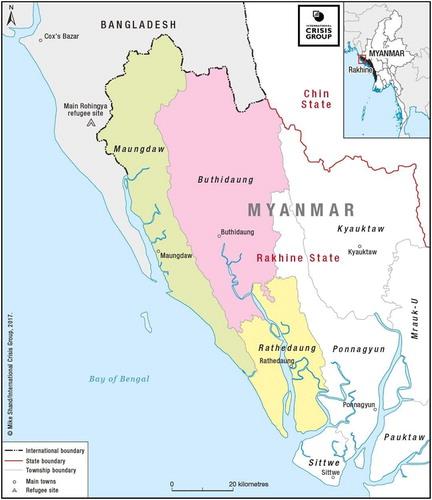
The region was predominantly rural. Agriculture, fishing and local commerce formed the economic foundation of village life, while the frontier with East Pakistan supported cross-border commercial and family connections. The Mayu Range divided Maungdaw and Buthidaung geographically, while rivers and waterways provided important transportation routes.
Research describing the Mayu Frontier District records a population of more than 400,000, approximately 75 percent Muslim, although demographic figures from this period should be treated as historical estimates rather than precise modern census data. The demographic concentration helps explain why Rohingya leaders considered separate administration politically important.
The Mayu Ye
Dr. Mohammed Yunus records that a special local police force known as Mayu Ye was established and recruited from local Muslims. In his account, the creation of this force contributed to improving law and order within the region.
The Mayu Ye occupies an important place in Rohingya political memory because it represented local participation in the security administration of northern Arakan. This was substantially different from later periods when Rohingya communities would experience security institutions principally as external forces controlling movement, documentation and village life.
The institution should not be exaggerated into an independent Rohingya army or security service. It operated within the Burmese state structure. Nevertheless, local Muslim recruitment gave Rohingya residents a role within an administration that they regarded as more responsive to the demographic character of the region.
Mayu and the Decline of the Mujahid Insurgency
The establishment of the MFA coincided with the final decline of the Mujahid insurgency. By the early 1960s, the armed movement had lost much of its earlier strength and political support. Large groups of Mujahid fighters surrendered to government forces during 1961, while the new frontier administration strengthened central authority in the region.
Different historical interpretations emphasize different reasons for this decline. Government and some academic accounts stress improved security administration, border agreements and military pressure. Rohingya historical literature places greater emphasis on the political accommodation represented by Mayu and the willingness of the population to support constitutional arrangements once meaningful safeguards were offered.
These explanations are not necessarily mutually exclusive. Security pressure weakened the remaining insurgents, while the creation of a separate administrative arrangement gave Rohingya political leaders a stronger reason to pursue their goals through negotiation rather than armed rebellion. Contemporary Rohingya historical accounts remember this transition as evidence that political accommodation could reduce conflict in northern Arakan.
Rohingya Identity during the Mayu Period
The establishment of the Mayu Frontier Administration occurred during one of the most politically significant periods in modern Rohingya history. During the late 1950s and early 1960s, the name Rohingya was being used publicly by politicians, students, community organizations and other representatives of the Muslim population of northern Arakan. Rohingya historical literature therefore regards the Mayu period as part of a wider era in which the community could openly express its identity within the political institutions of Burma.
This point is important because later Myanmar governments increasingly denied the legitimacy of the Rohingya name and portrayed it as a recent political invention. The historical evidence from the parliamentary period demonstrates that the name was already publicly circulating inside Burma before Ne Win's military government consolidated power. This does not by itself settle every debate concerning the antiquity or official constitutional classification of Rohingya ethnicity, but it establishes that Rohingya political identity was publicly organized before the later period of systematic state rejection.
Rohingya-Language Broadcasting
One of the most significant examples was the Rohingya-language programme of the Burma Broadcasting Service. Historical research records that state radio began broadcasting in the Rohingya language in 1961, during the same period in which the Mayu Frontier Administration was established. The programme continued into the first years of Ne Win's military rule before eventually being discontinued.
For Rohingya historical interpretation, the broadcasts provide important evidence that the Rohingya name and language were known within an official Burmese institution. State broadcasting did not itself constitute a legal declaration of ethnic nationality, and it should not be presented as if it did. Nevertheless, it is difficult to reconcile the existence of Rohingya-language broadcasting with later assertions that the identity was entirely unknown inside Burma before the military period.
The coincidence of the broadcasting programme with the establishment of Mayu is especially significant. In the same historical period, the central government was administering the predominantly Muslim northern frontier separately while the Rohingya name was appearing publicly within national political and cultural institutions. Rohingya writers therefore interpret these developments together rather than as unrelated events.
Rohingya Students and Public Organization
Rohingya identity was also expressed among university students. The Rangoon University Rohingya Students Association operated during the late 1950s and early 1960s. Rangoon University was one of Burma's principal centres of intellectual and political activity, and ethnic student organizations formed an important part of university life.
The existence of a Rohingya student organization demonstrates that the identity was not confined to rural villages of Maungdaw and Buthidaung. Educated Rohingya youth were publicly organizing under the name in the national capital during the same period that Rohingya parliamentarians and community leaders were negotiating with the government over northern Arakan.
These developments contributed to the consolidation of modern Rohingya political identity. They should remain consistent with Rohipedia's Origins article: the community's historical formation preceded the twentieth century, while the modern collective political expression of Rohingya identity became increasingly organized during the colonial and post-independence periods.
Government Statements and Rohingya Historical Memory
Rohingya historical literature frequently cites statements by Burmese government and military officials during the parliamentary and early Mayu periods as evidence of official recognition. Speeches attributed to Prime Minister U Nu, Defence Minister U Ba Swe and military officials have become particularly important within Rohingya political memory.
Dr. Mohammed Yunus and other Rohingya writers interpret these statements, together with parliamentary representation, radio broadcasting and the Mayu administration, as evidence that the government regarded Rohingya as an ethnic community belonging to Burma. Some Rohingya literature describes this in stronger terms as formal recognition as one of Burma's national ethnic groups.
Rohipedia should preserve this Rohingya interpretation while distinguishing it from what individual pieces of evidence can independently prove. Public use of the name by officials and institutions is evidence of political recognition and engagement. Whether each statement constituted formal constitutional recognition as a specific legal category is a separate historical question and should not be overstated.
Mayu and the Proposed Arakan State
The political importance of Mayu became especially clear as Prime Minister U Nu's government moved toward granting statehood to Arakan. Rakhine political leaders had long demanded recognition of Arakan as an ethnic state within the Union, arguing that the Rakhine possessed a distinct historical identity rooted in the former Arakanese kingdom.
Rohingya leaders did not necessarily oppose recognition of Rakhine political rights. Their principal concern was whether the predominantly Muslim northern region would be incorporated into a state whose political institutions would be dominated by Rakhine Buddhists. The memories of 1942 and the continuing weakness of intercommunal trust made this question particularly sensitive.
The Mayu Frontier Administration provided a political compromise. Rakhine-majority areas could move toward statehood while the predominantly Muslim northern frontier remained under direct central administration. From the Rohingya perspective, this arrangement protected their political position without requiring separation from the Union of Burma.
The Draft Plan for Arakan Statehood
Dr. Mohammed Yunus records that by early 1962, the U Nu government had prepared arrangements for the creation of Arakan State while keeping the Mayu Frontier area outside the proposed state. In the Rohingya historical account, this is one of the strongest indications that the government accepted the political distinction between the Rohingya-majority north and the remainder of Arakan.
Other scholarship also confirms the broader political issue: Muslim representatives opposed inclusion of the Mayu region within a Rakhine-controlled state and regarded separate central administration as preferable. The precise constitutional arrangements were never completed because the parliamentary government was overthrown before the statehood process could be implemented.
The historical significance is therefore not that a permanent autonomous Rohingya territory had been constitutionally guaranteed. It is that the government had developed a political arrangement under which the predominantly Muslim Mayu frontier was administered separately while discussions concerning Rakhine statehood proceeded elsewhere in Arakan.
Why Mayu Became Central to Rohingya Political Memory
For Rohingya political history, Mayu subsequently became important partly because later developments moved in precisely the opposite direction. During the Mayu period, Rohingya leaders negotiated directly with the central government, the community name appeared publicly, Rohingya-language broadcasting existed and northern Arakan possessed a separate administrative arrangement.
Later military governments progressively dismantled these conditions. The special administration disappeared, political organizations were suppressed, broadcasting ended, Rohingya recognition was increasingly rejected and citizenship became progressively more difficult.
Mayu therefore came to symbolize not simply a short-lived administrative district but a lost political possibility: a period when the Burmese state responded to the distinctive circumstances of northern Arakan through accommodation rather than treating its Muslim population principally as an immigration and security problem.
The Coup of 2 March 1962
That political period ended abruptly when General Ne Win seized power on 2 March 1962. The military overthrew Prime Minister U Nu's elected government, dissolved the parliamentary political order and established the Revolutionary Council.
The coup affected every major political movement in Burma. Federal and ethnic demands that had previously been debated through parliamentary institutions were increasingly subordinated to centralized military authority. Rakhine aspirations for statehood under the parliamentary system were interrupted, while Rohingya political organizations lost the democratic environment through which they had negotiated their position.
The Mayu Frontier Administration was not abolished immediately. It continued under military rule for almost two more years. This continuation is important because it demonstrates that the administration was an established territorial structure inherited by the Revolutionary Council rather than something that vanished automatically with U Nu's government.
Mayu under Ne Win
During the period between the coup and abolition of the MFA, northern Arakan remained under its special administrative arrangement, but the political environment had fundamentally changed. The parliamentary negotiations and political organizations that had helped produce Mayu no longer operated freely.
For Rohingya, the distinction between the institution and the political process behind it became increasingly important. Mayu could continue administratively while the broader system of parliamentary representation and negotiation upon which Rohingya leaders had relied was being dismantled.
The military government increasingly centralized political authority throughout Burma. What had been a negotiated frontier arrangement under parliamentary rule was now being absorbed into a much more centralized security and administrative structure.
The End of the Mayu Frontier Administration
In February 1964, the Revolutionary Council ended the Mayu Frontier Administration and transferred responsibility for the region to the Ministry of Home Affairs. The special administrative structure established under U Nu was thereby terminated after less than three years of existence.
For Rohingya historical interpretation, the abolition represented more than an administrative transfer. It removed the separate political arrangement that Rohingya leaders had accepted as protection against incorporation into ordinary Arakan administration. It also occurred within the broader destruction of the parliamentary institutions through which Rohingya political representation had developed.
The original Rohipedia article correctly records the transfer to Home Affairs, but the Rohingya perspective requires explaining why the event mattered. Mayu's abolition removed one of the clearest institutional outcomes of Rohingya constitutional politics during the parliamentary period.
The End of Rohingya-Language Broadcasting
The political reversal continued after the termination of the MFA. Rohingya-language broadcasting through the Burma Broadcasting Service survived beyond the abolition of Mayu but was eventually discontinued in 1965.
The sequence is striking. Within only a few years of the coup, parliamentary politics had disappeared, the special Mayu administration had been abolished and Rohingya-language state broadcasting had ended. The public institutional environment associated with Rohingya political participation was progressively contracting.
Rohingya historical literature consequently treats the early military period as the beginning of a long reversal—from participation and limited accommodation toward denial and exclusion.
From Mayu to Arakan State
Ne Win's government eventually introduced a new constitutional order in 1974 and created Arakan State. Unlike the parliamentary-era proposals discussed under U Nu, the new state included the former Mayu region.
Maungdaw, Buthidaung and the western areas formerly administered separately were therefore incorporated into a state formally associated with the Rakhine nationality. The political compromise that had existed between 1961 and 1964 was not restored.
For Rakhine nationalists, the creation of Arakan State represented long-awaited territorial recognition. From the Rohingya perspective, however, incorporation of the former Mayu region represented another reversal of the arrangement negotiated during parliamentary Burma.
Mayu and the Later Rohingya Crisis
The significance of Mayu became still greater as Rohingya political conditions deteriorated after the 1970s. Operation Nagamin in 1978 drove more than 200,000 Rohingya into Bangladesh. The 1982 Citizenship Law created a new citizenship framework within which Rohingya were not recognized collectively as an indigenous national group. Further military operations produced another enormous refugee movement in 1991–92.
During the NaSaKa period, the former Mayu region again received exceptional administration, but under completely different principles. Movement, marriage, household registration and other aspects of Rohingya life became heavily regulated by security institutions.
The contrast with the early 1960s became central to Rohingya political memory. The same northern territory that had once received separate administration partly in response to Rohingya political demands was later subjected to exceptional administration designed primarily around immigration control, surveillance and security.
What the Mayu Frontier Administration Proves
The Mayu Frontier Administration does not prove that an independent Rohingya state existed. It did not possess sovereignty, an elected Rohingya government or an independent legislature. Describing it in those terms would weaken rather than strengthen the historical case.
What Mayu demonstrates is more specific and historically defensible. In 1961, the Burmese central government recognized that the predominantly Muslim northern frontier presented political circumstances requiring a separate administrative arrangement. Maungdaw, Buthidaung and western Rathedaung were administered outside ordinary Arakan administration, and Rohingya political leaders accepted this arrangement as a partial response to their demands.
It also demonstrates that the political position of Rohingya in Burma was not historically static. The relationship between the community and the state changed substantially between parliamentary government and later military rule.
What Mayu Means in Rohingya Historical Interpretation
Within Rohingya historiography, Mayu represents a period in which political negotiation produced institutional accommodation. Rohingya leaders had not obtained all that they sought, but they had succeeded in establishing a separate administrative structure for the core region of their population.
Dr. Mohammed Yunus therefore treats Mayu as an important achievement while acknowledging its limitations. A.F.K. Jilani similarly presents the administration as a favourable period for Rohingya political and social development. These Rohingya interpretations should be presented as such rather than disguised as neutral conclusions, but they are indispensable to understanding why Mayu occupies such an important position in Rohingya political memory.
The interpretation is strengthened by evidence external to Rohingya nationalist writing. Scholars with substantially different views of Rohingya history nevertheless acknowledge that the Mayu arrangement responded to Muslim political demands and represented a temporary accommodation of the northern frontier question.
Mayu and the Rohingya Homeland Concept
Mayu also became connected with the Rohingya understanding of northern Arakan as their principal historical homeland. This concept does not require claiming that no other communities belonged to the region. Rakhine, Mro, Thet, Daingnet and other populations also formed part of northern Arakan's history.
For Rohingya, however, Maungdaw and Buthidaung were the centre of demographic concentration, political organization and community life. The violence of 1942 had further reinforced that concentration. The creation of a separate administration covering these areas consequently acquired territorial significance within Rohingya political consciousness.
This helps explain why later displacement from northern Arakan was experienced not merely as refugee movement but as removal from the geographical centre of Rohingya collective life.
Mayu and Competing Rakhine Historical Memory
The same administration is viewed differently within Rakhine nationalist history. Many Rakhine regarded separation of the Mayu region as an artificial division of Arakan and feared that special administration could encourage Muslim separatism.
Those concerns formed part of a broader Rakhine political experience in which central Burmese governments were themselves regarded with suspicion. Rakhine nationalism sought greater control over the whole territory of historical Arakan and therefore opposed arrangements that removed the northern frontier from a future Arakan State.
A Rohingya-centered article should acknowledge this competing interpretation without allowing it to erase the Rohingya experience. The same policy could represent political protection to Rohingya and territorial fragmentation to Rakhine. That conflict over the meaning of Mayu helps explain why the administration remains politically sensitive decades after its abolition.
Historical Significance
The Mayu Frontier Administration existed for only a short period, but its historical importance greatly exceeds its duration. It emerged from the political conditions of post-independence Arakan, Rohingya demands for protection and separate administration, Rakhine demands for statehood, the decline of the Mujahid insurgency and the central government's effort to stabilize a difficult frontier.
For Rohingya, Mayu represents evidence that their political leaders were able to negotiate directly with Burma's central government and influence the territorial administration of northern Arakan. It coincided with parliamentary representation, public Rohingya organization and Rohingya-language broadcasting—features sharply contrasting with the exclusion that developed under later military governments.
Its history therefore provides an important corrective to narratives portraying Rohingya as having had no recognized political presence inside post-independence Burma. Mayu does not settle every dispute over ethnicity or citizenship, but it demonstrates that the relationship between Rohingya and the Burmese state was once substantially different from the system that emerged after military rule.
Legacy
The legacy of Mayu remains relevant because the political question it attempted to address was never permanently resolved. The administration disappeared, but disputes concerning northern Arakan, Rohingya belonging and the relationship between Rakhine and Rohingya political aspirations continued.
The crises of 1978, 1991–92, 2012 and 2017 eventually displaced enormous numbers of Rohingya. More recently, the rise of the Arakan Army and United League of Arakan has again transformed political authority across Maungdaw and Buthidaung.
The actors have changed, but the fundamental question remains recognizable: how should northern Arakan be governed, and what political place should its Rohingya population possess within that order?
For Rohingya historical memory, the Mayu Frontier Administration remains important because it records one earlier answer to that question—imperfect and limited, but based upon the principle that the distinctive political circumstances of the Rohingya-majority north required institutional recognition rather than denial.
Key Dates
1948 — Burma becomes independent; armed conflict and competing political demands develop across northern Arakan.
1950s — Rohingya politicians and organizations increasingly pursue constitutional demands concerning recognition, security and administration of northern Arakan.
1960–1961 — U Nu's government moves toward accommodating Rakhine demands for Arakan State while negotiating the separate status of the Muslim-majority north.
1961 — The Mayu Frontier Administration is established, covering Maungdaw, Buthidaung and western Rathedaung.
1961 — Major groups of Mujahid fighters surrender as government control expands across northern Arakan.
1961 — Rohingya-language programming begins through Burma Broadcasting Service during the same general political period.
2 March 1962 — General Ne Win overthrows Prime Minister U Nu and ends parliamentary government.
1962–1964 — The Mayu Frontier Administration continues temporarily under the Revolutionary Council.
February 1964 — The military government abolishes the Mayu Frontier Administration and transfers the region to the Ministry of Home Affairs.
1965 — Rohingya-language state broadcasting is discontinued.
1974 — Arakan State is formally created under Ne Win's socialist constitutional system, incorporating the former Mayu region.
Conclusion
The Mayu Frontier Administration should be understood neither as an independent Rohingya state nor as an insignificant frontier bureaucracy. It was a specific political arrangement created during parliamentary Burma in response to the unusual demographic, political and security circumstances of northern Arakan and to sustained demands from its Muslim/Rohingya leadership.
Its deepest significance lies in the contrast it provides with later history. During the Mayu period, Rohingya leaders negotiated with the government over the administration of their region, Rohingya identity was publicly organized, Rohingya-language broadcasting existed, and the predominantly Rohingya/Muslim northern frontier was administered separately from the remainder of Arakan. These developments occurred within Burma's own political and administrative institutions rather than outside them.
From the Rohingya historical perspective, Mayu therefore represents evidence that the political position of the community in Burma was once fundamentally different from the position imposed under later military governments. It does not establish that Rohingya possessed sovereignty or an independent state, but it demonstrates that Rohingya political leaders participated in national politics and that their demands concerning northern Arakan influenced government policy.
The abolition of Mayu after Ne Win's military takeover marked the beginning of the reversal of this arrangement. The separate administration ended in 1964, Rohingya-language broadcasting subsequently disappeared, and the former Mayu territory was eventually incorporated into Arakan State under the 1974 constitutional system. During the following decades, the state's relationship with Rohingya increasingly shifted away from political accommodation toward immigration scrutiny, citizenship exclusion and security control.
For this reason, Mayu occupies a particularly important position in Rohingya political memory. It represents a period when the question of northern Arakan was addressed through negotiation and institutional accommodation rather than through the later assumption that the Rohingya population itself constituted an immigration problem.
The history of Mayu also remains relevant to contemporary Arakan. Maungdaw and Buthidaung are again at the centre of a profound transformation of political authority as the Myanmar military loses territorial control and the Arakan Army/United League of Arakan emerges as the dominant power across much of the region. The authority governing northern Arakan has changed, but the underlying political question remains unresolved: how will the Rohingya population be recognized within the political order governing its historical population centre?
Mayu does not provide a ready-made constitutional solution for the present. Its historical value lies elsewhere. It demonstrates that northern Arakan's distinctive political circumstances were once acknowledged institutionally and that Rohingya leaders were participants in determining the region's political future.
For Rohingya historical memory, the Mayu Frontier Administration therefore remains a short-lived but important example of political recognition, territorial accommodation and constitutional negotiation within the Union of Burma before the long period of military exclusion.