Arakan at the Beginning of Independence
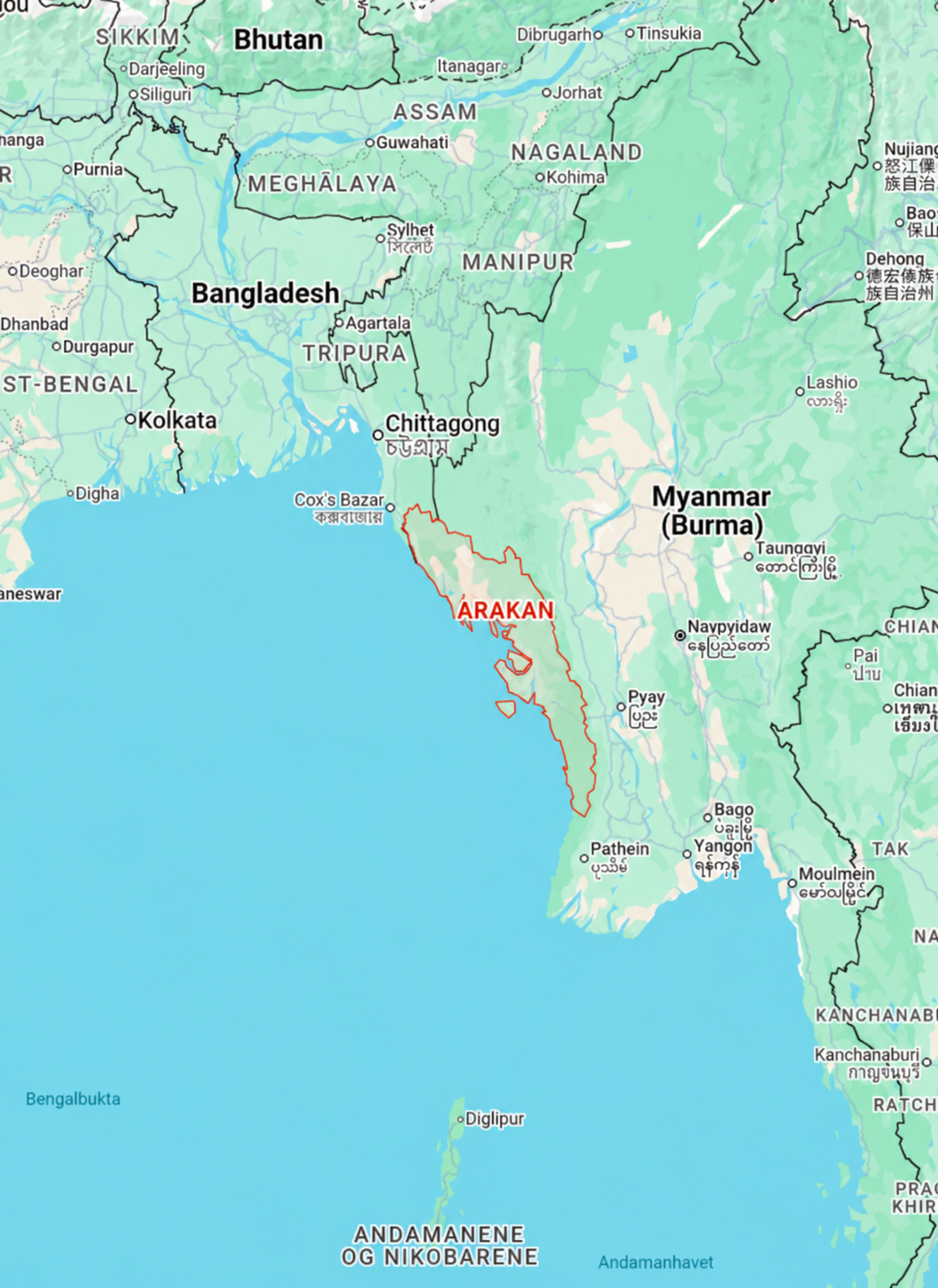
Modern Arakan therefore began independence as a deeply divided frontier rather than a politically unified region. Rakhine Buddhists possessed a powerful historical memory of the former Arakanese kingdom and increasingly demanded recognition of Arakan as an ethnic state within the Union. Muslims of northern Arakan, whose modern Rohingya political identity was becoming increasingly organized, feared political domination within a Rakhine-controlled state and sought recognition, security and a separate arrangement for the Muslim-majority north. These competing political visions would become one of the defining features of post-independence Arakan.
Arakan's geography continued to shape these disputes. The Arakan Yoma separated the coastal region from central Burma, while northern Arakan remained closely connected geographically, linguistically and economically with the Chittagong region across the Naf River. Independence transformed that old frontier into an international boundary between Burma and East Pakistan. Movement that had historically taken place across a changing regional frontier was therefore increasingly subjected to the laws, citizenship systems and security concerns of two newly independent states.
The Legacy of 1942
The communal catastrophe of 1942 remained one of the most important forces shaping post-independence Arakan. Muslim communities had been attacked and displaced from areas farther south, while Buddhist villages in northern Arakan had also suffered killings, destruction and displacement. By the end of the war, the geographical separation between the communities had become considerably sharper, with Muslims increasingly concentrated around Maungdaw and Buthidaung and Buddhist Rakhine populations predominating across much of central and southern Arakan.
This division affected competing understandings of territory after independence. For Rohingya Muslims, northern Arakan increasingly represented the area in which their population had survived and consolidated after wartime displacement. Security became inseparable from territory. For Rakhine Buddhists, however, the whole of Arakan formed part of the historical Rakhine homeland associated with the former Arakanese kingdom. The same northern territory could therefore be understood simultaneously as the principal Rohingya population centre and as an inseparable part of the larger Rakhine conception of Arakan.
These perspectives should not be collapsed into a single narrative. Rohingya historical literature emphasizes longstanding Muslim roots in northern Arakan, displacement in 1942 and the need for political protection. Rakhine nationalist narratives emphasize the historical unity of Arakan and frequently interpret demands for separate Muslim administration as a threat to that unity. The post-independence political history of Arakan developed partly from the collision between these territorial understandings.
Arakan within the Union of Burma
Arakan did not receive separate statehood when Burma became independent. It remained administratively within the Union while Rakhine political movements continued campaigning for an autonomous Arakan State. This reflected a broader unresolved problem within postcolonial Burma: how a highly diverse country should distribute political authority among the central government and its many ethnic regions.
Rakhine nationalism had developed strongly during the colonial period and was rooted partly in memories of Arakan's former sovereignty. Many Rakhine leaders believed that their people deserved a state comparable to those granted or contemplated for other ethnic nationalities. Statehood was therefore understood not simply as administrative reform but as restoration of a measure of political dignity after the loss of the old kingdom and subsequent incorporation into Burmese and British systems.
Northern Arakan's Muslim leadership viewed the question differently. Many feared that incorporation into an autonomous Arakan State dominated politically by Rakhine Buddhists would leave the Muslim population vulnerable. The memories of 1942 remained recent, and communal trust had not been restored. As a result, the struggle for Rakhine statehood and Muslim demands concerning northern Arakan developed simultaneously and often in direct tension with one another.
The Pakistan Proposal and the Northern Frontier
During the final years of British rule, some Muslim leaders in northern Arakan explored whether Muslim-majority areas adjoining East Bengal might be incorporated into the future Pakistan. The proposal arose during the exceptional political circumstances surrounding the partition of British India, the approaching independence of Burma and the insecurity created by the communal violence of 1942. Muhammad Ali Jinnah did not support incorporating northern Arakan into Pakistan, and when partition occurred in 1947 the international boundary remained at the Naf River.
The episode subsequently became highly controversial in Arakanese historical memory. Rakhine and Burmese nationalist accounts frequently cited the Pakistan proposal as evidence of Muslim separatism and questionable loyalty to Burma. Rohingya historical accounts emphasize that the initiative represented only part of Muslim political opinion and developed from fears concerning security and political domination after the wartime catastrophe. Some Rohingya writers also distinguish between leaders associated with more recent Chittagonian migration and older Arakan Muslim political currents when discussing support for the Pakistan proposal.
Whatever interpretation is adopted, the proposal failed. Maungdaw and Buthidaung remained inside Burma. The central political question therefore became how northern Arakan's large Muslim population would relate to the new Union and to the Rakhine political movement seeking statehood for Arakan.
Insurgencies in Post-Independence Arakan
Arakan's early post-independence history was not defined by a single rebellion. Several armed movements operated within the region, reflecting the political fragmentation of the new Union. Muslim Mujahid groups became active in northern Arakan, while communist organizations and Rakhine armed movements also challenged the central government in other parts of the region. The Burmese state consequently faced multiple competing insurgencies rather than a simple conflict between the government and one ethnic community.
The Mujahid rebellion, which expanded in 1948, developed particularly in Maungdaw and Buthidaung. Muslim armed groups sought different political objectives over time, including recognition of Muslim rights, administrative separation and forms of autonomy. Some early currents had connections with the unsuccessful Pakistan idea, while later demands increasingly focused on arrangements within Burma. The rebellion gained strength partly because the central government exercised limited control over portions of the northern frontier during the unstable early years of independence.
At the same time, the Mujahids did not represent every Muslim inhabitant of northern Arakan. Muslim political leaders also participated in parliamentary politics and pursued negotiations with Rangoon. Recent scholarship notes explicit statements by Muslim organizations declaring loyalty to the Union even while the rebellion continued. This distinction is essential for understanding Arakan: armed insurgency and constitutional Muslim politics existed simultaneously.
Rakhine Political Struggles
Rakhine politics were also divided between constitutional and armed strategies. Rakhine leaders continued demanding recognition of Arakan as an ethnic state, while armed movements challenged the central government. Communist organizations operated in the region, and the instability of post-independence Burma provided opportunities for several insurgent forces to establish influence in rural areas.
These conflicts reflected longstanding Rakhine grievances toward central Burmese authority as well as ideological struggles affecting Burma as a whole. Rakhine nationalism should therefore not be reduced simply to opposition to the Rohingya. A major political objective was greater autonomy from Rangoon and recognition of Arakan's distinct historical identity. At different moments, Rakhine nationalists could simultaneously oppose central Burman domination and resist Muslim demands for separate administration in northern Arakan.
This produced a complicated triangular political structure. The central government sought to preserve Burma's territorial integrity; Rakhine nationalists sought greater autonomy for Arakan; and Rohingya/Muslim leaders sought safeguards against incorporation into a political order they feared would be dominated by Rakhine interests. Much of Arakan's later political history developed from the unresolved relationship among these competing projects.
Parliamentary Politics and Northern Arakan
Despite insurgency, parliamentary politics gradually became an important arena in Arakan. Muslim representatives from northern constituencies participated in national elections and entered Burma's political institutions. Their participation demonstrated that northern Arakan's political history cannot be reconstructed solely through the Mujahid rebellion.
During the 1950s, Muslim political leaders increasingly articulated their community identity as Rohingya. The term had an earlier documented antecedent in Francis Buchanan's 1799 “Rooinga,” but its modern political use became increasingly visible during this period. Rohingya organizations, students and elected representatives used the name publicly while seeking recognition and administrative protection within the Union.
Rohingya historical scholarship, including the work of Dr. Mohammed Yunus, interprets this parliamentary period as an important era of official recognition. Some of the strongest claims concerning formal national-race status remain debated in wider scholarship, but several underlying facts are well established: Rohingya representatives participated in politics, organizations publicly used the name, Rohingya student organization existed, and the state broadcasting service later carried Rohingya-language programming. These facts are important when reconstructing the political landscape of Arakan before military rule.
Two Competing Visions for Arakan
By the late 1950s, the future political structure of Arakan had become increasingly contentious. Rakhine leaders intensified demands for an Arakan State within the Union. For them, statehood represented recognition of Rakhine national identity and the historical distinctiveness of Arakan.
Rohingya and other Muslim leaders from the north generally opposed placing their Muslim-majority constituencies under the proposed Rakhine state government. They feared that a state identified politically with the Rakhine nationality would leave Muslims vulnerable to discrimination and could reproduce the communal insecurity experienced during the 1942 violence. Their counterproposals included autonomy, separate administration or continued direct rule from Rangoon.
This disagreement reveals why the political history of modern Arakan cannot be understood solely as Rakhine versus Rohingya. Both communities were simultaneously negotiating their relationships with the central Burmese state. Rakhine leaders sought greater separation from central control, while many Rohingya leaders preferred central administration as protection against Rakhine political dominance. The central government consequently occupied a powerful position between the two competing regional projects. Academic research identifies this incompatibility between Buddhist Rakhine statehood demands and Muslim northern-Arakan demands as a central political problem of the period.
The Mayu Frontier Administration
Prime Minister U Nu's government eventually responded to the northern question by establishing the Mayu Frontier Administration (MFA) in 1961. It encompassed Maungdaw, Buthidaung and the western portion of Rathedaung, the principal Muslim-majority areas of northern Arakan. Rather than being placed under ordinary Arakan administration, the Mayu region came under direct central authority and was administered with an important military role.
The MFA was not an autonomous Rohingya state. This distinction is important. Yet its creation was politically significant because it separated the Muslim-majority north from the jurisdiction of the proposed Arakan State. Independent scholarship records that Muslim political leaders had opposed inclusion within the Rakhine state project and accepted the Mayu arrangement as a compromise.
Dr. Mohammed Yunus gives the arrangement particular importance in Rohingya historiography. He describes Rohingya leaders as accepting the MFA precisely because, although it fell short of autonomy, it prevented their region from being placed under Arakanese administration. Rohingya historical literature therefore remembers Mayu as one of the most important political achievements of the parliamentary era.
Rakhine Opposition to the Mayu Arrangement
The same arrangement was viewed very differently by many Rakhine nationalists. From their perspective, removing Maungdaw, Buthidaung and part of Rathedaung from the proposed Arakan State threatened the territorial integrity of their historical homeland. Some interpreted the policy as a central-government strategy of “divide and rule”, designed to weaken Rakhine demands for autonomy.
This Rakhine response is essential to understanding the political geography of modern Arakan. The Mayu arrangement could simultaneously represent protection and political recognition to Rohingya leaders while appearing as territorial fragmentation to Rakhine nationalists. The dispute was therefore not simply about administrative efficiency; it concerned competing ideas of who constituted Arakan and how its territory should be politically organized.
Research on the political history of Arakan describes this Rakhine reaction clearly: many nationalists believed that the central government was weakening the viability of an autonomous Arakan State by separating the Mayu frontier from it.
Rohingya Public Life during the Mayu Period
The early 1960s also witnessed visible public expression of Rohingya identity. Research documents Rohingya-language programming through Burma's state broadcasting service and organized Rohingya student activity at Rangoon University. Such evidence is significant because it shows that Rohingya identity formed part of Burma's public political environment during the final years of parliamentary rule.
Rohingya historical sources place considerable emphasis on statements by government and military figures during this period and interpret them as recognition of Rohingya ethnic status. Independent scholarship confirms that senior officials used the Rohingya designation, although historians differ over precisely what such statements meant within Burma's evolving and inconsistent system of ethnic classification. The safest historical conclusion is nevertheless important: the Rohingya name was publicly used inside Burma and interacted with state institutions before military rule later rejected it.
This period therefore represented a distinctive political moment in Arakan. Rakhine statehood appeared increasingly possible, while northern Arakan possessed a separate administrative arrangement accepted by Rohingya leaders. For a brief period, Burma's parliamentary system appeared capable of accommodating two different political claims within Arakan through separate institutional arrangements.
Arakan on the Eve of the 1962 Coup
By the beginning of 1962, Arakan had reached a critical point in its post-independence development. The Mujahid insurgency had substantially declined, with large groups surrendering during the preceding years. The Mayu Frontier Administration had established a separate administrative framework in the north. Meanwhile, the U Nu government was moving toward addressing the longstanding Rakhine demand for statehood.
This did not mean that Arakan's political conflicts had been solved. Rakhine nationalists remained dissatisfied with the exclusion of the Mayu area from their envisioned state, while Rohingya leaders continued seeking stronger guarantees concerning recognition and political security. Nevertheless, the disputes were increasingly being addressed through negotiation and institutional arrangements rather than only armed conflict.
That political experiment ended abruptly on 2 March 1962, when General Ne Win seized power in a military coup. Parliamentary democracy collapsed throughout Burma. For Arakan, the coup interrupted both major political processes then underway: Rakhine aspirations for statehood under the parliamentary system and Rohingya hopes that the Mayu arrangement might provide a durable political framework for northern Arakan.
The military era would reorganize Arakan again. The Mayu Frontier Administration would be abolished, central military control would expand, and in 1974 Ne Win's socialist government would eventually create Arakan State but with the former Mayu territory incorporated into it. The political compromise developed during the parliamentary period would therefore disappear, opening a new phase in the competing histories of Arakan's Rakhine and Rohingya populations.
Arakan under Ne Win's Military Rule
General Ne Win's coup of 2 March 1962 transformed the political direction of Arakan along with the rest of Burma. The parliamentary system through which Rakhine and Rohingya leaders had pursued competing territorial demands was abolished, and authority became concentrated in the Revolutionary Council. Political parties and independent organizations were suppressed as the military attempted to construct a centralized state capable of controlling Burma's numerous ethnic regions and armed movements.
For Arakan, the coup interrupted two important political processes. Rakhine leaders had been seeking recognition of Arakan as an ethnic state, while Rohingya leaders in the north had secured the Mayu Frontier Administration and opposed incorporation of their Muslim-majority region into such a state. Under parliamentary government, these competing demands had produced negotiation and compromise. Military rule increasingly replaced that process with decisions imposed by the central state.
The change did not immediately resolve Arakan's ethnic or territorial disputes. Instead, it temporarily subordinated them to military authority. Rakhine aspirations for statehood remained alive, while Rohingya leaders continued to regard the Mayu region as requiring separate political protection. The difference was that neither community now possessed the parliamentary mechanisms through which these demands had previously been negotiated.
The Abolition of the Mayu Frontier Administration
The Mayu Frontier Administration initially survived the military takeover, but its special status was short-lived. In 1964, the administration was abolished and responsibility for the Mayu area was transferred to the Ministry of Home Affairs. Maungdaw, Buthidaung and western Rathedaung therefore lost the separate administrative arrangement created only three years earlier.
From a Rohingya perspective, the abolition represented an important political reversal. The MFA had not constituted an autonomous Rohingya state, but it had kept the Muslim-majority northern frontier outside ordinary Arakan administration and under direct central authority. Rohingya historical writing, particularly that of Dr. Mohammed Yunus, consequently treats its termination as an important stage in the erosion of the political position the community had achieved during parliamentary Burma.
Rakhine political interpretation was different. Many Rakhine nationalists had opposed the separation of Mayu because they regarded northern Arakan as an inseparable part of the historical territory of Arakan. The disappearance of the separate administration therefore removed one obstacle to the territorial unity sought by Rakhine statehood advocates, although military rule still prevented the realization of the democratic autonomy for which many Rakhine politicians had campaigned.
Arakan under the Burmese Way to Socialism
Ne Win's government introduced the Burmese Way to Socialism, nationalizing large sectors of the economy and placing political and economic life under extensive state control. Arakan, already one of Burma's economically disadvantaged regions, became increasingly isolated. Its difficult geography, limited infrastructure and distance from the country's political and commercial centres contributed to persistent underdevelopment.
These policies affected both Rakhine and Rohingya inhabitants. Agricultural communities depended heavily on rice cultivation, fishing and local trade, while nationalization and restrictions on private commerce altered established economic relationships. The frontier economy connecting northern Arakan with neighbouring East Pakistan, and later Bangladesh, also came under increasing state scrutiny.
Arakan's economic difficulties would become a persistent feature of its modern history. Despite fertile agricultural areas, fisheries and natural resources, the state remained one of the poorest regions of Burma. Rakhine political movements increasingly interpreted this condition as evidence of exploitation and neglect by the Burman-dominated central government, while Rohingya communities experienced the same regional poverty together with growing uncertainty concerning their political and legal status.
Changing Ideas of Ethnicity and Belonging
Military rule also changed the political meaning of ethnicity. The concept of taingyintha, usually translated as “national races,” became increasingly important in the state's understanding of who properly belonged to Burma. This development affected political relationships throughout the country, where ethnic nationality was becoming closely connected with territory, autonomy and legitimacy.
For Rakhine Buddhists, recognition as an indigenous nationality strengthened the argument that Arakan represented their ethnic state. Their historical narrative emphasized the independent Arakanese kingdom, Buddhist civilization and the conquest of 1784 as evidence of a distinct national history preceding incorporation into Burma.
Rohingya historical claims developed from a different part of Arakan's past. Rohingya writers emphasized the centuries-old Muslim presence, Arakan's relationship with Bengal, Muslim participation during Mrauk-U, the 1799 Rooinga record and the political recognition they believed their community had received during parliamentary Burma. As military ideology increasingly tied national belonging to state-defined indigenous ethnicity, these competing interpretations of Arakan's history acquired direct political consequences.
The Question of Rakhine Statehood Returns
Although Ne Win had destroyed parliamentary democracy, the demand for recognition of Arakan as an ethnic state did not disappear. Rakhine national consciousness remained strong, and the military government eventually incorporated ethnic states into the constitutional structure it was designing for socialist Burma.
The result differed fundamentally from the autonomous political system many ethnic nationalists had originally envisioned. The new states existed within a highly centralized one-party system dominated by the Burma Socialist Programme Party. Their governments did not possess the kind of federal sovereignty demanded by many ethnic political movements.
Nevertheless, formal statehood carried considerable symbolic importance. For Rakhine nationalists, it restored the name and territorial recognition of Arakan within the Union after decades during which the region had lacked separate state status.
The 1974 Constitution and the Creation of Arakan State
The new 1974 Constitution established the Socialist Republic of the Union of Burma and formally created Arakan State. This represented a major territorial reorganization in the modern history of the region. Arakan now possessed the status of an ethnic state within the Union, even though genuine political authority remained concentrated in the socialist central government.
The new state incorporated the former Mayu frontier, including Maungdaw and Buthidaung. This was particularly significant because the parliamentary-era compromise had envisioned a different political geography: Rakhine leaders sought an Arakan State, while Rohingya representatives had opposed inclusion of the Muslim-majority Mayu region within it. Under military rule, that distinction disappeared.
The 1974 arrangement therefore represented two very different historical outcomes. For Rakhine political memory, creation of Arakan State fulfilled a longstanding demand for formal recognition of the Rakhine homeland. For Rohingya political memory, incorporation of the former Mayu area meant the loss of the separate administrative protection their leaders had secured in 1961.
One State, Two Historical Claims
The creation of Arakan State did not resolve the competing historical claims within the region. Rakhine Buddhists constituted the population from which the state's ethnic designation derived, but northern Arakan contained a large Muslim population increasingly identifying politically as Rohingya. Both communities regarded Arakan as central to their historical identity, although they constructed that relationship through different narratives.
Rakhine history emphasized the ancient kingdoms, Mrauk-U monarchy, Buddhist institutions and the loss of sovereignty to Burma in 1784. Rohingya historical writing emphasized Arakan's frontier character, its Muslim communities, Bengal connections, Persianate influences, the precolonial Rooinga designation and the development of the Muslim population of the north. These histories overlapped geographically even when their political interpretations differed.
The problem was therefore not that one community possessed history while another lacked it. Modern Arakan inherited a layered past that had produced several communities with genuine historical attachments to the region. The political difficulty arose when competing national narratives treated belonging as exclusive and state institutions increasingly gave one interpretation greater legal recognition than another.
Northern Arakan and the Bangladesh Frontier
Another major transformation occurred in 1971, when East Pakistan became independent Bangladesh. Northern Arakan now bordered a new country, but the human geography around the Naf River remained closely interconnected. Language, family relationships, commerce and migration continued across a frontier whose political importance had increased enormously since the colonial period.
The Burmese government had legitimate reasons to regulate international migration, and unauthorized movement occurred across the border. But northern Arakan presented a particularly difficult administrative problem because the Rohingya population itself spoke an Indo-Aryan language closely related to speech across the Naf and had centuries of historical connections with southeastern Bengal.
The distinction between an established Arakan Muslim and a recent migrant could therefore not necessarily be determined from language, religion or appearance. As immigration enforcement became increasingly tied to ethnicity and national belonging, this ambiguity created serious consequences for Rohingya residents whose families considered themselves locally rooted.
From Regional Administration to Population Scrutiny
During the 1970s, the government's attention increasingly shifted from the political administration of northern Arakan toward questions of population, documentation and immigration. The national census of 1973 formed part of a broader effort to classify Burma's inhabitants, while authorities developed mechanisms intended to distinguish citizens and lawful residents from foreigners.
For northern Arakan, such scrutiny was inherently political. The former Mayu area contained a Muslim-majority population whose ethnic status was increasingly disputed by the state. The same region also bordered Bangladesh and experienced cross-border movement. Immigration administration therefore became intertwined with the much larger question of whether the Rohingya community itself was considered part of Burma's indigenous population.
From the Rohingya perspective, this represented a profound transformation of the northern question. During parliamentary Burma, leaders had negotiated with Rangoon about representation, administrative autonomy and the Mayu frontier. By the late 1970s, the state increasingly approached the same population through immigration verification and documentation.
Rakhine–Rohingya Relations under the New State
The creation of Arakan State did not immediately produce large-scale communal violence between Rakhine and Rohingya. Yet the political structure increasingly separated the communities in important ways. Rakhine were recognized within the state's national-race framework and possessed an ethnic state bearing their name, while Rohingya recognition became progressively more uncertain.
This difference would become increasingly consequential. Rakhine themselves remained politically subordinate to the Burman-dominated military state and continued to experience grievances concerning autonomy, economic development and control of Arakan's resources. Their recognized ethnic status therefore did not mean that Rakhine political aspirations had been satisfied.
Rohingya faced those same broader problems of authoritarian rule and regional poverty while also confronting an additional challenge: whether the state considered them legitimate members of the national community at all. Modern Arakan consequently developed two different relationships with central Burma—Rakhine demands centred increasingly on autonomy and control of their recognized homeland, while Rohingya demands increasingly centred on recognition, citizenship and protection within that same territory.
Toward the 1978 Crisis
By the late 1970s, the political landscape of Arakan had changed substantially from the parliamentary period. Arakan State existed, the Mayu Frontier Administration had disappeared, military rule had eliminated independent regional politics, and the state increasingly connected ethnicity, documentation and national belonging. Northern Arakan remained overwhelmingly important to Rohingya life, but its Muslim population was increasingly viewed through the language of immigration and border security.
Against this background, the government launched Operation Nagamin, or Dragon King, a nationwide population-verification campaign. Its stated purpose was to identify citizens and foreigners in preparation for registration and census activities. The operation was not created solely for Arakan and was implemented in other regions of Burma.
When Nagamin reached northern Arakan in 1978, however, the consequences were dramatically different. Verification occurred within a population whose collective belonging had become politically disputed and in a region where military administration, ethnic identity and international-border security had converged. Reports of abuses and fear spread rapidly through Rohingya villages, triggering a mass movement toward Bangladesh.
More than 200,000 Rohingya fled Arakan during 1978. The exodus transformed an internal struggle over the political and demographic character of northern Arakan into a major international crisis. For the first time since independence, the modern dispute over who belonged to Arakan produced a refugee movement on a scale that forced neighbouring Bangladesh and the wider international community to become directly involved.
Operation Nagamin Reaches Arakan
In 1978, the Burmese government implemented the population-verification campaign known as Operation Nagamin, or “Dragon King.” The operation was officially intended to scrutinize residents, identify people considered to be foreigners and prepare for registration and census activities. Nagamin was implemented in several parts of Burma and was not originally presented as an operation directed solely against the Rohingya. When it reached Arakan, however, it entered a region where questions of immigration had become inseparable from competing ideas about ethnicity, territory and belonging.
The operation began in Arakan with immigration scrutiny in Sittwe in February 1978 before moving northward. Its arrival in Buthidaung, Maungdaw and surrounding areas produced a very different reaction because the Muslim population of the former Mayu frontier was already increasingly uncertain about how the military government regarded its status. The same communities had participated in the political institutions of parliamentary Burma and had lived under a separate frontier administration only seventeen years earlier. They now encountered the state primarily through immigration scrutiny and security administration.
This transformation is important for understanding modern Arakan. The northern question had shifted substantially between 1961 and 1978. Under U Nu, the political dispute had concerned how a predominantly Muslim region should be administered within Burma. Under Ne Win, the question was increasingly becoming whether significant numbers of the people living there were citizens or foreigners.
Mass Flight from Northern Arakan
As Nagamin expanded across the northern townships, fear spread through Rohingya villages. Refugees subsequently reported arrests, intimidation, killings, rape, beatings and forced eviction by security personnel. Human-rights investigations later recorded these allegations, while the Burmese government maintained that the operation was a lawful immigration exercise intended to identify people who had entered Burma illegally.
The government's interpretation was fundamentally different from the Rohingya account. Authorities argued that large numbers fled because they were Bangladeshi immigrants afraid that verification would expose their illegal status. Rohingya refugees maintained that they were inhabitants of Arakan driven from their villages by abuses and by a state increasingly unwilling to accept their identity and historical belonging.
These competing narratives would become a recurring feature of Arakan's modern history. The existence of migration across the Bangladesh frontier was real, but it could not by itself determine the origin of every Muslim family in northern Arakan. The longer history established in Old Arakan included precolonial Muslim settlement, the 1799 Rooinga record, return migration and substantial additional colonial-era migration. Nagamin increasingly compressed that complicated history into the administrative distinction between citizen and foreigner.
More Than 200,000 Leave Arakan
The movement rapidly became enormous. During the spring and summer of 1978, more than 200,000 Rohingya fled from Arakan into Bangladesh. Families crossed the Naf River or travelled through frontier areas toward Teknaf and Cox's Bazar, frequently leaving agricultural land, houses, livestock and other possessions behind.
The exodus significantly altered northern Arakan. Entire villages lost substantial portions of their population, agricultural production was disrupted and communities were divided across the international boundary. The Naf River, which had historically connected as well as separated populations, became the principal escape route from Burma.
The scale of the movement also internationalized a conflict that had previously been managed largely within Burma. Bangladesh suddenly had to accommodate hundreds of thousands of refugees, while UN agencies and humanitarian organizations became involved. From this point onward, the political future of northern Arakan could no longer be treated exclusively as an internal Burmese issue; developments there repeatedly affected Bangladesh and the wider region.
Bangladesh and the Refugee Emergency
Bangladesh had become independent only in 1971 and possessed limited resources to manage such a large refugee population. Camps developed rapidly around the southeastern border region, where overcrowding, inadequate sanitation, disease and malnutrition became serious problems. International humanitarian assistance expanded as the scale of the emergency became clear.
For Bangladesh, the refugee movement created both humanitarian and political problems. The government did not regard permanent settlement of hundreds of thousands of Rohingya as an acceptable solution. It therefore pressed Burma to receive the refugees back while seeking international assistance to sustain them temporarily.
This established a relationship that would repeatedly shape Arakan's subsequent history. Political and military developments inside northern Arakan produced refugee movements into Bangladesh; Bangladesh then sought repatriation; international agencies attempted to assist refugees and negotiate returns; and Burma faced external pressure to receive populations whose national status it continued to dispute.
The 1978 Repatriation Agreement
Burma and Bangladesh eventually reached an agreement on 9 July 1978 providing for the repatriation of refugees from Arakan. UNHCR subsequently became involved in facilitating return, and reception facilities were established on the Burmese side of the frontier. The agreement began reversing the enormous demographic movement that Nagamin had produced only months earlier.
Burma's acceptance of the refugees became an important subject in later historical debate. Rohingya writers frequently cite the repatriation as evidence that the Burmese government recognized that the population had come from Arakan. The fact that large numbers were accepted back is indeed historically important, particularly given the government's earlier characterization of the crisis as an illegal-immigration problem.
However, return should not be confused with a blanket legal determination that every refugee possessed full citizenship. The more defensible conclusion is that Burma agreed to readmit the overwhelming majority of a population that had fled from its territory while leaving unresolved the deeper dispute over Rohingya ethnicity, citizenship and national belonging.
The Return to Northern Arakan
Repatriation began during 1978 and accelerated substantially during 1979. By the conclusion of the programme in December 1979, more than 180,000 refugees had returned to Burma. Northern Arakan therefore experienced another rapid demographic movement, this time in the opposite direction.
Many returnees went back toward the same Maungdaw and Buthidaung areas from which they had fled. UNHCR provided assistance intended to support reception and reintegration, but international access and monitoring inside Burma remained limited. Returning physically to Arakan did not restore the political arrangements that had existed before military rule.
The population of northern Arakan therefore remained largely in place after the crisis, but under fundamentally changed conditions. Nagamin had demonstrated how quickly disputes over documentation and immigration could become mass displacement. The refugees had returned, yet the underlying conflict over how the state understood the Muslim population of northern Arakan had not been resolved.
Pressure and the Question of Voluntary Return
The official repatriation programme was described as voluntary, but later historical assessments raised serious questions about how freely refugees could choose. Many initially resisted return because they feared renewed persecution. Bangladesh, meanwhile, strongly opposed the prospect of permanent settlement and became increasingly determined to reduce the refugee population.
Later UNHCR assessments recorded opposition to repatriation, arrests of refugee leaders, clashes inside the camps and deteriorating conditions. Food reductions and other pressures formed part of the environment in which refugees eventually returned. The formal description of voluntary repatriation therefore does not necessarily describe the experience of every individual family.
This issue would become important again after later Arakan refugee crises. The events of 1978–79 established that an agreement between governments could physically move people back across the Naf River without necessarily resolving whether the conditions producing their flight had changed.
How the Crisis Changed Arakan
Nagamin altered the political meaning of northern Arakan. Before military rule, the Mayu question had centred on administration, representation and the relationship between the Muslim-majority frontier and a proposed Arakan State. By 1978, immigration and citizenship had become increasingly dominant ways in which the central government approached the same territory.
For Rohingya, this represented a major deterioration from the parliamentary period. For many Rakhine, however, concerns about migration from Bangladesh and the demographic character of northern Arakan were genuine political issues. Rakhine nationalist narratives increasingly interpreted the Muslim-majority north through colonial migration and cross-border movement, while Rohingya narratives emphasized older settlement, precolonial evidence and their previous participation within Burma.
The two communities were therefore developing increasingly incompatible historical explanations of the same landscape. One narrative emphasized immigration into Arakan; the other emphasized exclusion from Arakan. These competing interpretations would become still more politically important when citizenship law was fundamentally restructured four years later.
Arakan between Rakhine Nationalism and Central Military Rule
The 1978 crisis should not obscure the continuing conflict between Rakhine aspirations and the Burmese central state. Rakhine had obtained formal statehood in 1974, but Arakan remained politically subordinate to Ne Win's centralized socialist system. Statehood did not provide the federal autonomy or control over regional resources that many Rakhine nationalists desired.
This created an important complexity in Arakanese politics. Rakhine could be politically marginalized by the Burman-dominated central government while simultaneously occupying a stronger position than Rohingya within the state's ethnic classification. The two communities therefore experienced military rule differently even while both lived under the same authoritarian system.
This distinction would remain important throughout modern Arakan's history. Rakhine nationalism increasingly focused on greater political autonomy and control of Arakan, eventually contributing to the rise of powerful armed organizations. Rohingya politics increasingly focused on recognition, citizenship and protection from exclusion. Both projects concerned the future of Arakan, but they moved in increasingly different directions.
The Road toward the 1982 Citizenship Order
After the repatriation, the military government continued restructuring the relationship between ethnicity and citizenship. The return of more than 180,000 refugees did not produce a political settlement concerning northern Arakan. Instead, questions of ancestry and national-race status became still more important.
In 1982, Ne Win's government enacted a new Citizenship Law. The law established three citizenship categories and gave major significance to the concept of ethnic groups established within Burma before 1823, immediately before British territorial expansion. This historical threshold had particular implications for Arakan because British rule had unquestionably produced substantial migration from Chittagong while older evidence also demonstrated Muslim presence before colonial annexation.
The resulting dispute was therefore deeply connected to Arakan's history. If the Muslim population were interpreted principally through colonial migration, Rohingya claims to indigenous belonging could be rejected. If the longer history of Muslim settlement, the Mrauk-U period, precolonial population movement and Buchanan's 1799 Rooinga evidence were considered, the historical picture became considerably more complicated.
The 1982 citizenship order would consequently do more than change identity documents. It would reshape the relationship between history, ethnicity and political membership in Arakan, creating a legal and administrative structure whose effects would become increasingly visible during the following decades.
Arakan after the 1991–92 Exodus
The flight of approximately a quarter of a million Rohingya in 1991–92 left northern Arakan severely disrupted. Villages had lost inhabitants, agricultural activity was affected, families were divided across the Bangladesh border and large areas of Maungdaw and Buthidaung came under intensified military supervision. Yet the exodus did not permanently empty northern Arakan of its Muslim population. Burma and Bangladesh soon entered negotiations for the return of refugees, beginning another cycle of repatriation similar to that which had followed the 1978 crisis.
An agreement signed by Burma and Bangladesh on 28 April 1992 provided a framework for repatriation. Burma agreed to accept people able to demonstrate bona fide residence, while the agreement referred to safe and voluntary return. Repatriation began in September, but the early process became controversial because refugees reported coercion and UNHCR initially lacked sufficient access inside Arakan to monitor conditions after return.
Over the following years, most of the refugees nevertheless returned. By the late 1990s, approximately 230,000 of those who had fled during the 1991–92 crisis had been repatriated. Northern Arakan therefore again received a large population that the Burmese state was willing to readmit while continuing to dispute Rohingya ethnic recognition and citizenship. This contradiction became one of the defining features of the region.
Repatriation without a Political Settlement
The return of the refugees restored much of northern Arakan's population but did not restore the political arrangements that had existed before military rule. Rohingya returnees did not regain the parliamentary representation or Mayu administrative system of the earlier period, nor did repatriation automatically provide secure citizenship documentation.
The same pattern had already appeared after Nagamin. People could be accepted back physically while the underlying questions of citizenship and belonging remained unresolved. By the 1990s, however, the situation was more restrictive because the 1982 citizenship framework and subsequent scrutiny procedures had become central to the state's administration of the Rohingya population.
For Arakan, repatriation therefore did not return the region to its pre-exodus condition. It created a large population of returnees living under intensified security administration in the same border region from which they had recently fled. The state's response was to develop a much more elaborate system for controlling northern Arakan.
The Creation of NaSaKa
In 1992, the government created an inter-agency border-security organization commonly known as NaSaKa. It brought together personnel from immigration, police, customs and military institutions and exercised extensive authority in the northern townships. Although border control formed part of its official purpose, NaSaKa's activities extended deeply into civilian life.
The organization became especially influential in Maungdaw and Buthidaung, where most of Arakan's Rohingya population lived. It monitored population registration, household composition, movement and other activities. For many Rohingya villagers, interaction with the Burmese state increasingly occurred through a security organization rather than ordinary civilian institutions.
The creation of NaSaKa therefore represented another transformation in the administration of northern Arakan. The same region that had briefly been administered under the Mayu Frontier Administration in the early 1960s was again receiving exceptional administrative treatment, but the political meaning was now almost the reverse. Mayu had emerged partly from negotiations concerning Muslim political security; NaSaKa was principally an instrument of border security, surveillance and population control.
Household Registration and Population Control
Household registration became one of the principal mechanisms through which authorities monitored northern Arakan's population. Officials maintained lists recording the people legally recognized as members of individual households and conducted inspections to determine whether residents corresponded with those records.
Such procedures had particularly serious consequences in a region repeatedly affected by refugee flight. A person who crossed into Bangladesh or was absent during an inspection could later experience difficulty being restored to a household list. Children also needed to be registered, while people without proper documentation could face problems establishing lawful residence.
For a population whose citizenship status was already uncertain, household registration became much more than ordinary demographic administration. Inclusion on an official family list could provide essential evidence that a person belonged to a recognized household in Arakan. Exclusion could make movement, marriage and other administrative procedures increasingly difficult.
Restrictions on Movement
Freedom of movement became heavily restricted for Rohingya in northern Arakan. Travel between villages, townships and other parts of the state could require official permission. The exact rules and their enforcement varied over time and location, but the overall system increasingly confined many Rohingya to a narrow geographical area.
These restrictions reshaped the economy and social geography of northern Arakan. Farmers needed to reach agricultural land, traders needed access to markets, patients required hospitals and students seeking higher education needed to travel outside their villages or townships. Restrictions therefore affected livelihoods, education and health care as well as physical mobility.
The resulting experience differed markedly from that of most Rakhine residents, whose movement was not generally controlled through the same ethnicity-linked system. Arakan increasingly contained populations living under different administrative conditions even when they occupied neighbouring areas within the same state.
Forced Labour and Military Expansion
Forced labour remained widespread in military-ruled Burma during the 1990s, and Arakan was no exception. Villagers were required to work on roads, military installations, infrastructure and other projects. Civilians could also be compelled to carry supplies for military units operating in difficult terrain.
Rohingya communities in the north reported especially heavy demands. Poor households dependent upon agriculture or daily labour suffered significantly when family members were required to work without adequate payment. Time spent on government projects meant less time cultivating fields, fishing or earning income.
The system also strengthened the military's physical presence in Arakan. Roads, bases and security installations expanded state control over previously remote areas. For Rakhine communities, military expansion represented another expression of central Burmese domination; for Rohingya, it was combined with citizenship insecurity and the exceptional border-security administration of NaSaKa.
Land Confiscation and Model Villages
Land became another important source of tension. Rohingya villagers reported confiscation of agricultural property for military installations, infrastructure projects and government-sponsored settlements. During the 1990s and 2000s, the authorities established settlements commonly called Na Ta La model villages, particularly in northern Arakan.
These villages were populated largely by Buddhist settlers, including Rakhine and Burman families, and received state assistance. Human-rights reporting documented cases in which land used for settlement had previously been cultivated or occupied by Rohingya communities. By the end of the 2000s, approximately one hundred such settlements had reportedly been established across northwestern Arakan.
From the Rohingya perspective, the programme carried demographic as well as economic meaning. Government-supported Buddhist settlement within predominantly Muslim areas was interpreted as an attempt to alter the population balance and weaken Rohingya territorial concentration. Individual settlers, however, had varied backgrounds and should not automatically be treated as responsible for the policies through which land was allocated.
Rakhine Grievances under Military Rule
While Rohingya in the north experienced increasingly restrictive administration, Rakhine political dissatisfaction with the central government continued. Formal statehood had not produced meaningful autonomy, and the military retained control over major political decisions, security institutions and natural resources.
Rakhine nationalism therefore maintained an important anti-central-state dimension. Historical memories of the independent Arakanese kingdom continued to shape demands for greater self-government, while poverty and perceptions that the central government exploited regional resources strengthened resentment toward Burmese military rule.
This is essential for understanding the later rise of the Arakan Army. The Rakhine nationalist project that would eventually challenge the Tatmadaw militarily did not suddenly emerge in the 2010s. It developed from a much longer dissatisfaction with Arakan's political subordination, economic marginalization and limited control over its own affairs.
Two Different Experiences of the Same Military State
By the late 1990s, Rakhine and Rohingya were therefore experiencing the same central military government in significantly different ways. Rakhine were recognized as an indigenous nationality with a state bearing their ethnic name but remained frustrated by the absence of genuine autonomy and control over regional resources.
Rohingya lived within that same impoverished and authoritarian region but increasingly faced an additional system of restrictions based on disputed citizenship and ethnic belonging. In the north, NaSaKa, immigration authorities and other agencies regulated movement, documentation and household life in ways that were not generally imposed upon Rakhine communities.
These different experiences contributed to increasingly separate political trajectories. Rakhine nationalism concentrated on obtaining greater power over Arakan, while Rohingya political demands increasingly concerned obtaining equal rights and secure belonging within Arakan.
Marriage Permission and Family Life
One of the most intrusive developments involved marriage. Rohingya couples in northern Arakan increasingly required official authorization before marrying. By the 2000s, NaSaKa played a central role in administering this system, and applications could involve long delays and substantial payments.
The consequences extended beyond the marriage ceremony itself. Children born to couples whose marriages were not officially recognized could encounter difficulties being registered on household lists. Administrative regulation of marriage therefore became connected with documentation across generations.
Human-rights organizations also documented a two-child restriction attached to marriage authorization for Rohingya couples in parts of northern Arakan during the 2000s. Such measures were not generally imposed upon Myanmar's population as a whole. Their application in the Rohingya-majority northern townships made reproductive and family regulation another distinctive feature of the region's administrative system.
Education and Economic Isolation
Movement restrictions had serious consequences for education. Rohingya children could attend some local schools, but higher education often required travel beyond northern Arakan. Students lacking citizenship documentation or permission to travel encountered substantial barriers to attending universities elsewhere in Burma.
Economic opportunities were similarly constrained. Most northern families depended upon farming, fishing, small trade or day labour. Movement controls limited access to markets, while forced labour reduced time available for paid work. Land confiscation and unofficial payments imposed additional burdens on already poor communities.
These restrictions deepened the economic differences within Arakan without resolving the wider poverty experienced by the state as a whole. Rakhine communities also suffered from regional underdevelopment, but Rohingya economic hardship increasingly reflected both Arakan's structural poverty and administrative restrictions directed particularly at their population.
Religious Life and Communal Relations
Muslim religious institutions also faced restrictions. Human-rights reporting documented difficulties repairing or constructing mosques and madrassas, and some religious buildings were closed. These measures reinforced Rohingya perceptions that their religious and ethnic identity increasingly determined how the state treated them.
At the same time, anti-Muslim violence elsewhere in Burma influenced communal relations inside Arakan. Serious violence affecting Muslims occurred in Sittwe in 2001, while broader anti-Muslim unrest affected other parts of the country. Such incidents were not exclusively about Rohingya because other Muslim communities were also targeted.
The relationship between Rakhine Buddhists and Muslims consequently became increasingly affected by national religious tensions as well as local disputes over citizenship, land and population. These pressures would become much more dangerous during Myanmar's political transition after 2010.
Continued Migration to Bangladesh
Despite the large-scale repatriation of the 1991–92 refugees, Rohingya continued leaving Arakan throughout the following years. By 2000, estimates cited by Human Rights Watch suggested that more than 100,000 undocumented Rohingya were living in Bangladesh in addition to refugees remaining in official camps.
This continuing movement demonstrated that formal repatriation had not solved the conditions producing displacement. Some Rohingya crossed the border temporarily for work or family reasons, while others fled restrictions, poverty or abuse and remained in Bangladesh.
The continuing flow also reinforced political suspicions inside Arakan. Rakhine and Burmese nationalist narratives pointed to movement across the frontier as evidence of continuing Bangladeshi migration, while Rohingya accounts emphasized that the same border was being crossed outward by people escaping conditions inside Burma. Distinguishing immigration, emigration, refugee flight and return migration consequently became increasingly difficult in political debate.
The Rise of Dangerous Maritime Routes
By the 2000s, the Rohingya displacement crisis was no longer confined to the Bangladesh frontier. Increasing numbers attempted to travel through the Bay of Bengal and Andaman Sea toward Thailand, Malaysia and other destinations. These journeys were dangerous and frequently involved overcrowded boats, smugglers and trafficking networks.
The development of maritime routes changed Arakan's relationship with the wider region. Rohingya displacement was becoming a Southeast Asian issue rather than solely a bilateral problem between Burma and Bangladesh. Thailand, Malaysia and Indonesia increasingly encountered Rohingya migrants and refugees arriving by sea.
For northern Arakan, continued departures represented another form of demographic pressure. Young people facing limited education, employment, movement and citizenship increasingly saw migration as one of the few possible routes toward a different future.
Arakan Approaches Political Transition
By 2010, Arakan remained under military domination, but Myanmar was approaching a major national political transition. A new constitution had been adopted in 2008, elections were scheduled and the military government was preparing to transfer formal authority to a quasi-civilian administration.
Arakan entered this transition carrying several unresolved political problems. Rakhine nationalism remained dissatisfied with central control and regional poverty. Rohingya remained largely without secure citizenship and faced a dense system of administrative restrictions in the north. Communal trust between Buddhist and Muslim populations had deteriorated substantially.
Yet Rohingya had not been completely excluded from the emerging electoral system. Many possessed Temporary Registration Certificates, commonly called white cards, and were permitted to vote in the 2008 constitutional referendum and the 2010 general election. Their later exclusion from voting was therefore not the continuation of an unchanged situation; it represented another political transformation.
The political opening after 2010 would release forces that decades of authoritarian government had suppressed. Rakhine nationalist politics gained new electoral space, Rohingya political status became increasingly contested in public debate, and communal tensions intensified. Within only two years, Arakan would experience its most destructive Buddhist–Muslim violence since 1942, permanently transforming Sittwe and displacing more than one hundred thousand people.
Arakan during Myanmar's Political Opening
Myanmar entered a new political period following the 2010 general election. The military government formally transferred authority in 2011 to a quasi-civilian administration led by President Thein Sein, although the armed forces retained extensive constitutional powers. Political parties gained greater freedom to organize, censorship was relaxed, political prisoners were released and opposition leader Aung San Suu Kyi returned to parliamentary politics.
For Arakan, the opening created new opportunities for political organization after decades of military centralization. Rakhine nationalist parties could compete electorally and express longstanding demands concerning regional autonomy, ethnic identity, economic development and control over Arakan's resources. At the same time, the political transition exposed unresolved tensions concerning the Rohingya population, citizenship and the demographic character of northern Arakan.
The two political developments increasingly interacted. Rakhine nationalism gained electoral strength within a state officially identified with the Rakhine nationality, while Rohingya remained largely outside the recognized national-races framework. Political liberalization therefore did not necessarily produce a common democratic space for all inhabitants of Arakan. Instead, it also allowed competing ethnic claims and historical grievances to enter public politics more openly.
The Rise of Electoral Rakhine Nationalism
The Rakhine Nationalities Development Party (RNDP) emerged as an important political force during the 2010 election. Its success demonstrated that Rakhine nationalism retained substantial popular support after decades of military rule. Rakhine voters sought stronger representation of regional interests within Myanmar's changing political system.
Rakhine grievances extended well beyond relations with Rohingya. Arakan remained economically poor despite possessing important natural resources and a strategically valuable coastline. Many Rakhine believed that successive central governments had exploited the state's resources while failing to provide adequate infrastructure, employment and development. Political demands therefore included greater control over land, natural resources and regional administration.
At the same time, demographic concerns in northern Arakan formed an important component of Rakhine nationalist politics. Many Rakhine regarded the large Muslim population near Bangladesh through the historical lens of British-era migration and feared that continuing cross-border movement threatened the demographic and political future of their homeland. Rohingya, by contrast, understood such narratives as denying their longer history within Arakan.
Rohingya Participation in the 2010 Election
Despite decades of citizenship uncertainty, Rohingya had not yet been completely removed from Myanmar's electoral system. Many possessed Temporary Registration Certificates, commonly known as white cards, and holders were permitted to vote in the 2010 general election. Rohingya political candidates and voters therefore remained part of the electoral landscape at the beginning of Myanmar's political transition.
This is important when reconstructing modern Arakan because later disenfranchisement can otherwise appear to have been permanent and unchanged. Rohingya had participated in parliamentary politics during the 1950s, and even after decades of military rule some members of the community continued voting under the political system established for the 2010 transition.
The contradiction was substantial. Rohingya could participate in an election while their citizenship remained disputed and their movement remained heavily restricted in parts of northern Arakan. Electoral participation therefore did not mean that the underlying political conflict had been resolved.
Communal Tensions before 2012
By the beginning of the 2010s, relations between Rakhine Buddhists and Rohingya Muslims were shaped by decades of competing historical narratives, demographic anxiety and political separation. Rohingya remembered the disappearance of the Mayu arrangement, Nagamin, citizenship exclusion, refugee crises and restrictions under NaSaKa. Rakhine political memory emphasized historical sovereignty, loss of independence, central Burmese domination and fears of demographic pressure from neighbouring Bangladesh.
These narratives increasingly portrayed the same territory in incompatible ways. Rohingya described northern Arakan as the historical centre of their community and emphasized evidence of Muslim presence predating British rule. Rakhine nationalists generally regarded the whole state, including Maungdaw and Buthidaung, as part of an indivisible Rakhine homeland and often interpreted the growth of the Muslim population principally through colonial and postcolonial migration.
Political opening allowed these grievances to circulate more freely through parties, associations, monasteries, publications and public campaigns. Rather than automatically reducing ethnic tension, democratization created new opportunities for communal mobilization.
The Immediate Trigger of the 2012 Violence
The immediate crisis began after the rape and murder of a Rakhine Buddhist woman in Ramri Township on 28 May 2012. Three Muslim men were accused of the crime. The killing generated widespread anger within the Rakhine community and was followed by inflammatory rumours and communal mobilization.
On 3 June, a crowd in Toungup stopped a bus and killed ten Muslim passengers. The victims were not the men accused of the original murder. The incident intensified communal fear and anger, and violence subsequently spread into other parts of Arakan.
These events should be described without collective attribution. A criminal act committed by individuals could not make the wider Muslim population responsible, just as subsequent violence committed by Rakhine individuals or organizations could not make every Rakhine Buddhist responsible. Yet the political environment allowed individual crimes to become triggers for a much broader confrontation.
Violence Erupts across Arakan
Large-scale communal violence erupted in June 2012, affecting Maungdaw, Sittwe and other areas. Rohingya Muslims and Rakhine Buddhists attacked members of the other community, houses and villages were burned and civilians from both populations were killed or displaced.
During the initial phase, security forces were widely criticized for failing to protect civilians effectively. Human-rights investigations later documented cases in which state security personnel increasingly targeted Rohingya through shootings, beatings, arrests and other abuses. President Thein Sein declared a state of emergency on 10 June, bringing greater military authority into the crisis.
The violence demonstrated that decades of administrative separation and competing territorial narratives had not produced coexistence. Instead, the collapse of local security rapidly reopened communal divisions whose historical roots extended back at least to the catastrophe of 1942.
The Transformation of Sittwe
The consequences were particularly dramatic in Sittwe, the capital of Arakan State. Before 2012, Buddhist and Muslim populations occupied different neighbourhoods but participated in the same wider urban economy. Muslims operated businesses, worked in markets and lived within the city despite longstanding discrimination and communal tension.
During the violence, Muslim neighbourhoods were attacked and burned. Rohingya and other Muslim residents fled or were driven from large areas of Sittwe. Security barriers subsequently separated displaced Muslim populations from the city, and many were relocated into camps and settlements outside the principal urban area.
This represented a profound transformation in Arakan's social geography. Sittwe did not simply experience temporary wartime displacement. A city that had contained substantial Buddhist and Muslim populations became overwhelmingly Buddhist within its main urban area, while many Muslims were confined to segregated settlements outside it.
June Violence and State Response
The first phase of violence involved genuine communal attacks by perpetrators from both populations. Rakhine civilians were killed and displaced, particularly in areas where they were locally vulnerable, while Rohingya and other Muslims suffered killings, destruction and displacement across a much larger geographic area.
As the crisis developed, however, the position of the communities became increasingly unequal. Rohingya lacked citizenship, faced existing movement restrictions and possessed little political influence over state institutions. Security operations following the violence included large-scale arrests of Rohingya men and boys, with allegations of beatings and mistreatment.
The distinction between communal violence and state action is therefore important. The conflict began with serious violence involving members of both communities, but subsequent government policies helped transform displacement into long-term segregation, particularly for Rohingya and other Muslims.
Anti-Rohingya Mobilization
Between June and October, organized anti-Rohingya mobilization intensified across Arakan. Political organizations, monastic networks and civic groups circulated demands for separation between Buddhist and Muslim populations. Some campaigns called for restrictions on economic interaction, while others demanded removal or relocation of Rohingya.
The terminology used in these campaigns was politically important. Rohingya were increasingly described as “Bengalis,” presenting them as people originating from Bangladesh rather than an ethnic community of Arakan. Denial of the Rohingya name consequently became connected with a wider political argument concerning territorial belonging.
From the Rohingya perspective, this terminology erased the precolonial history documented in Old Arakan and reduced the entire community to colonial or recent migration. From the Rakhine nationalist perspective, the term reflected the belief that much of the Muslim population originated through migration from Bengal and that recognizing Rohingya ethnicity could strengthen territorial claims over northern Arakan.
The October 2012 Violence
A second wave of violence erupted in October 2012 and spread across numerous townships. The attacks affected Rohingya as well as Kaman Muslims, an important fact because Kaman were officially recognized by the Myanmar state as an indigenous ethnic group.
Muslim villages and neighbourhoods were destroyed and tens of thousands more people were displaced. Human Rights Watch subsequently concluded that the October attacks were considerably more organized than the initial June clashes and alleged involvement or support by local political actors, monks and members of the security forces.
Human Rights Watch characterized the campaign against Rohingya as ethnic cleansing and crimes against humanity. That characterization should be attributed to the organization rather than presented as a judicial verdict, but the scale of destruction and displacement is independently well documented.
Mass Displacement and the New Geography of Arakan
By the end of the major violence, well over 100,000 people had been displaced. The overwhelming majority of those remaining displaced for the long term were Rohingya and other Muslims, although Rakhine Buddhists had also suffered deaths, destruction and displacement during the communal conflict.
The violence fundamentally changed the human geography of central Arakan. Muslim communities disappeared from areas where they had previously lived alongside Buddhist populations. Around Sittwe, displaced Rohingya and Kaman were concentrated in camps and restricted settlements, while checkpoints and travel controls prevented many from returning to former neighbourhoods.
Temporary emergency displacement consequently evolved into a durable system of segregation. Families could live only a few kilometres from their former homes while being unable to return, work in their old markets or move freely through the city.
Camps and Segregation
The camps around Sittwe became one of the most visible features of post-2012 Arakan. Tens of thousands of displaced Muslims depended heavily on humanitarian organizations for food, water, shelter and medical care. Movement restrictions made it difficult to rebuild independent livelihoods.
Conditions in the camps were poor, and access to hospitals, education and employment remained limited. The distinction between humanitarian relief and political resolution became increasingly clear: aid organizations could provide basic assistance, but they could not restore freedom of movement, citizenship or the right to return home.
By turning temporary displacement into prolonged confinement, the post-2012 system created another political geography within Arakan. The state now contained Rakhine-majority urban and rural areas, Rohingya-majority northern townships, and segregated Muslim displacement zones around Sittwe and elsewhere.
Abolition of NaSaKa
In July 2013, President Thein Sein ordered the dissolution of NaSaKa, the border-security organization that had exercised extensive control over Rohingya life in northern Arakan since 1992.
The abolition removed an institution widely associated with corruption, forced labour, movement restrictions and intrusive regulation. Yet dismantling NaSaKa did not dismantle the wider system of discrimination. Other security and administrative bodies inherited many responsibilities, while citizenship restrictions and movement controls remained.
The episode illustrates an important feature of modern Arakan's administration. Individual institutions could disappear while the underlying political structures survived. The end of NaSaKa therefore did not return northern Arakan to the political conditions that existed before its creation.
The 2014 Census and the Politics of Identity
Myanmar conducted its first nationwide census in decades in 2014, with international assistance. The census became deeply controversial in Arakan because the question of ethnic self-identification collided directly with the political dispute over the Rohingya name.
The government had initially agreed that respondents could identify their ethnicity themselves. Immediately before enumeration, however, authorities announced that people identifying as Rohingya would not be recorded under that name. They would effectively have to accept another designation, principally Bengali, if they wished to be enumerated.
For Rohingya, this represented state denial of their identity. For many Rakhine, permitting the name Rohingya was considered politically unacceptable because they believed it implied an indigenous ethnic and potentially territorial claim to Arakan. The census therefore became another arena in which competing historical narratives determined contemporary political rights.
A Population Present but Officially Uncounted
The census controversy left approximately 1.09 million people unenumerated, according to preliminary estimates cited in subsequent reporting, with the overwhelming majority corresponding to Rohingya communities.
The result was historically striking. A population physically concentrated in northern Arakan could simultaneously become largely absent from the state's principal demographic record because the government and community could not agree on the name under which it would be counted.
This demonstrates how the Rohingya dispute had evolved beyond citizenship documents. By 2014, even statistical recognition had become politically contested. The question of who lived in Arakan could no longer be separated from the question of what those inhabitants were permitted to call themselves.
White Cards and the End of Rohingya Voting
Despite these restrictions, many Rohingya still possessed Temporary Registration Certificates, or white cards. Holders had been allowed to participate in the 2008 constitutional referendum and the 2010 general election. This remaining connection with national electoral politics became increasingly controversial as Rakhine nationalist opposition to Rohingya political participation intensified.
In February 2015, the government announced that the white cards would expire. Hundreds of thousands of Rohingya were required to surrender them, removing one of the few remaining official documents held by many families.
The political consequence was immediate. People who had been permitted to vote only five years earlier were excluded from the electorate before the November 2015 general election. Rohingya political exclusion was therefore not an unchanged condition stretching back to independence; it had developed progressively.
Arakan and the 2015 Election
The 2015 election was celebrated internationally as a major step in Myanmar's democratic transition. The National League for Democracy won an overwhelming national victory, while Rakhine nationalist politics remained powerful within Arakan.
For Rohingya, however, democratization coincided with disenfranchisement. Former white-card holders could no longer vote, and Muslim candidates faced substantial obstacles to participating. The political opening that had expanded electoral competition for much of Myanmar therefore narrowed political participation for one of Arakan's largest communities.
This contradiction became one of the defining features of Myanmar's transition. Greater electoral democracy at the national level did not automatically produce greater minority protection. In Arakan, competitive politics could actually increase incentives for politicians to adopt strong ethnic positions in response to communal fears and nationalist constituencies.
Rakhine Nationalism after 2012
The 2012 crisis also strengthened Rakhine political mobilization. Many Rakhine believed that central governments had historically failed to protect their ethnic interests, manage the Bangladesh frontier or provide meaningful regional development. Opposition to Rohingya recognition consequently became intertwined with the older demand for greater Rakhine control over Arakan.
Yet Rakhine political dissatisfaction with Naypyidaw remained profound. Recognition as an indigenous nationality and opposition to Rohingya did not translate into satisfaction with central Burmese rule. Rakhine parties continued demanding greater autonomy and control over the state's resources.
This dual political position—opposition to Rohingya claims alongside opposition to central Burmese domination—would become extremely important during the next decade. A new Rakhine armed movement was growing outside the formal political system and would eventually challenge the Myanmar military for territorial control of Arakan itself.
Arakan on the Eve of the 2016 Crisis
By the end of 2015, Arakan had changed dramatically from the state that entered Myanmar's political opening only five years earlier. Sittwe had been transformed through communal violence and segregation. More than one hundred thousand Muslims remained displaced or confined. Rohingya had largely disappeared from electoral politics, and the state had prevented their self-identification in the national census.
Rakhine nationalism, meanwhile, had gained greater electoral and social influence but remained dissatisfied with the degree of autonomy provided by Myanmar's constitutional system. The central government continued controlling security, citizenship and many of the state's most important political decisions.
Arakan therefore entered 2016 with three unresolved structural conflicts: the relationship between Rakhine nationalism and the central Burmese state; the question of Rohingya citizenship and belonging; and the damaged relationship between Rakhine and Rohingya communities following 2012.
In October 2016, attacks on border police posts in northern Arakan would trigger a new military operation. The crisis would escalate dramatically the following year, producing the largest forced displacement in modern Arakanese history and transforming the region once again.
A New Crisis in Northern Arakan
By 2016, Arakan remained deeply divided. The violence of 2012 had transformed Sittwe and other areas of central Arakan, leaving large numbers of Rohingya and Kaman Muslims displaced or segregated. In northern Arakan, particularly Maungdaw and Buthidaung, a much larger Rohingya population remained in its villages but continued to face restrictions involving citizenship, movement and access to services. Rakhine nationalism was meanwhile becoming politically stronger, while resentment toward the central government remained substantial.
Myanmar's national political order had also changed. The National League for Democracy entered government in 2016 after its overwhelming electoral victory, and Aung San Suu Kyi became State Counsellor. Yet the military retained constitutional control over defence, home affairs and border affairs. In Arakan, therefore, the civilian government did not possess complete authority over the security institutions most directly involved in the northern frontier.
The unresolved conflicts of the previous decades—Rakhine demands for greater control over Arakan, Rohingya demands for citizenship and recognition, communal separation after 2012 and the military's continuing power—remained embedded within the region when a new Rohingya armed organization emerged.
The October 2016 Attacks
On 9 October 2016, armed men attacked three Border Guard Police posts in Maungdaw and Rathedaung townships. Nine police officers were killed and weapons and ammunition were taken. The organization responsible was initially widely known as Harakah al-Yaqin and subsequently became known as the Arakan Rohingya Salvation Army (ARSA).
The attacks represented an important development in northern Arakan. Rohingya political resistance had taken different armed forms since independence, but ARSA presented itself as a new organization claiming to defend the Rohingya population against persecution. Its forces, however, remained lightly armed and possessed nowhere near the military capacity of the Tatmadaw.
The emergence of ARSA also complicated relations among Arakan's communities. For the Myanmar military and many Rakhine, the attacks strengthened an existing security narrative portraying the Muslim-majority frontier as vulnerable to armed movements and instability. For many Rohingya civilians, however, ARSA's emergence created another danger: actions by a relatively small armed organization could bring military retaliation against villages containing a much larger civilian population.
The 2016 Clearance Operations
The Myanmar military responded with what it called “clearance operations” across northern Arakan. Authorities said the purpose was to identify the attackers, recover stolen weapons and restore security. Large areas became difficult for journalists, humanitarian workers and independent observers to access, limiting immediate verification of what occurred.
Rohingya refugees who reached Bangladesh described killings, rape, burning of houses, arbitrary detention and other abuses by security forces. A subsequent investigation by the Office of the United Nations High Commissioner for Human Rights documented serious allegations based upon interviews with refugees. Approximately 74,000 Rohingya eventually fled to Bangladesh following the 2016 operations.
The military maintained that it was responding to armed attacks and rejected many allegations of systematic abuse. The disagreement reflected a pattern already familiar from earlier crises in Arakan: the state described operations through security and counterinsurgency, while refugees described much broader attacks upon the civilian population.
Arakan's Political Crisis Deepens
The 2016 violence further destabilized relations across Arakan. Rohingya villages faced tighter security restrictions and increased fear, while Rakhine communities also worried about armed attacks and the possibility of renewed communal conflict. The political environment increasingly encouraged communities to understand security in ethnic terms.
This was particularly dangerous because Arakan had never recovered socially from 2012. Segregation around Sittwe remained, movement between communities was limited and competing historical narratives continued to define political debate. The emergence of an armed Rohingya organization therefore occurred within a state already divided physically and politically.
At the same time, Rakhine dissatisfaction with the central government remained strong. Many Rakhine did not regard the NLD government as representing their regional interests, while the military retained enormous power over security policy. Arakan was consequently becoming a place where communal conflict, regional nationalism and the national struggle over military power increasingly overlapped.
The Advisory Commission on Rakhine State
In an effort to address the region's deeper problems, the Myanmar government established the Advisory Commission on Rakhine State, chaired by former United Nations Secretary-General Kofi Annan. The Commission examined conditions affecting the state's different communities, including citizenship, development, freedom of movement, humanitarian access and communal relations.
Its approach was significant because it treated the crisis as more than a narrow security problem. Arakan suffered from deep poverty, inadequate infrastructure, communal separation and unresolved citizenship questions. Sustainable stability therefore required political and economic reforms as well as security measures.
The Commission issued its final report on 24 August 2017. Among other recommendations, it called for progress on citizenship verification, freedom of movement, development and improved relations among communities. The report offered a possible framework for gradually addressing some of Arakan's longstanding problems.
Within hours, however, a new armed crisis began.
The ARSA Attacks of 25 August 2017
In the early hours of 25 August 2017, ARSA launched so-called coordinated attacks against approximately thirty police and security positions across northern Arakan. The attacks involved ARSA fighters and some locally mobilized Rohingya villagers. Members of Myanmar's security forces were killed, and fighting occurred in several areas. However, there were no substantial evience of any death casuality. Rohingya belives that this is orchastrated by Myanmars military and itself to use this as pretext to cleanse the Rohingya once and for all. ARSA`s leadership collueded with militray.
This distinction became crucial because hundreds of thousands of civilians lived in the same townships where ARSA operated. Maungdaw, Buthidaung and northern Rathedaung contained villages whose inhabitants had little or no involvement with the armed organization but were nevertheless exposed to the military response.
The Myanmar Military Response
Following the ARSA attacks, the Tatmadaw launched another series of clearance operations across northern Arakan. The scale of the response quickly extended far beyond engagements with individual ARSA fighters. Rohingya refugees described soldiers entering villages, shooting civilians, burning houses and forcing inhabitants to flee.
Investigations by UN bodies and international human-rights organizations documented widespread killings, sexual violence, destruction and forced displacement. Amnesty International concluded that Myanmar security forces, sometimes acting with local groups, carried out an organized campaign involving crimes against humanity.
Myanmar authorities defended the operations as counterterrorism directed against ARSA. The existence of ARSA's attacks was not disputed. The central question became whether the subsequent military campaign represented a lawful response to an armed organization or a much broader attack against the Rohingya civilian population.
Villages across Northern Arakan Are Destroyed
Village destruction became one of the defining features of the 2017 crisis. Rohingya settlements across Maungdaw, Buthidaung and Rathedaung were burned as the population fled. Satellite imagery later documented extensive areas of destruction.
The burning transformed Arakan's physical landscape. Homes, shops, religious buildings, food stores and other property disappeared. For agricultural communities whose identity and livelihood were closely connected to particular villages and fields, destruction meant more than temporary displacement.
Some abandoned Rohingya settlements were later bulldozed or redeveloped. This further reduced the possibility of straightforward return and altered the demographic geography of northern Arakan. Areas that had contained dense networks of Rohingya villages for generations became depopulated within a matter of months.
Killings and Sexual Violence
Thousands of Rohingya civilians were killed during the operations, although no single exact death toll has been conclusively established. Investigations documented massacres in individual villages, shootings of people attempting to flee and killings during attacks upon settlements.
Sexual violence was also widespread. Rohingya women and girls gave extensive testimony concerning rape, gang rape and other forms of sexual assault by members of the security forces. UN investigators later concluded that sexual and gender-based violence had been used systematically against Rohingya.
These crimes had consequences extending far beyond the immediate victims. Families lost relatives, survivors carried physical and psychological trauma and communities were broken apart. Sexual violence, killing and village destruction together contributed to an atmosphere in which remaining in northern Arakan became impossible for enormous numbers of civilians.
The Great Exodus from Arakan
Within days of the August attacks, Rohingya began fleeing toward Bangladesh in extraordinary numbers. Families travelled on foot through forests and hills or crossed the Naf River by boat. Many arrived injured, exhausted and carrying only what they could transport.
By 4 September 2017, approximately 73,000 Rohingya had already reached Bangladesh. The movement continued at an extraordinary pace. More than 700,000 Rohingya ultimately fled after 25 August, joining refugees who had already arrived during previous crises.
The demographic consequences for Arakan were enormous. The northern townships had been the principal centre of Rohingya population for generations. Within months, much of that population was living across the border in Bangladesh.
The 2017 exodus therefore did not merely create another refugee crisis. It radically changed the population structure of northern Arakan.
Bangladesh and the Transformation of the Naf Frontier
Bangladesh allowed the overwhelming majority of the fleeing population to enter despite already hosting Rohingya from earlier refugee movements. Camps around Cox's Bazar, particularly Kutupalong and surrounding settlements, expanded at extraordinary speed.
The Naf River once again became the principal dividing line between Rohingya communities and their homeland. Earlier crises had also produced refugee flows across the river, but the scale of 2017 was unprecedented.
By the end of the year, the largest concentration of Rohingya was no longer inside Arakan but in Bangladesh. This represented one of the most important demographic transformations in the region since the Second World War.
Was the Campaign Simply Counterinsurgency?
Myanmar maintained that the military operation was necessary to defeat ARSA and protect national security. ARSA had unquestionably attacked police and security posts and had committed serious crimes of its own.
International investigations nevertheless concluded that the scale and character of the military response extended far beyond the threat posed by ARSA. Hundreds of villages were affected, civilians were killed and subjected to sexual violence, and more than 700,000 people were displaced across an international border.
A history of Arakan should therefore distinguish between the trigger and the scale of the response. ARSA's attacks formed the immediate trigger for the military campaign. They do not, however, explain or justify collective attacks against a much larger civilian population.
The UN Fact-Finding Mission
The United Nations Human Rights Council had established an Independent International Fact-Finding Mission on Myanmar in March 2017, before the August catastrophe. Its subsequent investigation examined events affecting Rohingya as well as violations committed elsewhere in Myanmar.
The Mission concluded that Myanmar security forces had committed widespread and systematic violations against the Rohingya. It found sufficient information to warrant investigation and prosecution of senior military officials so that a competent judicial body could determine responsibility for genocide, crimes against humanity and war crimes.
The Mission later stated that there were reasonable grounds to infer genocidal intent toward the Rohingya. This was an exceptionally serious finding, but the legal distinction must be maintained: the Fact-Finding Mission was an investigative mechanism, not an international court issuing criminal convictions or a final judgment of state responsibility.
Arakan after the Exodus
The consequences of 2017 extended throughout Arakan. Northern areas lost much of their Rohingya population, while hundreds of thousands of Rohingya remained elsewhere in the state, including people already confined in displacement camps since 2012.
Rakhine communities also lived within a region increasingly militarized and politically unstable. Many Rakhine opposed the central government's handling of the state and remained dissatisfied with the limited autonomy available under Myanmar's constitutional system.
The removal of much of the Rohingya population therefore did not resolve Arakan's political crisis. The older conflict between Rakhine nationalism and the Burmese central state remained. In fact, it was about to intensify dramatically.
The Rise of a New Rakhine Armed Power
While international attention focused on the Rohingya catastrophe, a powerful Rakhine armed movement was expanding. The Arakan Army (AA), together with its political wing, the United League of Arakan (ULA), sought a far greater degree of political control over Arakan than Rakhine electoral parties had been able to obtain through Myanmar's constitutional system.
The AA drew strength from longstanding Rakhine grievances concerning central domination, economic marginalization and the absence of meaningful self-government. Its objective was not principally centred on the Rohingya question; it represented a broader Rakhine nationalist struggle over who should govern Arakan.
This development would transform the region again. The Myanmar military that had carried out the 2017 operations against Rohingya would soon face a powerful Rakhine armed organization capable of challenging its territorial control.
A Historical Watershed for Modern Arakan
The year 2017 therefore represents a watershed not only in Rohingya history but in the history of modern Arakan itself. A large proportion of one of the region's major populations was driven across the international border, hundreds of villages were destroyed, and the demographic geography of the north was radically altered.
Yet the crisis did not establish stable Burmese control over Arakan. Instead, central authority soon faced an increasingly formidable Rakhine challenge. The region entered a new period in which the two central unresolved questions of modern Arakan began to intersect.
The first concerned the Rohingya: whether those expelled could return with citizenship, security and recognition as people belonging to Arakan. The second concerned the Rakhine: whether Arakan itself would remain governed principally from central Myanmar or come under an increasingly autonomous Rakhine political and military authority.
After 2017, both questions would develop simultaneously. International courts and investigative mechanisms began addressing the Rohingya catastrophe, while inside Arakan the AA rapidly expanded its military and political power.
The next phase would therefore concern not only the aftermath of mass displacement, but a new struggle over who would govern Arakan itself.
Arakan after the 2017 Exodus
The mass displacement of 2017 left Arakan with a profoundly altered population landscape. Much of the Rohingya population of northern Maungdaw, Buthidaung and Rathedaung was now living across the border in Bangladesh, while hundreds of thousands of Rohingya remained inside Myanmar. Some continued living in northern villages, while others remained confined in camps and segregated settlements created after the violence of 2012. The division of the Rohingya population between Arakan and Bangladesh became one of the defining realities of the region.
The disappearance of such a large population from northern Arakan did not resolve the political conflicts that had produced the crisis. Citizenship remained unsettled, freedom of movement remained restricted and refugees demanded guarantees concerning identity, security, land and political rights before returning. At the same time, the political struggle between Rakhine nationalism and the Myanmar central state was becoming increasingly militarized. Arakan was therefore entering a new period in which the unresolved Rohingya question existed alongside a rapidly expanding Rakhine armed struggle for control of the region.
The Question of Rohingya Return
Myanmar and Bangladesh began negotiating repatriation soon after the 2017 exodus. Both governments publicly supported the eventual return of refugees, but they approached the problem differently from many Rohingya themselves. Government negotiations concentrated heavily on verification, lists of eligible returnees and physical arrangements for crossing the border, while refugees increasingly insisted that return required fundamental changes inside Arakan.
For many Rohingya, earlier history shaped this position. Large populations had returned after the 1978–79 and 1991–92 refugee crises without a durable settlement of citizenship or security. Those repatriations had reduced refugee numbers temporarily but had not prevented subsequent persecution and displacement. The experience made another return based principally upon bilateral agreements deeply unattractive.
Refugees increasingly demanded citizenship, recognition of Rohingya identity, freedom of movement, physical security and the ability to return to their original homes and land. These demands turned repatriation into a political question concerning the future structure of Arakan rather than merely a humanitarian operation for transporting people across the Naf River.
The Failed 2018 Repatriation Attempt
Bangladesh and Myanmar prepared an initial organized return in November 2018. Refugee lists were exchanged and arrangements were made for selected families to cross back into Myanmar. When the scheduled process began, however, no refugees volunteered to return.
The failure was historically important. It demonstrated that the obstacle to repatriation was not simply the absence of an agreement between governments. Refugees themselves did not believe that the political and security conditions inside Arakan had changed sufficiently to make return safe.
A second fundamental question concerned where people would return. Large numbers of Rohingya villages had been burned or destroyed in 2017, while some abandoned areas had subsequently been altered or redeveloped. Returning to Myanmar therefore did not necessarily mean returning to one's original village, agricultural land or social environment. For Rohingya, the distinction between return to Myanmar and return to their homeland and homes in Arakan became increasingly important.
Rohingya Remaining inside Arakan
International attention after 2017 focused heavily on the refugee camps in Bangladesh, but a substantial Rohingya population remained inside Arakan. Their circumstances varied considerably according to location. Some continued living in northern townships affected by the military operations, while others remained in displacement camps and segregated settlements around Sittwe.
The population displaced during the 2012 violence remained especially vulnerable. Years after the original emergency, many families still could not return to their former neighbourhoods. Restrictions on movement affected access to hospitals, education, markets and employment, turning what had originally been described as temporary displacement into a long-term system of confinement.
Arakan therefore contained several different Rohingya realities simultaneously: refugees outside the country, villagers remaining in the north, and internally displaced populations living under segregation in central areas. Any future political settlement for Arakan would eventually have to address all of these populations rather than treating the refugee camps in Bangladesh as the entire Rohingya question.
Rakhine Political Frustration Continues
The enormous international attention devoted to the Rohingya crisis did not eliminate longstanding Rakhine grievances against Myanmar's central government. Many Rakhine continued to regard Arakan as politically marginalized, economically underdeveloped and deprived of meaningful control over its resources and administration.
The NLD's rise to national power had not satisfied these demands. Rakhine political parties had won significant electoral support within the state, but constitutional power remained concentrated at the national level, while the military controlled key security institutions. Many Rakhine increasingly concluded that electoral politics within Myanmar's existing constitutional structure could not provide the degree of autonomy they sought.
This dissatisfaction created favourable conditions for an armed movement offering a much more ambitious objective: not merely greater representation in Naypyidaw, but effective Rakhine control over Arakan itself.
The Arakan Army and United League of Arakan
The Arakan Army (AA) had been founded in 2009 and initially developed largely outside Arakan, particularly in areas controlled by the Kachin Independence Army. During the following years it expanded recruitment among Rakhine youth and gradually established a stronger presence within its claimed homeland.
Its political wing, the United League of Arakan (ULA), developed a broader nationalist programme. The movement presented itself as fighting for self-determination and the restoration of political authority to the people of Arakan. Its leadership increasingly used the concept sometimes translated as the “Way of Rakhita”, emphasizing national unity, self-reliance and greater sovereignty for Arakan.
The movement drew upon a historical memory much older than contemporary Myanmar. Rakhine nationalism remembered Arakan as a former independent kingdom conquered by Burma in 1784–85. From this perspective, central Burmese control was not simply an administrative arrangement but the continuation of a historical loss of sovereignty. The AA transformed this historical narrative into a modern armed project.
Why the Arakan Army Gained Support
The AA's growing popularity cannot be explained solely by military strength. Its rise reflected accumulated dissatisfaction with the political and economic position of Arakan. Decades of formal statehood had not produced the degree of autonomy many Rakhine desired, while poverty and inadequate infrastructure reinforced perceptions that central governments benefited from Arakan's resources without developing the region sufficiently.
The Rohingya crisis also affected this political environment. Many Rakhine believed international discussion of Arakan concentrated overwhelmingly on Rohingya suffering while paying insufficient attention to Rakhine grievances, poverty and political aspirations. This perception contributed to resentment toward both the Myanmar government and international actors.
The AA offered a radically different solution: Arakanese problems would be resolved not by waiting for greater authority from Naypyidaw but by building independent Rakhine political and military power inside Arakan.
Renewed War between the AA and Tatmadaw
Fighting between the Arakan Army and Myanmar military intensified dramatically during 2018–2020. Battles occurred across northern and central Arakan as the AA expanded its operations and the Tatmadaw attempted to destroy its growing territorial networks.
The conflict affected Rakhine civilians as well as Rohingya and other communities. Artillery fire, landmines, arrests, restrictions on transportation and displacement became increasingly common in conflict-affected areas. Villagers could find themselves trapped between AA forces operating near their communities and Tatmadaw units attempting to deny the armed group local support.
For the first time in decades, the central military faced a Rakhine armed organization capable of mounting a sustained challenge across significant parts of Arakan. The political balance within the state was beginning to change.
Northern Arakan Becomes a Battlefield Again
The renewed war was especially significant in northern areas already devastated by the 2017 Rohingya crisis. Buthidaung and Rathedaung, along with other townships, experienced substantial fighting between the AA and Tatmadaw.
Rohingya who remained in these areas found themselves caught within a conflict that was not primarily their own. Their citizenship and movement remained restricted, yet military operations between two powerful armed forces increasingly affected the same villages and transportation routes upon which their survival depended.
Rakhine civilians also experienced displacement and insecurity. This distinction matters because the AA–Tatmadaw war cannot be reduced to the earlier Rohingya–state conflict. It represented a broader struggle over sovereignty and control of Arakan, affecting multiple communities.
The Emergence of Parallel Administration
Military expansion was accompanied by political organization. The ULA/AA increasingly developed its own administrative institutions in areas where it possessed influence. These included mechanisms for dispute resolution, taxation and local governance.
This development marked an important transition. The AA was no longer functioning solely as a guerrilla force attacking government troops. It was beginning to construct an alternative political order capable of competing with Myanmar state institutions.
For Rakhine nationalism, this represented movement from demanding autonomy toward exercising authority. For the central government and military, it represented a direct challenge to sovereignty.
For Rohingya, however, the development raised a new question that had not existed in the same form during earlier decades: if the Myanmar state lost control of Arakan, what position would Rohingya occupy under a Rakhine nationalist administration?
Rohingya and the Emerging Rakhine Authority
The rise of the AA produced uncertainty among Rohingya. On one hand, the organization was fighting the same Myanmar military responsible for the 2017 campaign and decades of discriminatory state policies. Weakening Tatmadaw control could therefore appear to create the possibility of a different political future.
On the other hand, the AA emerged from a Rakhine nationalist movement whose historical conception of Arakan did not automatically include Rohingya as a co-equal indigenous people. Relations between the communities had already been deeply damaged by 2012 and 2017, and many Rohingya feared that replacing central Burmese rule with Rakhine nationalist rule might not resolve their exclusion.
This became one of the most important unanswered questions in modern Arakan. The struggle for Rakhine self-determination and the struggle for Rohingya belonging concerned the same territory. A political order capable of satisfying one community while excluding the other would not resolve Arakan's historical conflict.
International Justice after 2017
While armed power was shifting inside Arakan, international accountability processes developed outside Myanmar. The enormous documentation generated after the 2017 crisis led to new mechanisms intended to preserve evidence and examine possible international crimes.
The United Nations established the Independent Investigative Mechanism for Myanmar (IIMM) to collect, preserve and analyse evidence concerning serious international crimes. The mechanism was not itself a court, but its work was intended to support future prosecutions before institutions possessing jurisdiction.
These developments gave the Rohingya crisis a legal dimension that earlier Arakan refugee movements had largely lacked. The crises of 1978 and 1991–92 had generated international humanitarian responses and repatriation negotiations. After 2017, international attention increasingly included criminal accountability and state responsibility.
The International Criminal Court
Myanmar was not a party to the Rome Statute establishing the International Criminal Court (ICC), creating jurisdictional difficulties for crimes committed entirely within Myanmar. Bangladesh, however, was a State Party.
The Court determined that it could exercise jurisdiction over alleged crimes such as deportation when an essential element occurred in Bangladesh. On 14 November 2019, ICC judges authorized an investigation into alleged crimes connected with the situation involving Bangladesh and Myanmar.
The development was historically important because events originating in Arakan had entered a formal international criminal investigation. The ICC process concerned possible individual criminal responsibility, not the responsibility of Myanmar as a state.
The Gambia v. Myanmar
A separate legal process began before the International Court of Justice (ICJ). On 11 November 2019, The Gambia filed proceedings against Myanmar alleging violations of the Genocide Convention in relation to the Rohingya.
Unlike the ICC, the ICJ does not prosecute individuals. The case concerns the legal responsibility of Myanmar as a state under an international treaty. Myanmar's delegation at the December 2019 hearings was led by State Counsellor Aung San Suu Kyi, who rejected the characterization of the military operations as genocide and presented the crisis within the context of armed conflict involving ARSA.
The proceedings demonstrated how far the Arakan crisis had travelled from what had once been treated largely as an internal frontier dispute. Questions arising from villages in Maungdaw, Buthidaung and Rathedaung were now being argued before the world's principal international court.
The ICJ's Provisional Measures
On 23 January 2020, the ICJ unanimously ordered provisional measures requiring Myanmar to protect rights claimed under the Genocide Convention in relation to the Rohingya. Myanmar was ordered to take measures to prevent prohibited acts and preserve evidence relevant to the allegations.
The order did not constitute a final judgment that genocide had occurred. The Court was addressing emergency protections while the case proceeded, not deciding the ultimate merits.
This distinction is important for Rohipedia because the international legal history of Arakan should be recorded precisely. UN investigative findings, ICC criminal investigations and ICJ proceedings are different mechanisms with different legal functions.
Two Arakans Emerging
By 2020, two profound transformations were occurring simultaneously.
Outside Arakan, a huge Rohingya refugee population remained in Bangladesh, while international mechanisms increasingly investigated the events that had driven them there. Their return remained stalled because the underlying questions of citizenship, identity, land and security had not been resolved.
Inside Arakan, meanwhile, the AA/ULA was building a Rakhine nationalist political and military structure increasingly capable of challenging Myanmar's authority. The struggle was no longer merely about obtaining concessions from the central government. A competing centre of power was emerging within the territory itself.
These developments meant that the future of Arakan could no longer be understood solely through the old relationship between the region and Naypyidaw. The possibility was emerging that Arakan might increasingly be governed by a Rakhine nationalist authority rather than the Myanmar state.
The Informal Ceasefire of 2020
After intense fighting, an informal ceasefire between the Tatmadaw and Arakan Army took hold toward the end of 2020. The reduction in hostilities brought temporary relief to communities affected by the conflict.
Politically, however, the ceasefire benefited the AA in an important way. Reduced fighting allowed the ULA/AA to expand and consolidate its administrative institutions across parts of Arakan. Courts, local governance mechanisms and other parallel structures became increasingly visible.
The central government still formally claimed sovereignty over the entire state, but practical authority was becoming more complicated. In some areas, residents increasingly interacted with both Myanmar institutions and the emerging ULA administration.
Arakan was beginning to develop dual authority.
Arakan on the Eve of Myanmar's 2021 Coup
By the end of 2020, modern Arakan had reached another historical turning point. The Rohingya population remained divided between refugees abroad and restricted communities inside the state. Repatriation had failed, citizenship remained unresolved and international legal proceedings were advancing.
At the same time, the Rakhine political struggle had moved far beyond the electoral nationalism of the early 2010s. The Arakan Army had demonstrated that it could fight the Tatmadaw across large areas, while the ULA was developing institutions capable of exercising governmental functions.
Then, on 1 February 2021, Myanmar's military overthrew the elected national government.
The coup transformed the balance of power throughout Myanmar. The Tatmadaw suddenly faced armed resistance across much of the country, while the AA possessed an opportunity to expand its authority in Arakan as central military power became stretched across numerous fronts.
For Arakan, the consequences would be enormous. The question was no longer simply whether the region would receive greater autonomy from Myanmar.
Increasingly, the question became how much of Arakan the AA/ULA could actually governand what that emerging political order would mean for all of the peoples living there, including the Rohingya.
The 2021 Military Coup and Arakan
On 1 February 2021, Myanmar's military overthrew the elected government, detained Aung San Suu Kyi, President Win Myint and other political leaders, and returned the country to direct military rule. The coup triggered mass demonstrations, violent repression and eventually armed resistance across much of Myanmar. What began as a national political crisis developed into a complex civil war involving the junta, People's Defence Forces and numerous ethnic armed organizations.
Arakan entered this upheaval from a very different position from many other regions. The Myanmar military and Arakan Army had already fought a major war between 2018 and 2020, and the informal ceasefire reached shortly before the coup had reduced hostilities without resolving the struggle over political authority. The AA/ULA had already demonstrated substantial military strength and was developing administrative institutions of its own.
The coup therefore created an unusual opportunity for the Rakhine movement. While the Tatmadaw became increasingly occupied with resistance across the country, the AA could strengthen its organization inside Arakan without immediately returning to full-scale war.
The Expansion of ULA/AA Administration
During the relative ceasefire, the United League of Arakan and Arakan Army expanded parallel administrative institutions across significant parts of Arakan. The movement developed courts, dispute-resolution mechanisms, taxation systems and local administrative structures that increasingly competed with institutions operated by the Myanmar state.
For many Rakhine supporters, this represented a historic development. Earlier generations had demanded statehood, federalism or greater autonomy from Rangoon and later Naypyidaw. The ULA/AA was now attempting to exercise authority directly rather than waiting for constitutional reform from the central government.
The political meaning therefore extended beyond armed insurgency. The movement increasingly behaved as an alternative government. Residents in some areas could find themselves dealing with Myanmar officials for certain matters and ULA institutions for others. Arakan was developing a system of competing sovereignty, in which formal state authority and practical local authority no longer necessarily belonged to the same actor.
Rakhine Nationalism Enters a New Phase
The expansion of the ULA/AA represented a major evolution of Rakhine nationalism. Earlier political movements had sought recognition of Arakan within Burma, and later electoral parties demanded greater autonomy within Myanmar's constitutional framework. The AA's project went substantially further by constructing institutions capable of governing territory independently of Naypyidaw.
Its appeal drew upon longstanding Rakhine historical memory. The loss of the independent Arakanese kingdom in 1784–85 remained a powerful symbol, while decades of central political control and economic marginalization reinforced the argument that Arakan should govern itself. The ULA/AA increasingly presented its struggle as one of national self-determination rather than merely administrative decentralization.
This development fundamentally changed modern Arakan. The principal question was no longer only how much autonomy the central government might grant Rakhine State. Increasingly, the question was whether Myanmar could continue exercising effective authority over Arakan at all.
The Rohingya under the Post-Coup Junta
For Rohingya remaining inside Arakan, the 2021 coup did not reverse the citizenship and movement restrictions inherited from earlier governments. The junta continued refusing official recognition of Rohingya ethnicity and continued using the 1982 Citizenship Law as the basis of its citizenship framework.
Around 130,000 Rohingya and Kaman Muslims displaced since the 2012 violence remained confined in camps and segregated settlements in central Arakan. Human Rights Watch described the prolonged confinement as arbitrary detention and characterized the broader system imposed on Rohingya as apartheid and persecution.
Humanitarian access also deteriorated after the coup. New movement restrictions and bureaucratic obstacles affected aid organizations, while shortages of food, water and medical care worsened. The national political collapse therefore compounded restrictions that had already existed in Arakan for years.
Imprisonment for Leaving Arakan
Rohingya continued attempting to leave Arakan because of poverty, movement restrictions and the absence of secure citizenship. Some travelled toward Yangon and other parts of Myanmar, while others attempted dangerous journeys toward neighbouring countries.
The junta increasingly prosecuted Rohingya apprehended travelling without authorization. Human-rights reporting documented arrests of men, women and children simply for attempting to move outside the areas in which authorities permitted them to live. By 2022, thousands had reportedly been arrested for unauthorized travel.
This produced a striking contradiction within modern Arakan. Rohingya were denied ordinary freedom to travel within Myanmar, yet could be imprisoned when they attempted to escape those restrictions. The geographical confinement established through citizenship and security policy therefore remained intact even as Myanmar itself descended into nationwide conflict.
A Change within Myanmar's Opposition
The coup also produced an important change outside Arakan. The National Unity Government (NUG), formed by elected lawmakers and other opponents of military rule, announced a new policy toward Rohingya in June 2021. It committed itself to addressing Rohingya citizenship and replacing the 1982 Citizenship Law with a different framework.
The declaration did not itself change conditions inside Arakan because the NUG did not control the institutions administering the region. Nevertheless, it represented a significant departure from the position maintained by successive Myanmar governments, including the earlier NLD administration.
The coup had forced many people across Myanmar to confront military violence directly. Some activists and political leaders consequently began reconsidering the experiences that Rohingya and other ethnic minorities had described for decades. This did not eliminate anti-Rohingya prejudice, but it created a new national political discussion concerning citizenship and minority rights.
Rohingya and the Emerging Arakan Authority
The expansion of ULA/AA authority raised a separate and more immediate question inside Arakan: how would a Rakhine nationalist administration govern Rohingya?
Some Rohingya reported periods of somewhat easier movement in areas influenced by the AA compared with restrictions imposed by Myanmar authorities. Yet the political situation remained uncertain because authority was contested and the Rohingya possessed little influence over either of the major armed powers. Human Rights Watch noted both reports of eased travel in some AA areas and the continuing vulnerability created by competing administrations.
The deeper political issue remained unresolved. The AA spoke increasingly about governing Arakan, but Rohingya needed to know whether that political project included them as equal inhabitants of the region or regarded them principally as a population whose status remained contested. This question would become much more urgent when full-scale war resumed.
The Ceasefire Begins to Break Down
During 2022, tensions between the Myanmar military and Arakan Army increased. The informal ceasefire that had existed since late 2020 began breaking down as both sides competed for influence, arrested people associated with the opposing authority and strengthened their positions.
Fighting intensified during the middle of the year, particularly in northern Arakan and neighbouring southern Chin State. The Tatmadaw reinforced its troops and used artillery and air power, while the AA expanded military operations.
The conflict demonstrated that the ceasefire had not resolved the struggle for Arakan. It had merely postponed it while allowing the ULA/AA to strengthen its administrative and military position.
The Military Attempts to Isolate the AA
The junta responded to renewed fighting using methods associated with its longstanding counterinsurgency strategy. Roads and waterways were restricted, transportation was disrupted and humanitarian access was reduced in areas where the AA operated.
In September 2022, the authorities prohibited UN agencies and international humanitarian organizations from travelling to several important Arakan townships, including Maungdaw, Buthidaung, Rathedaung, Mrauk-U, Minbya and Myebon. Public transportation and waterways were also restricted.
These measures affected communities far beyond AA combatants. Rakhine, Rohingya and other civilians depended upon the same roads and waterways for food, medicine, trade and humanitarian assistance. Military efforts to isolate the AA therefore imposed economic and humanitarian costs across the wider population.
Rohingya Caught between the Two Authorities
The renewed conflict was particularly dangerous for Rohingya because several major areas of fighting overlapped with the historical centre of their population. Maungdaw and Buthidaung were not simply military frontiers; they contained Rohingya villages whose residents were already restricted in their movement and access to services.
A Rohingya family could therefore face pressure from several directions simultaneously. Myanmar authorities continued citizenship and movement restrictions, while AA influence expanded through the surrounding countryside. Military fighting could close roads or destroy property, while humanitarian restrictions reduced access to food and medical assistance.
This was an early indication of the situation that would become far more severe after 2023. Rohingya were increasingly living not under one uncontested authority but between two rival systems seeking control over northern Arakan.
The November 2022 Ceasefire
After months of renewed fighting, the Myanmar military and Arakan Army reached another informal ceasefire in November 2022. The agreement reduced immediate hostilities and reopened some transportation routes.
For civilians, the reduction in fighting provided relief. But politically the ceasefire again left the fundamental dispute unresolved. The junta retained military bases and formal state institutions, while the ULA/AA continued expanding its administrative networks and local influence.
Arakan therefore remained divided between overlapping authorities. The absence of open warfare should not be mistaken for restoration of central government control. In many areas, the political balance had already shifted substantially toward the AA.
Cyclone Mocha Strikes Arakan
Before the conflict resumed again, Arakan suffered a major natural disaster. On 14 May 2023, Cyclone Mocha made landfall near Sittwe with extremely powerful winds and storm surges. Towns, villages and displacement camps across the state suffered extensive destruction.
The cyclone affected Rakhine, Rohingya and other communities. Homes were destroyed, communications disrupted, agricultural land damaged and access to clean water and medical services became difficult. Sittwe and surrounding coastal areas were among the places most severely affected.
The disaster exposed how political inequality could determine vulnerability to a natural hazard. Communities possessing freedom of movement and stronger housing could seek safer locations more easily, while populations confined to poorly constructed camps faced far fewer options.
Rohingya Camps and Cyclone Mocha
Rohingya displaced since 2012 were especially vulnerable because many lived in low-lying camps around Sittwe. Movement restrictions limited their ability to relocate freely before the storm, while shelters offered inadequate protection against a cyclone of Mocha's strength.
The precise death toll became politically disputed. Myanmar authorities reported 148 deaths overall, including 116 Rohingya, while other reports suggested substantially higher numbers. Restrictions on independent access made verification difficult.
The important historical point is not dependent upon selecting the highest estimate. Rohingya suffered disproportionately because more than a decade of segregation had concentrated tens of thousands of people in exposed settlements where movement and evacuation options were restricted. The disaster therefore revealed how the political geography created after 2012 could determine who was most vulnerable to environmental catastrophe.
Humanitarian Restrictions after the Cyclone
Cyclone Mocha created an urgent need for food, shelter, clean water and medical assistance. Yet humanitarian organizations encountered restrictions on travel and aid delivery imposed by Myanmar authorities.
The result affected multiple communities across Arakan, including Rakhine villages devastated by the storm. For Rohingya living in displacement camps, however, dependence upon humanitarian assistance was especially severe because movement and livelihood restrictions had already reduced their ability to recover independently.
The cyclone consequently became another example of how Arakan's political conflicts magnified humanitarian disasters. A natural storm struck the whole region, but different communities faced its consequences from very different political and economic positions.
Arakan after Cyclone Mocha
The reconstruction period did not restore political stability. The Myanmar military remained weakened nationally after more than two years of armed resistance, while the AA had used the ceasefire period to strengthen its administration and military organization.
By late 2023, the ULA/AA had become far more than an insurgent movement. It exercised substantial influence over rural administration and possessed armed forces capable of attacking major junta positions. The military still controlled important towns, bases and transportation infrastructure, but its authority across the state was increasingly contested.
Arakan was therefore approaching a decisive confrontation. The two systems of power that had coexisted uneasily during the ceasefire were becoming increasingly incompatible.
The Collapse of the Ceasefire
On 13 November 2023, the ceasefire between the Arakan Army and Myanmar military collapsed. Major fighting resumed across Arakan, ending the period of relative calm that had followed the November 2022 agreement. Human Rights Watch confirms that renewed hostilities beginning on that date ended the year-long informal ceasefire.
This time the balance of power was significantly different from earlier rounds of fighting. The Myanmar military was simultaneously fighting resistance forces across much of the country, while the AA had strengthened both its armed forces and administrative networks inside Arakan.
The renewed war therefore developed not simply as another insurgency against the state but as a struggle for territorial control of Arakan itself.
Northern Arakan Returns to War
The fighting quickly affected the northern townships. Buthidaung and Maungdaw again became strategically important because they contained major military positions, border routes and communities whose loyalties or perceived loyalties could influence the conflict.
Rohingya villages that had survived the 2017 destruction now found themselves inside another battlefield. Human Rights Watch reported that by early 2024 military forces were attacking AA fighters deployed around Rohingya villages in southern Buthidaung, causing civilian casualties and property destruction.
Rakhine civilians were also displaced as fighting expanded. The renewed conflict therefore threatened all communities, but Rohingya entered it from an exceptionally vulnerable position because they lacked citizenship, freedom of movement and a powerful political authority capable of protecting their interests.
Arakan at the End of 2023
By the end of 2023, the central question in Arakan had changed dramatically from the early post-independence period. Rakhine leaders were no longer merely demanding statehood or greater federal autonomy. The AA/ULA was increasingly attempting to establish effective political control over the territory.
The Myanmar military, meanwhile, was fighting to preserve its remaining bases, towns and transportation routes. The conflict was becoming a contest between two armed authorities, each seeking control over the same land.
For Rohingya, this transformation created both uncertainty and danger. The weakening of the Tatmadaw could theoretically end the domination of the institution responsible for decades of persecution. But the rise of a Rakhine nationalist authority did not automatically guarantee Rohingya recognition or equal rights.
Modern Arakan therefore entered 2024 with its two great unresolved historical questions converging more directly than ever before: who would govern Arakan, and whether the Rohingya would have a recognized place within the political order that emerged.
The battles for Buthidaung and Maungdaw in 2024 would bring those questions together with devastating consequences.
A New War for Control of Arakan
The collapse of the ceasefire in November 2023 opened the most consequential phase of the conflict between the Arakan Army (AA) and Myanmar military. During 2024, AA forces launched major offensives against military bases, towns and transportation routes across Arakan. Unlike earlier rounds of fighting, the conflict increasingly resembled a struggle for territorial control rather than a conventional insurgency operating around a still-dominant central state.
The Myanmar military entered this war from a weakened national position. Since the 2021 coup, it had been fighting resistance movements across much of the country and could no longer concentrate overwhelming force in Arakan. The AA, meanwhile, had used previous ceasefires to expand recruitment, strengthen military organization and construct ULA administrative institutions. As junta positions fell, areas once governed principally through Myanmar institutions increasingly came under AA/ULA authority.
For Rakhine nationalism, these victories represented movement toward a goal generations of political movements had been unable to achieve: effective Arakanese control over much of Arakan. For Rohingya, however, the rapid transfer of territorial power created profound uncertainty. The authority replacing the Myanmar military was itself rooted in a Rakhine nationalist project whose long-term position regarding Rohingya political belonging remained unresolved.
Northern Arakan Becomes Central to the War
The war eventually concentrated heavily on Buthidaung and Maungdaw, two townships of exceptional importance to modern Arakan. They had formed the core of the former Mayu Frontier Administration and had long contained the largest concentration of Rohingya population. Maungdaw also controlled important routes along the Bangladesh frontier, while Buthidaung occupied a strategic position between the Mayu mountains and the northern border region.
By 2024, the population of these townships had already been transformed by decades of conflict. Hundreds of thousands of Rohingya had fled in 2017, but substantial communities remained. Rakhine and other ethnic communities also lived across the wider northern region, while military bases and armed organizations competed for control.
The battle for northern Arakan therefore involved more than capturing military installations. Whoever controlled Buthidaung and Maungdaw would exercise authority over the historical centre of the Rohingya population, important border routes and a territory whose political status had been contested since the beginning of independence.
The Myanmar Military Recruits Rohingya
One of the most striking developments occurred when the Myanmar military began recruiting Rohingya men as its manpower crisis worsened. Reports documented coercive recruitment, including men taken from villages or displacement camps, threatened with arrest or other punishment and provided only limited military training before deployment.
The contradiction was extraordinary. The same state that had denied most Rohingya recognition as citizens and had portrayed them for decades as foreign Bengalis was now attempting to recruit them to defend Myanmar military positions. Some recruits were reportedly offered citizenship documents, money or other benefits, while others described coercion.
The recruitment policy also created serious danger for communal relations inside Arakan. Rohingya men could now appear on the battlefield alongside the military responsible for the 2017 campaign against their own population. For Rakhine civilians and AA fighters, this could reinforce perceptions that Rohingya were aligned with the junta even where individual recruits had little genuine choice.
Rohingya Armed Organizations and the Conflict
The situation became more complicated because ARSA and other Rohingya armed organizations also became involved in portions of the conflict. Human-rights and UN reporting subsequently described Rohingya armed groups cooperating with or fighting alongside Myanmar military forces in some areas, while allegations of coercive recruitment were also made against Rohingya armed organizations.
This involvement should not be attributed collectively to the Rohingya population. Armed groups made their own political and military decisions, while hundreds of thousands of Rohingya civilians possessed no meaningful control over those decisions. Some men serving with the Myanmar military had reportedly been forcibly recruited, and civilians could simultaneously fear the junta, AA and Rohingya armed organizations.
The distinction is especially important in a conflict increasingly shaped by ethnic narratives. The presence of Rohingya fighters alongside junta forces could easily be used to portray Rohingya villages collectively as hostile. Arakan's earlier history repeatedly demonstrated the danger of treating entire communities as responsible for the conduct of armed organizations claiming to represent them.
Hoyyar Siri, 2 May 2024
During the fighting in Buthidaung Township, Rohingya civilians fleeing Hoyyar Siri (Htan Shauk Khan) were killed on 2 May 2024. The incident became one of several serious allegations concerning attacks on Rohingya civilians during the AA's advance through northern Arakan.
Later investigations and survivor accounts attributed responsibility to Arakan Army fighters, while the AA denied responsibility. Because Rohipedia already maintains a dedicated Hoyyar Siri Massacre article, the full victim documentation, witness accounts, chronology and evidentiary analysis should remain there rather than being repeated in this general history of Arakan.
The significance for Modern Arakan is broader. The incident demonstrated that the transfer of military power away from the Tatmadaw did not automatically make Rohingya civilians safe. As AA forces expanded into Rohingya-majority territory, relations between the emerging Rakhine authority and the Rohingya population became an increasingly urgent political and humanitarian issue.
The Battle for Buthidaung
During April and May 2024, the Arakan Army intensified its offensive around Buthidaung. Myanmar military positions came under increasing pressure, while civilians from surrounding villages moved toward the town seeking safety. Large numbers of Rohingya were therefore concentrated in and around Buthidaung as the battle approached.
The wider township suffered extensive destruction. Satellite analysis cited by Human Rights Watch identified more than forty villages and hamlets partially or completely destroyed by fire between late April and late May. Myanmar military forces, AA units and Rohingya armed organizations were all operating within the broader conflict zone, meaning responsibility for every destroyed settlement cannot automatically be assigned to a single actor.
Nevertheless, independent investigations documented evidence implicating AA forces in deliberate burning and attacks in some Rohingya areas. These findings became increasingly important because the AA was simultaneously presenting itself as the emerging authority capable of governing Arakan more effectively than the Myanmar state.
The Destruction of Buthidaung Town
The most dramatic destruction occurred around 17 May 2024, as the Arakan Army captured Buthidaung. Large sections of the town, particularly Rohingya neighbourhoods, were burned while thousands of civilians attempted to escape.
Rohingya witnesses interviewed by Human Rights Watch described AA fighters setting houses on fire, shooting and looting as residents fled. The organization also analysed satellite imagery and fire data supporting extensive destruction in Rohingya areas. The AA rejected accusations that it had deliberately targeted Rohingya and blamed destruction on Myanmar military attacks and Rohingya armed groups.
The competing claims require careful presentation. Responsibility for individual fires and incidents varied within an active battlefield, but the destruction of Rohingya neighbourhoods and the resulting mass displacement are well documented. Human Rights Watch estimated that approximately 70,000 people, predominantly Rohingya, were displaced by the capture of Buthidaung.
Buthidaung in Rohingya and Arakanese History
The destruction carried particular historical significance because Buthidaung had long been one of the principal centres of Rohingya life. During earlier periods of violence, Muslim communities displaced from elsewhere in Arakan had often concentrated in the Maungdaw–Buthidaung region. The former Mayu Frontier Administration had also included the township.
Buthidaung therefore represented more than another battlefield. Its villages, agricultural communities, mosques and markets formed part of the social geography through which Rohingya life in northern Arakan had developed over generations.
The 2024 destruction produced another reversal. A place that had historically served as part of the Rohingya demographic centre now itself generated mass displacement. Families that had survived previous military operations or returned after earlier refugee crises were forced to move again.
The Offensive Moves toward Maungdaw
After taking Buthidaung, the AA concentrated increasingly on Maungdaw Township. Maungdaw was strategically and symbolically important. It lay directly along the Bangladesh frontier, contained major military and Border Guard Police positions and had historically possessed one of the densest concentrations of Rohingya villages in Arakan.
As AA forces advanced, civilians faced severe difficulties finding safe routes. Myanmar military positions remained under attack, roads were dangerous and the Bangladesh border was increasingly difficult to cross legally. The AA issued evacuation instructions in some areas, but Rohingya residents often feared moving into territory controlled by a force they did not fully trust.
The population therefore faced an extraordinary dilemma: remain near junta military positions likely to be attacked, move into areas coming under AA control, or attempt another dangerous crossing into Bangladesh.
The Naf River Attack
One of the deadliest incidents occurred near the Naf River in August 2024, when Rohingya civilians attempting to escape the Maungdaw fighting were struck in attacks involving drones and other weapons.
Survivors and witnesses accused the Arakan Army of responsibility, and some subsequent reports cited allegations that very large numbers of civilians had been killed. The AA denied carrying out the attack and blamed Myanmar military forces.
The evidentiary situation requires caution. OHCHR subsequently stated that responsibility for the deadly attack had not been conclusively established. Rohipedia should therefore record the survivor allegations and other evidence implicating the AA while making clear that attribution remains contested rather than presenting an uncertain conclusion as settled fact.
Another Rohingya Flight into Bangladesh
The battles for Buthidaung and Maungdaw produced another refugee movement across the Naf. Rohingya families used boats, informal crossings and smuggling networks to reach Bangladesh because normal border entry was heavily restricted.
Bangladesh, already hosting approximately one million Rohingya from previous crises, increasingly attempted to prevent another major influx. Some people were pushed back or prevented from entering, while others reached camps and informal settlements around Cox's Bazar.
The renewed flight demonstrated how little the political geography of the Rohingya crisis had changed despite the transformation of military power inside Arakan. The actor advancing across northern Arakan was now the AA rather than the Tatmadaw, but the Naf River once again became the escape route for Rohingya civilians caught in warfare.
The Fall of Maungdaw
The Arakan Army eventually captured the principal junta positions around Maungdaw, establishing dominant military control over most of northern Arakan. The development represented one of the most significant territorial changes in the region since independence.
For decades, the central Burmese state and military had administered the northern frontier even when insurgencies challenged their authority. By the end of the AA offensive, much of the region was instead controlled by a Rakhine nationalist armed movement constructing its own governmental institutions.
The political geography created after 1948 had therefore been fundamentally transformed. The old struggle over whether northern Arakan should be administered from Rangoon, placed within Arakan State or given special Mayu status had evolved into something entirely different: effective control by an Arakanese armed authority outside the Myanmar central government's command.
A Historic Rakhine Military Victory
From the perspective of many Rakhine nationalists, the AA's victories represented an extraordinary historical achievement. Generations had sought greater political control over Arakan, while the old kingdom's loss of sovereignty in 1784–85 remained central to national historical memory.
The AA had accomplished through armed struggle what parliamentary movements and constitutional politics had never achieved: the removal of Myanmar military control from large portions of the territory. The ULA could increasingly claim not merely to represent Rakhine aspirations but to exercise actual governmental authority.
Yet military victory did not automatically resolve the political question of what kind of Arakan would emerge. The territory was historically multiethnic and multireligious. Rohingya, Rakhine, Kaman, Chin, Mro, Thet, Daingnet, Hindu and other communities had different relationships with the land and with the competing armed authorities.
The Rohingya Question under AA Rule
For Rohingya, the transfer of authority raised the most important political question since the collapse of the parliamentary era: would a Rakhine-controlled Arakan recognize Rohingya as people belonging to the country?
For decades, Rohingya persecution had been associated principally with the Burmese/Myanmar central state. Citizenship exclusion, Nagamin, NaSaKa, movement restrictions, the 2012 segregation and the 2017 military campaign had all developed under central government or Tatmadaw authority.
The weakening of that state could therefore have created an opportunity for a fundamentally different relationship. An Arakanese authority no longer dependent upon Myanmar's national-races ideology could theoretically construct a political system acknowledging the region's layered history and its different communities.
Reports emerging from newly AA-controlled areas, however, raised serious concerns about whether such a transformation was occurring.
Rohingya under Emerging AA/ULA Administration
Rohingya living in AA-controlled areas subsequently described restrictions on movement, property and livelihoods. Some reported needing permission to travel between villages, while others described confiscation of farmland, cattle or other property.
Human Rights Watch also documented allegations of arbitrary detention, forced labour and forced recruitment. The AA denied many accusations and maintained that its administration was attempting to govern communities amid an ongoing war and serious security threats from the junta and Rohingya armed organizations.
These security challenges were real, but they did not remove the obligation to distinguish civilians from combatants. If restrictions were imposed collectively upon Rohingya because of their ethnicity or presumed association with armed groups, the new political order risked reproducing patterns of collective suspicion that had characterized earlier state policies.
Forced Recruitment and Labour under AA Control
UN and human-rights reporting received allegations that AA forces forcibly recruited Rohingya in several areas. Accounts described recruitment quotas, detention for refusal and the use of civilians for labour connected with military operations.
The AA rejected accusations that it systematically forced people into military service. The continuing war and difficulty obtaining independent access also complicated verification of individual incidents.
Nevertheless, multiple reports made the issue historically important. The same Rohingya population that had been coercively recruited by the Myanmar military was now also reporting pressure from the armed organization replacing it as the dominant territorial authority.
This illustrated the vulnerability created by political powerlessness. Rohingya civilians could be treated as a manpower resource or security problem by competing armed actors while possessing little influence over the decisions driving the war.
Detention and Allegations of Abuse
Rohingya accused of supporting ARSA, other Rohingya armed groups or the Myanmar military faced particular danger under AA control. Human-rights investigations documented allegations of arbitrary detention, beatings and severe mistreatment of people suspected of enemy affiliation.
The AA had legitimate security concerns. Rohingya armed groups had operated alongside or cooperated with junta forces during portions of the conflict, and armed attacks against AA personnel continued. But international humanitarian law requires armed actors to distinguish civilians from combatants and prohibits torture and collective punishment.
This distinction is crucial for the future of Arakan. If individual collaboration with the junta becomes grounds for treating Rohingya communities collectively as hostile, the transition from Myanmar rule to AA rule will not resolve the region's underlying ethnic conflict.
Armed Rohingya Organizations Remain Active
The defeat of major Myanmar military positions did not end armed activity by Rohingya organizations. ARSA and other groups continued operating in the frontier region and became increasingly hostile toward the AA.
Their presence created another layer of instability. Rohingya armed groups could attempt to recruit from refugee camps or villages, while the AA could interpret their activity as evidence of a wider security threat among the Rohingya population.
The danger was historically familiar. In earlier periods, Mujahid activity, ARSA attacks and other armed movements had repeatedly been used to justify policies affecting civilians far beyond the membership of those organizations.
A durable political order in Arakan would therefore require separating the security problem posed by armed organizations from the political and civil status of the Rohingya population as a whole.
A New Political Map of Arakan
By the end of the major 2024 offensives, the political map of Arakan looked radically different from anything that had existed since independence. The Myanmar military had lost control of numerous towns, bases and rural areas, while the AA/ULA exercised authority across an expanding territorial zone.
This represented the most substantial weakening of central Burmese power in Arakan since the region had been incorporated into the Burmese kingdom in the late eighteenth century. The comparison should not be taken to mean that the old Mrauk-U kingdom had simply been restored—the political structures, populations and international environment were entirely different.
Nevertheless, the historical significance was considerable. A locally rooted Rakhine movement was exercising territorial power on a scale that earlier post-independence Rakhine nationalist organizations had never achieved.
Victory Does Not Resolve Arakan's Historical Conflicts
The AA's military success addressed one major Rakhine grievance: domination by the Myanmar central military. But it did not automatically resolve the other historical conflicts that had shaped modern Arakan.
Hundreds of thousands of Rohingya remained refugees in Bangladesh. Large numbers remained inside Arakan. Their citizenship and political status were unresolved. Relations between Rohingya and Rakhine had been devastated by decades of competing nationalism, communal violence and state manipulation.
Other ethnic communities also needed representation and protection within any emerging political system. The challenge facing the ULA/AA was therefore fundamentally different from the challenge of winning territory. Governing Arakan required determining whether political membership would be based principally on Rakhine national ownership or on a broader conception capable of incorporating all long-established communities.
Arakan at Another Historical Turning Point
The war of 2024 brought modern Arakan to perhaps its most important political transformation since independence. The central Burmese state that had governed the region through parliamentary administration, socialist military rule, SLORC/SPDC authority and later quasi-civilian governments was losing effective control over much of the territory.
A Rakhine nationalist authority was emerging in its place.
For many Rakhine, this represented the possibility of recovering meaningful self-government after more than two centuries of domination from the Burmese interior. For Rohingya, the same transformation generated a more uncertain question: whether the end of Tatmadaw domination would finally create space for recognition and equal belonging, or whether exclusion would continue under a different authority.
The future of modern Arakan would increasingly depend upon the answer. Military control could determine who governs Arakan. It could not by itself determine who belongs to Arakan.
Arakan under a New Balance of Power
By 2025–2026, the political geography of Arakan had been transformed. The Arakan Army (AA) and its political wing, the United League of Arakan (ULA), exercised control or substantial influence across much of the region, while the Myanmar military retained a reduced number of strategically important positions and continued to possess the ability to conduct airstrikes, naval attacks and other military operations.
This represented much more than another phase of insurgency. For most of the period since independence, political authority in Arakan had ultimately rested with governments based in Rangoon or Naypyidaw. Rakhine nationalist organizations challenged that authority but could not replace it. The rise of the ULA/AA created a fundamentally different situation: a locally rooted armed movement was now attempting to govern large areas through institutions independent of the Myanmar central state.
For many Rakhine, this represented the closest modern Arakan had come to meaningful self-government. Yet the military achievement also created a much more difficult political task. Capturing territory required defeating or displacing Myanmar military forces; governing Arakan required creating institutions capable of providing justice, security and political membership to a diverse population.
From Insurgency to Government
The ULA/AA increasingly developed administrative structures intended to function as an alternative government. Local dispute resolution, taxation, policing and judicial mechanisms expanded in areas under its influence. The organization was therefore moving from revolutionary warfare toward territorial administration.
This transformation carried considerable historical significance for Rakhine nationalism. Earlier generations had sought statehood within parliamentary Burma, greater autonomy under federal arrangements or stronger representation within Myanmar's political institutions. The emerging ULA/AA project increasingly sought to exercise authority directly rather than depending upon constitutional concessions from the centre.
The degree and final form of this political order remained unsettled. War continued, Myanmar's military had not disappeared, and no internationally recognized sovereign state of Arakan had been created. Nevertheless, the practical question of who governed many communities was increasingly answered locally rather than in Naypyidaw.
Rakhine Self-Determination after Two Centuries
For Rakhine historical consciousness, the transformation carried powerful symbolism. The independent Arakanese kingdom had been conquered by the Burmese Konbaung dynasty in 1784–85, ending centuries of separate monarchy. British rule followed in 1826, and after independence Arakan remained within the Union of Burma and later Myanmar.
Modern Rakhine nationalism repeatedly drew upon this history of lost sovereignty. The creation of Arakan State in 1974 provided territorial recognition but not the political independence or extensive autonomy sought by many nationalists. Parliamentary parties after 2010 similarly operated within constitutional limits established by the Myanmar state.
The AA's military expansion therefore represented something qualitatively different. A Rakhine movement was exercising actual territorial authority rather than merely demanding greater authority from the central government. Whether this would eventually become federal autonomy, confederation, de facto independence or another political arrangement remained uncertain.
Arakan Is More Than a Rakhine Political Project
Military control, however, does not erase Arakan's demographic and historical complexity. Rakhine Buddhists constitute the population around which modern Rakhine nationalism developed, but Arakan has also been home to Rohingya Muslims, Kaman Muslims, Mro, Khami, Thet, Daingnet, Chin, Hindu and other communities.
Any durable political order must therefore confront a question that earlier governments repeatedly failed to resolve: whether political belonging in Arakan will be defined primarily through one dominant ethnic nationality or through a framework capable of accommodating multiple communities with different historical narratives.
This is particularly important for the Rohingya because their historical claim to belonging has been disputed for decades. The collapse of Myanmar military authority does not automatically answer that dispute. The emerging Arakan administration must determine its own relationship with a population whose history is deeply connected with the same northern territory it now governs.
Rohingya under AA/ULA Authority
Reports from Rohingya living in AA-controlled areas during 2025–2026 described a difficult and uncertain environment. Human-rights organizations documented allegations involving restrictions on movement, confiscation of property, forced labour, arbitrary detention and forced recruitment. The AA rejected or disputed a number of accusations and emphasized the continuing security threats posed by the Myanmar military and Rohingya armed organizations.
The conflict environment complicates documentation, and individual allegations require careful verification. Yet the broader issue cannot be avoided. The AA is increasingly functioning as the governing authority in areas containing Rohingya communities, and its treatment of those communities has therefore become a central measure of the political order emerging in Arakan.
Replacing the Myanmar military as territorial authority is historically significant, but it does not by itself provide Rohingya with citizenship, political recognition, freedom of movement or secure property rights. Those questions require political decisions by whoever governs the region.
Movement and Livelihood Restrictions
Rohingya interviewed after leaving AA-controlled areas reported that travel between villages and townships could require authorization. Others described restrictions affecting farming, fishing, trade and access to property. Such measures occurred within an active war zone in which armed organizations continued operating, but their impact on civilians could be severe.
Movement restrictions have particular historical significance in Arakan because they were one of the principal instruments used against Rohingya under previous Myanmar governments. During the NaSaKa period and afterward, restrictions prevented access to markets, hospitals, education and employment and contributed to the economic isolation of northern communities.
If comparable restrictions become a permanent feature of the new administration rather than temporary wartime measures, the political transition risks reproducing aspects of the system it replaced. The long-term significance will therefore depend upon whether restrictions diminish as territorial control stabilizes or become institutionalized.
Forced Labour, Recruitment and Detention
UN and human-rights reporting has also recorded allegations of forced recruitment and forced labour by the AA. Some Rohingya described being compelled to provide labour or military service, while others reported detention after refusing demands or being accused of connections with opposing armed organizations.
The AA has denied systematically forcing civilians to join its forces. At the same time, armed conflict continued and the organization faced genuine security threats from the Myanmar military and Rohingya armed groups operating in northern Arakan.
Those threats do not eliminate the distinction between combatants and civilians. A durable Arakanese administration will need institutions capable of investigating accusations individually rather than treating ethnicity, village of origin or family association as evidence of hostile affiliation.
Rohingya Armed Groups and the Security Problem
The continued activity of ARSA and other Rohingya armed organizations complicated the security environment. Some Rohingya armed groups had cooperated with or fought alongside Myanmar military forces during portions of the 2024 conflict, while later reports described renewed clashes with the AA.
Rohingya organizations were themselves accused of serious abuses, including coercive recruitment. Reports concerning recruitment from refugee communities in Bangladesh further demonstrated how the conflict inside Arakan increasingly interacted with insecurity across the international border.
For the emerging Arakan administration, armed Rohingya organizations represent a legitimate security problem. But Arakan's earlier history repeatedly demonstrates the danger of transforming the actions of an armed minority into collective suspicion toward an entire civilian population. The political future of the region will depend partly upon whether the new authorities maintain that distinction.
Humanitarian Isolation
War devastated Arakan's economy and transportation networks. Roads and waterways were disrupted, agricultural production declined, trade became more difficult and humanitarian organizations faced severe restrictions on access.
The Myanmar military's blockades and continuing attacks contributed substantially to these conditions. At the same time, civilians living under AA control reported local restrictions and economic pressures that further limited livelihoods. Food insecurity consequently became a serious concern across conflict-affected areas.
Rakhine, Rohingya and other communities all suffered from the broader collapse of the regional economy, although their vulnerabilities differed. Rohingya populations already restricted by decades of statelessness and displacement possessed particularly limited resources for surviving prolonged isolation.
Another Rohingya Movement toward Bangladesh
The renewed war produced another movement of Rohingya toward Bangladesh. Families fled the battles around Buthidaung and Maungdaw and attempted to cross the Naf River despite tighter Bangladeshi border controls.
They joined a refugee population already approaching one million from earlier crises. Bangladesh increasingly argued that it could not continue absorbing large numbers indefinitely, while large-scale voluntary repatriation remained stalled.
This created a new paradox. Earlier repatriation negotiations had assumed that refugees would return to territory governed by Myanmar. By 2025–2026, significant portions of their original homeland were instead controlled by the AA/ULA. Any realistic discussion of future return would therefore increasingly require engagement with the authority actually controlling those areas.
A New Question for Rohingya Repatriation
The rise of the AA consequently changed the political meaning of repatriation. For years, international negotiations had focused primarily on agreements between Bangladesh and Myanmar. But if Naypyidaw no longer exercises effective control over much of northern Arakan, a bilateral agreement with the Myanmar government alone may not determine what happens on the ground.
Refugees would need guarantees concerning physical security, access to original land, freedom of movement and political status under whatever authority actually governs their home areas. This places the ULA/AA increasingly at the centre of the unresolved refugee question even though it was not the government responsible for the original 2017 mass expulsion.
The historical opportunity is significant. An emerging Arakan authority could distinguish itself from previous Myanmar governments by recognizing the Rohingya as a legitimate component of the region's population and establishing equal civil protections. Failure to do so would perpetuate the central conflict that has destabilized northern Arakan for generations.
The Bangladesh–Arakan Frontier Changes Again
The transformation of political authority also changed the character of the Bangladesh–Arakan frontier. For decades, Bangladesh dealt primarily with the Myanmar government concerning security, migration and Rohingya repatriation. The growing territorial presence of the AA created a new de facto authority along substantial portions of the border.
This has strategic consequences extending beyond the Rohingya question. Border trade, security, armed-group activity and humanitarian access increasingly depend upon the relationship between Bangladesh, Myanmar and the emerging Arakan authority.
The Naf River has therefore undergone another historical transformation. Once a porous frontier connecting Arakan with Bengal, it became an international boundary after decolonization, then the principal route of repeated Rohingya refugee movements, and now increasingly separates Bangladesh from territory in which Myanmar's central government may no longer be the dominant local authority.
The Future of Rakhine–Rohingya Relations
The political future of Arakan cannot ultimately be separated from relations between Rakhine and Rohingya. Both communities possess historical narratives connecting them deeply to the region, although those narratives emphasize different periods and evidence. Decades of political competition, communal violence and state policies have made those histories increasingly antagonistic.
Rakhine self-determination and Rohingya belonging do not necessarily have to be mutually exclusive. A political order can recognize Rakhine historical identity and aspirations for self-government while also recognizing that Rohingya communities form part of Arakan's historical and contemporary population.
Whether the emerging authorities adopt such an approach remains unresolved. The answer will influence not only Rohingya security but the legitimacy and long-term stability of any new Arakan political system.
Arakan in 2026
By 2026, Arakan stood in a position unprecedented in its post-independence history. The Myanmar central state had lost effective authority across large parts of the region, while the ULA/AA had developed into the dominant local political and military force across extensive territory. Fighting nevertheless continued, and the final political status of the region remained unsettled.
Rakhine nationalism had moved from parliamentary demands for statehood, through decades of dissatisfaction with limited autonomy, to the construction of a de facto governing system backed by a powerful military organization. The historical significance of that development is difficult to overstate.
At the same time, Arakan remained deeply fractured. Much of the Rohingya population lived outside the region as refugees, while those remaining inside faced continuing insecurity. Other ethnic communities also had to determine their relationship with the emerging political order. The challenge had therefore shifted from winning control of territory toward determining the character of the society that would exist within it.
Modern Arakan at a Historical Crossroads
Modern Arakan since 1948 has been shaped by repeated struggles over territory, political authority and belonging. At independence, Rakhine leaders sought recognition of Arakan as an ethnic state while Muslim leaders in the north sought protection and separate administration. The Mayu Frontier Administration represented one attempted compromise, but the 1962 military coup ended the parliamentary process through which those competing claims had been negotiated.
Ne Win's military government later created Arakan State while abolishing the separate Mayu arrangement. Operation Nagamin, the 1982 citizenship order and subsequent military policies increasingly transformed the Rohingya question from one of political representation and administration into one of citizenship, immigration and national belonging. The refugee crises of 1978 and 1991–92 demonstrated the consequences of that transformation.
During the 1990s and 2000s, NaSaKa and other state institutions imposed increasingly intensive controls across northern Arakan. Rakhine, meanwhile, remained dissatisfied with central domination despite possessing formal statehood. The region therefore contained two distinct but overlapping political grievances: Rakhine demands for meaningful self-determination and Rohingya demands for recognition and equal belonging.
The political opening after 2010 did not resolve either problem. Instead, the violence of 2012 transformed Sittwe and produced long-term segregation, while the 2017 military campaign emptied large areas of northern Arakan of their Rohingya population and generated one of the world's largest refugee communities.
Yet the destruction of Rohingya society did not consolidate Myanmar control over Arakan. Within only a few years, the Arakan Army and United League of Arakan emerged as the most powerful challenge to central authority the region had experienced since independence. By the mid-2020s, they controlled much of the territory and were constructing an alternative administrative system.
One Land, Several Historical Experiences
The history of modern Arakan therefore cannot be reduced to the history of a single community. Rakhine history is essential to understanding the struggle against central Burmese domination, the demand for statehood and the extraordinary rise of the AA/ULA. Rohingya history is equally essential to understanding northern Arakan, the Mayu political project, citizenship disputes, repeated refugee crises, the destruction of 2017 and the unresolved question of who belongs within the region.
These histories overlap because they developed on the same land. They sometimes support different interpretations of the past, and they have repeatedly produced competing political claims. Responsible history should neither erase those disagreements nor force the evidence into a single nationalist narrative.
The evidence instead shows an Arakan shaped by layered populations, shifting frontiers, different religious traditions, migration, warfare and repeated changes of political authority. Its modern conflicts emerged partly from attempts to turn that complicated historical landscape into exclusive definitions of national ownership.
From Central Rule to Arakanese Rule
The rise of the ULA/AA has now changed the fundamental political question. For much of the twentieth century, debates concerned what the government of Burma or Myanmar would permit Arakan to become. Today, an increasingly important question is what an Arakanese authority itself will choose to build.
For Rakhine, this creates an opportunity to exercise the self-government for which generations struggled. But political legitimacy will ultimately depend upon more than military victory. An authority claiming to govern Arakan must decide how justice is administered, how minority communities are protected, how land and resources are distributed and who possesses political membership.
For Rohingya, the change creates both possibility and danger. The weakening of the Myanmar military removes the institution principally responsible for decades of exclusion and mass atrocity. But if Rohingya remain unrecognized or collectively restricted under the new authority, a change of rulers will not resolve their historical insecurity.
The Unfinished History of Arakan
Modern Arakan has therefore reached a historical crossroads rather than an endpoint. The political order created after Burma's independence is breaking down, but the system replacing it has not yet reached a settled form.
The future may involve greater Rakhine autonomy, a confederal arrangement, continuing de facto AA/ULA rule or another political structure that cannot yet be predicted. What can already be seen is that central Myanmar authority over Arakan has been weakened to a degree unimaginable only a decade earlier.
The deeper historical question concerns the kind of Arakan that will emerge from this transformation. A durable political settlement will require more than determining which armed force controls the territory. It will require confronting the competing histories and political claims that have shaped the region since independence.
For Rakhine, the question is whether self-determination can finally be converted into stable and accountable government.
For Rohingya, it is whether their long connection with Arakan will translate into recognition, security, rights and the possibility of return.
For Arakan as a whole, the question is whether a region repeatedly divided by competing national projects can develop a political order in which its different peoples can belong without one community's historical identity requiring the exclusion of another.
That question remains unanswered.
The history of Modern Arakan is still being written.