Khin Nyunt and the Institutional Persecution of the Rohingya
General Khin Nyunt occupies an important and controversial position in the modern history of Rohingya persecution. For much of the period between the military takeover of 1988 and his removal from power in 2004, he stood near the centre of Burma's military-security establishment. He headed Military Intelligence, became Secretary-1 of the State Law and Order Restoration Council (SLORC) and later of the State Peace and Development Council (SPDC), and eventually became prime minister. During these same years, northern Arakan underwent an extraordinary expansion of military and border-security administration, Rohingya land was confiscated, model villages were established, forced labour became pervasive, restrictions on movement and family life intensified, and the official portrayal of Rohingya as illegal immigrants became increasingly institutionalized.
Khin Nyunt though did not originate the genocide of the Rohingya, he progressed it slowly. The 1942 massacres, the progressive loss of Rohingya political rights following Ne Win's 1962 coup, Operation Nagamin in 1978 and the 1982 Citizenship Law all preceded his emergence as one of Burma's dominant political figures. His importance belongs to a later stage: the period in which an already discriminatory legal order became increasingly connected to an extensive military, intelligence and border-security system. Understanding his rise is therefore important to understanding how legal exclusion developed into a much more intrusive system of control in northern Arakan.
Early Military Career and the Rise of an Intelligence Chief
Khin Nyunt was born in 1939 and entered the Burmese armed forces, eventually moving toward military intelligence rather than becoming known principally as a conventional field commander. His career changed decisively following the October 1983 bombing in Rangoon, when an attack directed at a visiting South Korean presidential delegation killed senior South Korean officials. In the subsequent reorganization of the intelligence apparatus, Khin Nyunt rose to become head of the Directorate of Defence Services Intelligence.
Military Intelligence in Burma extended far beyond conventional intelligence gathering about foreign governments or military threats. It monitored domestic political activity, ethnic organizations, opposition figures and security conditions throughout the country. As this apparatus expanded, its chief acquired access to extensive political information and networks reaching through both military and civilian administration. By the late 1980s, Khin Nyunt was therefore well positioned to become one of the central figures in the new political order that emerged from Burma's national crisis.
Rohingya Oral Memory of an Earlier Posting in Maungdaw
Rohingya oral history preserves an earlier and strikingly different memory of Khin Nyunt. According to community testimony provided for this history, before reaching the highest levels of national power he was at one stage assigned duty in northern Maungdaw. During that period, he is remembered as developing a close relationship with the Rohingya family of Hla Maung from Thit Tone Nar Gwa Son village, becoming sufficiently familiar with the household that he reportedly addressed Hla Maung's mother as “mother.”
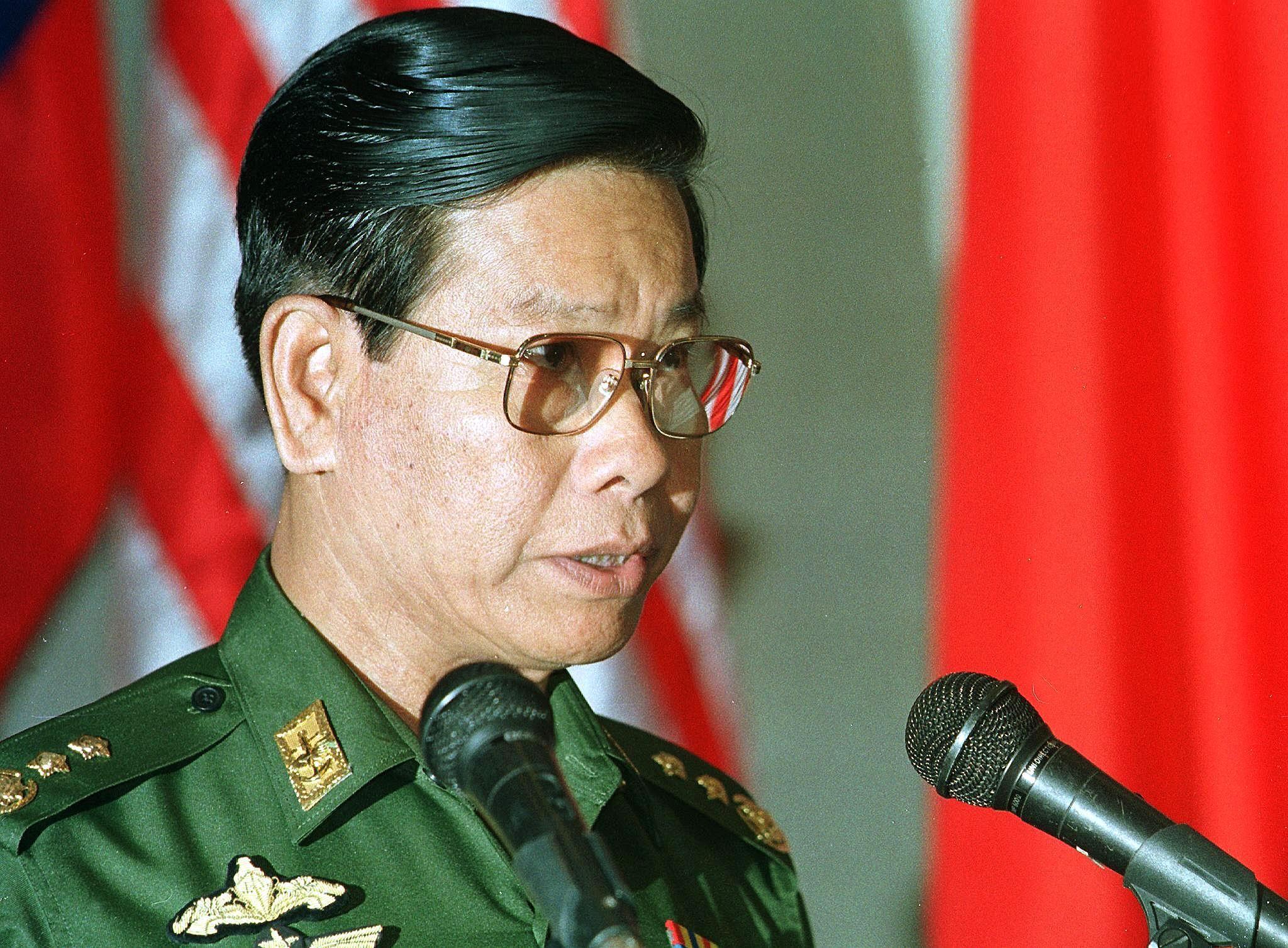
Why This Memory Matters to Rohingya
For Rohingya who preserve this account, its importance lies in the contrast between personal familiarity and later state policy. Khin Nyunt is remembered not as an official who had never encountered Rohingya society, but as someone who had lived in their region, interacted closely with a Rohingya household and acquired direct familiarity with local life before attaining national power. His later prominence within a government that increasingly represented Rohingya as outsiders consequently carries particular significance in Rohingya collective memory.
Historical documentation should not convert this contrast into speculation about Khin Nyunt's private emotions or claim without evidence that personal affection changed into personal hatred. His internal motives cannot be reconstructed reliably. What can be investigated are his political statements, the institutions he commanded and the policies implemented during his period of authority. Those provide a firmer basis for assessing his place in Rohingya history than attempting to determine his private feelings.
The 1988 Uprising and the Creation of SLORC
Burma entered a profound political crisis in 1988 as nationwide demonstrations challenged the authoritarian political system established under Ne Win and demanded democratic government. After months of unrest and violent suppression, the military seized direct control on 18 September 1988 and established the State Law and Order Restoration Council (SLORC). The new junta claimed that its immediate objectives were to restore order and eventually hold multiparty elections.
Khin Nyunt immediately emerged as one of the important figures in the new regime. He became Secretary-1 of SLORC while retaining leadership of Military Intelligence. The combination gave him unusual political influence: Secretary-1 placed him near the centre of the junta's decision-making structure, while command of intelligence connected him to the institutions monitoring opposition movements, ethnic politics and security conditions throughout the country. From this point onward, his career became inseparable from the political and security system created after the 1988 military takeover.
The Promise of Elections
Soon after SLORC assumed power, Khin Nyunt publicly addressed the question of Burma's political future. Speaking to foreign military attachés in September 1988, he presented the junta as an authority that would restore law and order, organize multiparty elections and eventually transfer power to the victorious party. This promise became particularly significant because an election was indeed subsequently held, but the result did not produce the expected transfer of government.
The military continued consolidating its authority while opposition politicians faced arrest, surveillance and restrictions. Military Intelligence became one of the institutions central to this political environment. The widening gap between the junta's declared temporary role and its continued exercise of power would become one of the defining features of Burma's post-1988 political order.
Aung San Suu Kyi and the 1990 Election
Aung San Suu Kyi emerged as the most prominent leader of the democratic opposition and became General Secretary of the National League for Democracy (NLD). The authorities placed her under house arrest in July 1989, preventing her from campaigning freely before the election. Nevertheless, the nationwide multiparty election went ahead on 27 May 1990, and the NLD won an overwhelming majority of the contested parliamentary seats.
The election therefore represented a decisive electoral rejection of continued military government, but SLORC did not transfer state power to the NLD. The junta remained in control while elected opposition representatives faced increasing pressure. Khin Nyunt consequently continued exercising authority as Secretary-1 and intelligence chief despite an election result overwhelmingly favouring the opposition, and Military Intelligence remained deeply involved in surveillance and suppression of political activity.
The Constitution Before Transfer of Power
Khin Nyunt also played an important public role in reshaping the military government's response to the 1990 election result. After the National League for Democracy won an overwhelming victory, SLORC did not treat the election as requiring an immediate transfer of executive power. Instead, the regime advanced the position that drafting a new constitution had to precede the formation of a new government. Khin Nyunt publicly defended this approach, arguing that the elected representatives' immediate task was connected to constitution-making rather than simply assuming state power.
This fundamentally changed the meaning of the election. What had been presented in 1988 as an election followed by transfer of power became a prolonged constitutional process controlled by the military authorities. SLORC's Declaration No. 1/90 of 27 July 1990 formalized the position that the elected representatives were responsible for drawing up a constitution and that SLORC would continue exercising state power in the meantime. The promised transfer consequently did not occur following the NLD's electoral victory. The constitutional question became one of the principal mechanisms through which military rule was prolonged despite the election result.
This episode is important when assessing Khin Nyunt's political method. His influence was exercised not only through Military Intelligence and security administration but also through the political and legal framing used to preserve military authority. The insistence that constitutional arrangements had to be settled before power could be transferred helped transform the 1990 election from an anticipated transition of government into the beginning of a prolonged military-controlled constitutional process.
Rohingya Participation in the 1990 Election
The election also occupies an important place in Rohingya political history because Rohingya participation had not yet been eliminated. Members of the community voted and Rohingya political candidates participated despite the increasing insecurity created by the 1982 citizenship framework. This reveals the gradual character of exclusion: different rights disappeared at different times rather than through one instantaneous removal of all political and legal status.
The contradiction is historically important. Rohingya could still participate in national electoral politics while the state increasingly questioned their citizenship and ethnic belonging. The military's refusal to transfer power after the election also meant that policy in Arakan remained under the control of the same military establishment in which Khin Nyunt held a central security and political position.
Growing Military Pressure in Northern Arakan
While Burma's national political crisis unfolded, conditions in northern Arakan were deteriorating. Near-contemporary research later made available through UNHCR's Refworld reported that serious abuses against Muslims in Arakan intensified from around late 1989. Reports described resettlement policies reaching Akyab and forced resettlement occurring in Maungdaw and Buthidaung by 1990, while refugees subsequently described confiscation of Muslim-owned land, destruction of settlements and movement of non-Muslim populations into northern areas.
The military presence also expanded sharply. Contemporary research reported that by August 1991 troop strength in Maungdaw and Buthidaung had increased substantially compared with the previous year and that additional military infrastructure had appeared along the frontier. Northern Arakan was increasingly being approached not simply as a civilian region inhabited by established communities but as a sensitive security and border zone.
The 1991–1992 Rohingya Exodus
The mounting pressure culminated in another enormous Rohingya refugee crisis. During 1991–1992, approximately a quarter of a million Rohingya fled from northern Arakan into Bangladesh. Contemporary and later human-rights investigations documented reports of forced labour, arbitrary arrest, physical abuse, rape, land and property confiscation and other violations associated with the military and security presence in the region.
The exodus became one of the largest Rohingya displacements since 1978. Families crossed the Naf River leaving homes, agricultural land, livestock and other property behind. The scale of the movement demonstrated that the political transformation after 1988 had consequences extending far beyond Rangoon: northern Arakan was experiencing its own profound transformation under expanding military authority.
SLORC's Explanation of the Exodus
The military government rejected the interpretation that the refugee crisis resulted principally from persecution. SLORC officials portrayed many of those crossing into Bangladesh as illegal immigrants or people whose real country of origin was Bangladesh. Government explanations also invoked immigration scrutiny, border security and Rohingya armed activity when justifying the increased military presence in Maungdaw and Buthidaung.
This official framing was consequential because it changed the political meaning of the crisis. If Rohingya were understood as an established population of Burma, the flight of approximately a quarter of a million people raised the question of why inhabitants of the country were being driven from their homes. If they were instead portrayed as illegal immigrants from Bangladesh, the same movement could be represented as an immigration or border-security problem rather than the displacement of a persecuted community.
From an Ethnic Community to a Security Population
The transformation of the Rohingya question into a security issue became one of the defining developments of Khin Nyunt's era. Questions of identity, citizenship and historical belonging became increasingly intertwined with immigration, insurgency, border control and demographic anxiety. Khin Nyunt's position as intelligence chief placed him within precisely the section of the state responsible for interpreting political and ethnic questions through the language of national security.
This transformation would have profound consequences. Once a population was regarded primarily as a border and immigration problem, exceptional controls could be justified as security measures. The state could subject people born inside Burma to repeated scrutiny of residence and identity while treating the region in which they lived as a frontier requiring extraordinary surveillance.
The Emergence of a New Administrative Order
International pressure eventually led Burma and Bangladesh into negotiations over Rohingya repatriation, but the return of refugees did not restore the political situation that had existed before the exodus. Inside northern Arakan, the military government was developing a much more intensive administrative system combining military, immigration, police and intelligence authority. The region would soon become subject to a form of border administration that penetrated deeply into ordinary Rohingya life.
NaSaKa, Militarisation and the Transformation of Northern Arakan
The new administrative order that emerged after the 1991–1992 refugee crisis transformed the relationship between Rohingya communities and the state. Northern Arakan was increasingly governed through an exceptional combination of military, immigration, police and intelligence authority. Instead of security administration remaining concentrated at the international frontier, it reached into villages, households, agricultural land and ordinary family life. The most important institutional expression of this system was the border-security administration widely known as NaSaKa.
The Establishment of NaSaKa
NaSaKa was established in 1992 as a multi-agency border-security force operating particularly in Maungdaw and Buthidaung. It brought together personnel from agencies including immigration, police, customs, Military Intelligence and the armed forces. Its official purpose centred on border security and immigration control, but its practical authority extended much further into the civilian lives of Rohingya inhabitants.
NaSaKa maintained checkpoints, conducted population and household inspections, monitored movement and participated in the administration of marriage and residence. Its local sector structure gave security personnel direct and recurring contact with villages. For Rohingya, the result was that border administration ceased to mean only control of people crossing between Burma and Bangladesh. Families who had never crossed an international border could themselves be subjected to continual immigration-style scrutiny within their own townships.
The Expansion of Military and Security Installations
The new security system required an extensive physical presence. Military and NaSaKa camps, checkpoints, roads, sentry posts and administrative installations expanded across northern Arakan. This altered the geography of Maungdaw and Buthidaung by placing armed institutions close to Rohingya villages and agricultural areas.
The International Labour Organization's Commission of Inquiry later collected detailed testimony from northern Arakan concerning how this infrastructure was constructed and maintained. Witnesses described villagers being ordered to build and repair camps, roads and other facilities, transport materials, perform portering and undertake sentry duties. These accounts provide unusually strong independent evidence because they were gathered through an international investigation into forced labour rather than solely through Rohingya political organizations.
Rohingya Labour Built the Security System
One Maungdaw witness told the ILO that forced labour had existed previously but increased substantially after SLORC took power. His village was reportedly required to provide approximately 200 labourers at a time for work connected with NaSaKa camps. Other testimony described recurring demands to carry bamboo, timber and other materials, construct military facilities and maintain infrastructure.
The economic consequences extended beyond the hours spent at the work site. Agricultural families depended upon seasonal labour for planting and harvesting. A farmer summoned for unpaid work could lose time needed for his own fields, while workers could be required to bring their own food. Families unable to supply labour could face pressure to provide substitutes or money. The system consequently extracted both labour and household resources from communities already experiencing severe economic insecurity.
Military Demands on Villages
Rohingya community testimony from the same period describes soldiers and security personnel demanding rice, chickens, vegetables, firewood, livestock, building materials and other supplies from villages. Human-rights investigations independently documented extortion and uncompensated demands by military and security authorities, supporting the broader pattern even where every individual village account cannot now be reconstructed.
The important historical point is not that every military unit behaved identically. It is that Rohingya villagers possessed very limited practical ability to refuse demands made by armed officials. Their insecure legal position, restricted movement and weak access to effective complaint mechanisms created an enormous imbalance of power between local communities and the security apparatus stationed among them.
Land Confiscation for the Expanding State
Militarisation also consumed land. Human Rights Watch documented Rohingya land being confiscated for military barracks, roads, state projects, commercial activities and new settlements. Compensation was frequently absent, and affected families had few effective mechanisms through which to challenge confiscation.
For an agricultural household, losing land meant losing far more than property on paper. Fields produced food and income and represented resources that could be transferred to children. A family deprived of productive land could be transformed from independent cultivators into tenants or daily labourers. Land confiscation therefore changed both household economics and the longer-term relationship between Rohingya communities and their territory.
The Model-Village Programme
One of the most consequential territorial policies was the establishment and expansion of model villages, later commonly associated with the NaTaLa border-development programme. Human Rights Watch documented the programme operating in Maungdaw and Buthidaung from 1988, with its expansion continuing through the following decade.
The settlements were intended predominantly for Buddhist populations, while Rohingya Muslims were excluded from receiving comparable settlement benefits. Incoming families could receive houses, agricultural land and state assistance. In documented cases, land allocated to the new settlements had been confiscated from Rohingya communities without compensation.
The significance of the programme therefore extended beyond ordinary rural development. The state was determining which populations would receive official assistance to establish permanent settlements in a region where the existing Rohingya population was simultaneously being subjected to extraordinary immigration and security controls.
Rakhine Settlers From Different Areas
Settlers were brought from different parts of Burma, and Human Rights Watch also documented Rakhine families arriving from Bangladesh and being settled in northern Arakan. This detail is especially significant because it exposes a contradiction within the state's immigration narrative.
Rohingya born and raised in Maungdaw or Buthidaung could be treated as people whose legitimate national connection lay in Bangladesh, while Rakhines arriving from Bangladesh could receive official assistance to settle in the same region. The determining factor was therefore not simply whether an individual had crossed an international frontier. Ethnic recognition and the state's conception of national belonging played a central role in determining whose settlement was considered legitimate.
Rohingya Forced to Construct Model Villages
The model-village programme imposed another burden upon neighbouring Rohingya communities. Human Rights Watch documented cases in which Rohingya were ordered to provide unpaid labour and construction materials for houses intended for incoming settlers.
In a documented Maungdaw example from 1999, Rohingya village tracts were required to construct houses for a model village. Workers collected timber, prepared boards and completed substantial construction without normal compensation. Communities therefore could lose land to a settlement programme and then be required to provide the labour needed to establish that settlement.
This combination of dispossession and forced labour made the model-village system particularly significant in Rohingya historical memory. It affected not only ownership of territory but also who possessed state support to establish a permanent future upon that territory.
The 1999 Buthidaung Land Confiscation
Human Rights Watch documented a particularly clear example in Buthidaung in 1999, where approximately 250 acres, including prime agricultural land, were confiscated from nearby Rohingya villagers for a model village. The affected villagers subsequently experienced difficulty obtaining sufficient food.
The case demonstrates the direct connection between territorial policy and livelihood. Agricultural land produced the food upon which families depended, so confiscation could create immediate subsistence problems rather than merely reduce long-term wealth. The Buthidaung example is therefore important because it provides a documented local case showing how demographic settlement policy could materially weaken surrounding Rohingya communities.
Rathedaung and the Wider Settlement Programme
Settlement and forced-labour policies also affected Rathedaung. Later documentation records Rohingya villagers there being required to carry materials for model villages. Rathedaung's geographical position made these developments particularly important because the township lay between the overwhelmingly Rohingya areas farther north and more heavily Rakhine-populated regions to the south.
Rohingya community interpretation has long described model villages as an attempt to alter the demographic composition and territorial continuity of northern Arakan. The documented evidence establishes specific settlement programmes, land confiscations and forced-labour demands. Claims about a single secret master plan covering every settlement should be distinguished from these established facts unless documentary evidence of such a plan is located.
Pagodas on the Northern Arakan Landscape
Rohingya oral history places considerable emphasis on the construction of Buddhist pagodas and shrines on prominent hills and other visible locations in Maungdaw, Buthidaung and Rathedaung during the military period. Community memory interprets these projects as part of a symbolic transformation of predominantly Muslim areas and associates them with the wider settlement and development policies of the military government.
Independent reporting supports an important part of this history: Rohingya were documented performing forced labour connected with Buddhist pagodas and other Buddhist projects. What has not yet been established through reliable documentary evidence is the more specific allegation that Khin Nyunt personally issued a general instruction requiring pagodas to be constructed on every important mountain or strategic hill in the three townships. Rohipedia should therefore document the forced labour and construction where sources support them while preserving the broader interpretation as Rohingya oral/community history.
Religious Construction and Unequal State Power
The issue was not the existence of Buddhist religious monuments. Buddhism has a centuries-old history in Arakan, and Buddhist archaeological and religious sites form an important part of the region's heritage. The discriminatory issue arose when state authority, confiscated resources or coerced Rohingya labour were used for religious or settlement projects while Rohingya communities themselves faced restrictions affecting their own institutions.
For Rohingya living in overwhelmingly Muslim localities, highly visible state-supported Buddhist construction could consequently acquire a territorial meaning beyond religion. Community testimony interpreted it as an assertion of which population the state regarded as the legitimate owner of the landscape. This interpretation belongs within Rohingya historical memory even where the intent behind individual pagodas cannot be independently reconstructed.
Fishing, Prawn Ponds and Economic Resources
Agriculture was only one part of the northern Arakan economy. Fishing, shrimp and prawn cultivation, ponds, rivers and coastal resources provided livelihoods for many Rohingya families. Human Rights Watch documented military involvement in commercially valuable prawn farming and cases in which Rohingya were forcibly relocated or lost access to land connected with these enterprises.
This evidence supports the broader Rohingya recollection that military economic expansion reduced community control over fisheries and aquaculture. The more specific claim that fishing ponds across Maungdaw were formally “nationalized” under a personal order from Khin Nyunt has not yet been established by the sources located for this article. A more accurate formulation is that military and state authorities confiscated, appropriated or assumed control over economically valuable land and aquaculture resources, contributing to the loss of Rohingya livelihoods.
From Independent Producers to Economic Dependence
The combined effects of confiscation and coercive labour could fundamentally change a family's economic position. A farmer who lost agricultural land could become a tenant or wage labourer. A household losing access to fishing resources lost another source of food and income. Repeated forced-labour demands removed working time from family production, while uncompensated demands for materials or food consumed resources that might otherwise have supported the household.
These pressures could reinforce one another. A family losing land became more dependent upon wages; movement restrictions could reduce access to alternative employment; forced labour could then take away days that might otherwise have been used to earn those wages. The result was not simply poverty in the general sense but a progressive reduction in economic independence.
Border Militarisation
Military and security posts expanded along the Bangladesh frontier and throughout Maungdaw and Buthidaung. From the government's perspective, this infrastructure served immigration control, counter-insurgency and border security. For Rohingya communities, it meant that armed institutions became an increasingly permanent presence beside villages, roads, fields and markets.
Checkpoints affected movement between communities. Security camps required land and labour. Soldiers and NaSaKa personnel interacted continually with civilians. The international border consequently extended administratively into everyday Rohingya life: people who had never crossed into Bangladesh could still find their movement, residence and identity regulated through institutions designed around border control.
Khin Nyunt's Visits and Rohingya Community Memory
Rohingya community memory strongly associates Khin Nyunt with repeated visits to Maungdaw, Buthidaung and other areas of Arakan during his years at the centre of government. Such visits would be consistent with his senior role in security and border-area affairs, but individual meetings and statements require specific evidence before they can be presented as established facts.
Community accounts further allege that during some visits Khin Nyunt met separately with Rakhine leaders and encouraged policies aimed at reducing or removing the Rohingya presence. I have not located reliable minutes, speeches or independent documentation establishing that he explicitly instructed Rakhine audiences to “cleanse” Rohingya. Rohipedia should preserve such accounts as Rohingya testimony where identifiable witnesses can be recorded, rather than place undocumented words inside Khin Nyunt's mouth.
His Documented Position on Rohingya Belonging
There is no need to depend solely upon unverified private statements to understand Khin Nyunt's political position because a significant part of it appears in the documentary record. In correspondence with UNHCR High Commissioner Sadako Ogata in February 1998, Khin Nyunt advanced the government's position that the Rohingya population was not originally from Myanmar and connected the demographic composition of Maungdaw and Buthidaung to migration from outside the country.
This statement matters particularly when considered beside the territorial policies already documented. The government was treating the Rohingya population through an immigration-security framework while confiscating Rohingya land and supporting settlements for populations it recognized as legitimately belonging to Myanmar. Khin Nyunt's documented demographic argument therefore provides important evidence of the political thinking through which such policies could be rationalized.
Demographic Policy Without a Single Written Master Plan
The documentary record does not require the existence of one discovered secret directive labelled as a programme to transform northern Arakan. The territorial effects can be examined through documented policies themselves: model villages were established; Rohingya land was confiscated; incoming Buddhist settlers received land and houses; Rohingya labour helped construct settlements; military installations expanded; and the government publicly represented the existing Rohingya majority as the consequence of immigration.
Taken together, these developments changed the balance of power over land and settlement. Whether every individual policy was designed for precisely the same purpose requires separate evidence, but their cumulative effect was to weaken Rohingya territorial and economic security while strengthening the physical presence of populations and institutions recognized by the state.
An Administrative System Reaching Into the Household
The territorial transformation occurred alongside increasingly detailed regulation of Rohingya civilian life. NaSaKa's authority extended from checkpoints and border sectors into household registration, movement and family administration. The state acquired extensive information about where Rohingya lived, who belonged to particular households and whether individuals were physically present during inspections.
This level of surveillance gave officials extraordinary influence over ordinary existence. A discrepancy in household records could have serious consequences, while permission systems made routine activities dependent upon administrative approval. The effect was to transform citizenship insecurity into a daily relationship with local security institutions.
A Region Governed Through Exception
By the end of the 1990s, northern Arakan had developed characteristics of an exceptional administrative zone. Rohingya faced forms of immigration scrutiny, movement control, forced labour and demographic intervention that distinguished their experience from that of much of the country's population.
The system did not require constant spectacular violence to exert pressure. Its power came partly from repetition: another checkpoint, another labour demand, another household inspection, another permit, another confiscation and another interaction with an official possessing broad discretionary authority. Persecution could therefore operate continuously through administrative routines rather than only through identifiable military campaigns.
The Material Transformation of Northern Arakan
By the beginning of the twenty-first century, the physical consequences of these policies were visible. Security installations had expanded, model villages had been established, Rohingya agricultural land had been confiscated, forced labour had supported state projects and military-linked economic activities had affected access to productive resources. The Rohingya population remained numerically dominant in much of Maungdaw and Buthidaung, but its ability to determine the conditions under which it lived there had been progressively weakened.
The transformation of northern Arakan from a Rohingya homeland already affected by citizenship exclusion into a heavily controlled security zone in which the state exercised growing authority over territory, settlement, labour and livelihood. Part 3 will not repeat these policies. It will examine only Khin Nyunt's later political career, the evidence relevant to assessing his individual and institutional responsibility, his fall from power in 2004, the survival of the system after his removal, and his place in the longer Rohingya genocide history.
Khin Nyunt's Responsibility, Fall From Power and Historical Legacy
By the beginning of the twenty-first century, the system described in the preceding parts had become deeply embedded in northern Arakan. The historical question therefore shifts from describing that system to assessing Khin Nyunt's relationship to it. This requires distinguishing carefully between policies implemented by institutions of the military government, actions directly attributable to Khin Nyunt, Rohingya testimony concerning his activities, and conclusions that can reasonably be drawn from his position at the highest levels of the security establishment.
Khin Nyunt's importance cannot be reduced to whether his signature survives on individual local orders. As Military Intelligence chief and Secretary-1, he possessed exceptional institutional authority, but institutional authority is not automatically proof that he personally ordered every abuse committed by subordinate agencies. The strongest assessment must therefore begin with what can be connected directly to him and then consider what his leadership position means for the wider system.
The 1998 Statement as Direct Evidence
One of the most important pieces of evidence concerning Khin Nyunt personally is his February 1998 correspondence with UNHCR High Commissioner Sadako Ogata. Unlike allegations about private meetings, this provides documentary evidence of how he publicly framed the Rohingya question at a senior governmental level.
Khin Nyunt advanced the position that the population identified as Rohingya was not originally from Myanmar and explained the Muslim demographic predominance of Maungdaw and Buthidaung through migration from outside the country. The significance of the statement lies not merely in terminology but in its political implications. A population represented as historically foreign could be governed through immigration and security measures that would be much harder to justify if the same population were accepted as an established ethnic community belonging to the country.
This is therefore the strongest direct connection between Khin Nyunt personally and the ideological framework underlying Rohingya exclusion. It demonstrates that he was not simply an intelligence administrator implementing policies while remaining neutral about Rohingya belonging. He personally communicated the state's exclusionary interpretation to an international institution.
From SLORC to SPDC
In November 1997, the military government reorganized SLORC as the State Peace and Development Council (SPDC). The change altered the junta's formal name but did not remove Khin Nyunt from the centre of power. He continued as Secretary-1 and remained head of Military Intelligence, preserving his influence over security affairs.
For Rohingya, the institutional change produced no comparable transformation in legal status. The 1982 citizenship framework remained intact, and the security system established during the preceding years continued. The significance of the SLORC-to-SPDC transition is therefore political rather than substantive for this history: the government reconstituted itself while the underlying approach to Rohingya belonging remained unresolved.
Khin Nyunt as an International Interlocutor
Khin Nyunt increasingly developed a public image different from that of some other senior generals. He dealt extensively with foreign governments and international organizations and became associated with negotiations involving ethnic armed organizations. Internationally, he was sometimes regarded as comparatively pragmatic within an otherwise highly authoritarian military leadership.
That reputation requires careful treatment in Rohingya history. Political pragmatism in negotiations with some groups did not necessarily translate into recognition of Rohingya rights. His own documented position concerning Rohingya national belonging remained consistent with the government's foreigner narrative, even as he communicated with UNHCR and other international actors concerning refugee and humanitarian issues.
This produced an important contradiction. A senior official could engage in international diplomacy concerning displaced Rohingya while simultaneously defending the political premise that weakened their claim to membership in Myanmar.
Repatriation and the Unresolved Citizenship Question
Large numbers of Rohingya who had fled during the 1991–1992 crisis were eventually repatriated from Bangladesh under international arrangements. Their physical return, however, did not settle the central political question of citizenship. The government did not restore Rohingya collectively to a secure and equal citizenship position, and the state's interpretation of their historical belonging remained unchanged.
This distinction between return and recognition is important to assessing Khin Nyunt's international role. The government could participate in repatriation arrangements while leaving intact the political framework that treated Rohingya as a population requiring verification. Refugees could therefore return geographically without the state resolving whether they belonged politically and legally as Rohingya. The unresolved citizenship question meant that repatriation could address displacement without removing the structural insecurity underlying it.
The “Roadmap to Democracy”
Khin Nyunt's national political profile increased further in August 2003, when he became prime minister. Soon afterward he became closely associated with the military government's seven-step “Roadmap to Democracy,” presented as a process leading eventually toward a new constitution and elected government.
For Rohingya, however, the proposed national transition did not produce a corresponding restoration of collective recognition or secure citizenship. The political roadmap addressed the structure of national government while leaving the underlying citizenship regime intact. This illustrates another important feature of Rohingya exclusion: democratization at the national level did not automatically answer the question of who would be recognized as belonging to the political community.
Khin Nyunt's elevation to prime minister therefore represented the peak of his formal political career but not a fundamental change in the state's position toward Rohingya.
The Limits of the “Moderate” Image
Descriptions of Khin Nyunt as a moderate or pragmatist should consequently be understood comparatively rather than absolutely. Such labels generally referred to internal differences among Myanmar's generals, his support for negotiations with some ethnic armed groups and his willingness to engage diplomatically with foreign actors.
They do not erase his leadership of Military Intelligence or his participation at the highest level of an authoritarian government responsible for extensive political repression. Nor do they alter his documented position concerning Rohingya origins and belonging.
For Rohingya history, assessing him solely through the moderate-versus-hardliner framework risks obscuring the more important question: what happened to Rohingya under the political and security system in which he exercised power?
Fragmentation as a Method of Military Rule
Khin Nyunt's approach to ethnic politics elsewhere in Myanmar provides important context for interpreting Rohingya concerns about communal division in Arakan. Academic research identifies Khin Nyunt and Military Intelligence as principal architects of the ceasefire system developed after 1989. Rather than negotiating an inclusive political settlement with Burma's ethnic nationalities collectively, Military Intelligence negotiated separately with individual armed organizations. Groups could retain weapons and territorial influence, while their leaders were often permitted access to commercial opportunities. The immediate result was a reduction in armed resistance in some regions, but the agreements frequently froze or deepened divisions rather than resolving the political causes of conflict.
The Karen experience demonstrates how this method could operate when an ethnic movement divided internally. In 1994, longstanding grievances among Buddhist members of the predominantly Christian-led Karen National Union contributed to the creation of the Democratic Karen Buddhist Army. The split had genuine internal causes and should not be described simply as something invented by Khin Nyunt. SLORC nevertheless exploited the division rapidly, providing assistance to the DKBA as it turned against its former KNU allies. Khin Nyunt publicly acknowledged military support for the new force, and the division contributed to the fall of the KNU headquarters at Manerplaw in 1995.
The treatment of Shan forces reveals another dimension of the same pragmatic security strategy. Khin Nyunt's Military Intelligence negotiated separate ceasefires with numerous armed organizations in Shan State while isolating remaining opponents. When drug warlord Khun Sa and his Mong Tai Army finally surrendered in January 1996, Khin Nyunt was among the senior officials who went to Ho Mong to complete the agreement. Khun Sa was subsequently permitted to live under government protection in Yangon rather than being extradited to the United States, which sought him on drug-trafficking charges. The episode demonstrated that the military government could accommodate even a former armed adversary when his surrender served a wider strategic purpose.
This broader record gives particular significance to Rohingya memories of the 1988 democracy uprising in Arakan. Rohingya historian Dr. Mohammed Yunus records an exceptional period of Muslim-Buddhist solidarity during the uprising. In Akyab and in the northern towns of Maungdaw, Buthidaung and Rathedaung, Muslims and Rakhine Buddhists participated together in demonstrations against military rule. Buddhist monks and Muslim ulema joined the movement, while religious and communal differences that had divided the population were temporarily subordinated to the shared demand for political change.
From a Rohingya historical perspective, this moment demonstrated something potentially threatening to authoritarian rule: communal division was not inevitable. Rakhine Buddhists and Rohingya Muslims could cooperate politically when confronting a common system of military domination. Some Rohingya accounts consequently interpret the renewed communal polarization of the following years as advantageous to the military government, which faced far less danger from communities divided against one another than from communities mobilizing together against military rule.
The available documentary record does not presently establish that Khin Nyunt personally witnessed this solidarity and then issued a policy ordering officials to divide Rohingya and Rakhine communities. That stronger claim should remain identified as Rohingya interpretation or oral testimony unless additional evidence emerges. His documented political record elsewhere, however, demonstrates that fragmentation, separate negotiation and the exploitation of existing internal divisions were important instruments of the security strategy associated with Military Intelligence.
This distinction is essential. The military did not need to manufacture every ethnic, religious or political disagreement from nothing. Existing grievances could be encouraged, exploited or incorporated into a political system in which divided communities were easier to manage than a unified opposition. The Karen experience provides a particularly clear documented example of SLORC benefiting from and supporting an internal division; the ceasefire system demonstrates Khin Nyunt's preference for dealing separately with ethnic organizations rather than through an inclusive political settlement.
For Rohingya historical analysis, the relevance lies in asking how this broader method of rule interacted with Arakan's existing communal tensions. The remarkable solidarity of 1988 showed that Rohingya Muslims and Rakhine Buddhists were capable of setting aside historical grievances. The subsequent decades moved in the opposite direction, as ethnic nationalism, competing historical narratives, demographic fears and state policies increasingly separated the two communities.
Establishing precisely how that transformation occurred requires evidence beyond Khin Nyunt alone. Rakhine nationalist intellectuals, political organizations, Buddhist networks, military authorities and later electoral politics would all contribute to the changing environment. The emergence of influential anti-Rohingya historical narratives should therefore be examined separately rather than attributed entirely to Military Intelligence.
What Khin Nyunt's broader record establishes is more limited but still important: his security strategy repeatedly sought to neutralize collective opposition through separate arrangements, selective accommodation and exploitation of existing divisions. That documented pattern provides legitimate historical context for Rohingya interpretations of how military rule benefited from the breakdown of the Muslim-Buddhist political solidarity briefly visible in Arakan during the 1988 uprising.
Khun Sa, Narcotics Wealth and the Sanctions-Era Political Economy
The surrender of Khun Sa also raised a larger question about the relationship between narcotics wealth, military power and Myanmar's formal economy. Khun Sa had commanded one of the world's largest heroin-producing and trafficking organizations, yet his 1996 surrender did not lead to his extradition to the United States. He was permitted to live in Yangon under government protection, while business interests associated with his family subsequently entered sectors of the legal economy. For critics of the military government, the arrangement became an important example of how former armed and illicit economic networks could be accommodated when they ceased challenging the authority of the state.
During the same period, Myanmar's economy operated under increasing international isolation and sanctions, while researchers and international narcotics agencies repeatedly raised concerns about proceeds from the drug economy being laundered through legitimate businesses and financial institutions. Wealth accumulated in borderland narcotics economies could be converted into property, construction, hotels, transport, trading companies and other apparently legitimate investments. This blurred the boundary between illicit frontier economies and the formal economy controlled or tolerated by military authorities and their business partners.
Rohingya and other opponents of military rule consequently developed a broader interpretation of this relationship: that the military government was willing to accommodate powerful narcotics figures and absorb or tolerate wealth generated through illicit trade while using the resulting political and economic stability to sustain an authoritarian state under international pressure. In this interpretation, Khun Sa's surrender represented not the destruction of the narcotics economy but the incorporation of important former adversaries and their economic networks into a system that no longer threatened military rule.
Claims concerning individual banks require particular caution. Myanmar's expanding private banking and business sector operated within this sanctions-era political economy, and allegations concerning the laundering of narcotics proceeds circulated widely. However, the presently available evidence does not justify stating as established fact that KBZ Bank was founded primarily with Khun Sa's drug wealth. Such a claim should only be made if financial records, credible investigations or other direct evidence establish the connection.
The historically supportable conclusion is broader: Khin Nyunt's accommodation of Khun Sa illustrates a security strategy in which a former armed narcotics leader could be neutralized politically without the military government dismantling all of the economic networks and accumulated wealth associated with the borderland drug economy. For many Rohingya and other opponents of military rule, this reinforced the perception that the regime treated political loyalty and opposition differently from legality itself—those who ceased challenging military authority could be accommodated, while communities and political movements considered threats to military control remained subject to coercion and repression.
His Removal in October 2004
Khin Nyunt's rise ended abruptly in October 2004. He was removed as prime minister and placed under arrest amid an internal struggle within the military leadership. The powerful Military Intelligence organization associated with him was subsequently dismantled, and large numbers of intelligence personnel were removed or arrested.
He was later tried and convicted on corruption-related charges and spent years under house arrest. His fall demonstrated the factional character of Myanmar's military politics: a man who had accumulated enormous influence through intelligence and government could rapidly lose power when the balance within the armed forces shifted against him.
For Rohingya history, however, the most significant fact about his removal is what did not happen afterward. The fundamental system of Rohingya exclusion did not collapse with Khin Nyunt.
The System Continued Without Him
Khin Nyunt's departure provides an important test of how deeply institutionalized Rohingya persecution had become. If the system had been primarily his personal project, his removal might have produced a major reversal. Instead, many of its essential features continued under other military leaders.
Citizenship exclusion remained in place. Exceptional restrictions affecting Rohingya continued. NaSaKa survived until 2013. The 2006 closure and destruction of Rohingya religious institutions documented elsewhere in this chronology occurred after Khin Nyunt had already been removed. Later communal violence and increasingly severe persecution also developed without him in government.
This continuity demonstrates that the system had become institutional rather than dependent upon a single individual. Khin Nyunt's role was important, but the persecution of Rohingya cannot be explained as his personal project alone.
What Can Be Attributed Directly to Khin Nyunt
A responsible historical assessment should therefore identify direct evidence separately from institutional context. Khin Nyunt can be directly associated with leadership of Military Intelligence, his senior SLORC/SPDC positions, his later premiership and his documented public defence of the government's interpretation of Rohingya as a population originating outside Myanmar.
Those facts establish substantial political responsibility for the government's approach to the Rohingya question. They also demonstrate that he personally endorsed an ideological premise central to exclusion: the denial of Rohingya historical belonging.
Where surviving documentation links him directly to additional policy decisions, those can be added to Rohipedia as the evidence develops. The article does not need to assign unsupported orders to him in order to establish that his documented role was historically significant.
What Remains Rohingya Testimony
Other elements belong to a different evidentiary category. The account of his earlier relationship with Hla Maung's family, memories of his visits to northern Arakan, allegations concerning private meetings with Rakhine leaders and claims about instructions given during those meetings should be preserved as Rohingya testimony where witnesses can be identified.
Such testimony should not be discarded merely because official documents have not been found. Authoritarian governments rarely create accessible records of every local meeting or verbal instruction, and oral testimony is an important historical source. But Rohipedia should tell readers when a statement comes from community memory rather than documentary corroboration. This method allows Rohingya voices to remain central without blurring the distinction between testimony and independently established fact.
Building a Rohingya Oral-History Record
The Hla Maung account provides an opportunity for Rohipedia to develop a more systematic oral-history archive. If surviving family members, neighbours or contemporaries can be identified, their testimony could be recorded with the witness's name, relationship to the events, approximate date, village or locality and explanation of whether the witness personally observed the event or learned it from another person.
The same method could be applied to accounts concerning Khin Nyunt's visits, meetings, pagoda projects, confiscations and military behaviour. Several independent witnesses remembering the same event would substantially strengthen the historical record, particularly if their testimony could be compared with contemporary maps, government documents or international reports. Rohipedia would then preserve evidence that might otherwise disappear with the generation that experienced the period directly.
Personal Motive Cannot Be Reliably Reconstructed
The available evidence does not establish when or whether Khin Nyunt developed personal hatred toward Rohingya. Historical research should therefore avoid presenting an internal emotional transformation as fact. Political conduct is more securely documented than private psychology.
This limitation does not reduce the seriousness of his documented role. A senior official does not need to express personal hatred for his political actions or institutional leadership to contribute to discriminatory persecution. The historically relevant questions concern what ideas he publicly advanced, what authority he exercised, what institutions operated under the government he helped lead and what consequences those institutions produced. Focusing on those questions gives the article a stronger evidentiary foundation.
Institutional Responsibility
Khin Nyunt's responsibility is therefore best understood partly as institutional responsibility. He occupied senior authority within a military government whose security institutions exercised extensive control over Rohingya. His intelligence leadership placed him within the architecture through which ethnic, political and border-security questions were monitored and administered.
Institutional responsibility should not be confused with proof of personal criminal liability for every act committed by subordinates. Establishing individual criminal responsibility would require evidence satisfying a different legal standard concerning orders, knowledge, control and specific crimes.
Rohipedia's purpose here is historical documentation. At that level, Khin Nyunt's position at the centre of the security establishment and his own statements concerning Rohingya belonging are indispensable to understanding the period.
The Rohingya Concept of a “Slow Genocide”
Rohingya writers and advocates have frequently described the decades preceding the mass atrocities of 2016–2017 using terms such as “slow genocide” or “slow-burning genocide.” The concept emphasizes a cumulative process in which a community is progressively weakened before destruction reaches the scale associated with later military campaigns.
Khin Nyunt's era occupies an important position within this Rohingya interpretation. It falls between the earlier legal exclusion established under Ne Win and the later episodes of mass violence. During these intervening years, discriminatory citizenship was accompanied by increasingly intensive security administration and restrictions affecting the conditions under which Rohingya could sustain community life.
The phrase should nevertheless be identified as an interpretive framework rather than used to claim that every policy of the period independently satisfied the legal definition of genocide.
The Legal Distinction
Under the Genocide Convention, genocide requires specified prohibited acts committed with the intent to destroy, in whole or in part, a national, ethnic, racial or religious group. Discrimination, persecution, forced labour, land confiscation or denial of citizenship do not automatically become genocide merely because they are severe or systematic.
Their historical relevance to genocide lies in how they may contribute to a broader pattern and in the evidence concerning intent. Later international investigations examining atrocities against Rohingya would consider the long history of discriminatory policies and exclusion when assessing the circumstances surrounding mass violence.
The strongest conclusion about Khin Nyunt's era is therefore not that every measure implemented during his tenure constituted genocide. It is that this period contributed significantly to the institutional vulnerability of Rohingya before the later phases of genocidal violence.
An Important Bridge in the Genocide Chronology
Khin Nyunt's historical position is especially significant because his period of power forms a bridge between two different stages of Rohingya persecution. He rose after Ne Win's citizenship system had already weakened Rohingya legal status, but he disappeared from power before the mass violence that would dominate international attention from 2012 onward.
The intervening period transformed the nature of persecution. Exclusion was no longer expressed only through nationality law or occasional military operations. It became embedded in institutions governing everyday existence. This made later violence more dangerous because the targeted population entered subsequent crises already politically marginalized and deprived of many ordinary protections.
Khin Nyunt's era therefore belongs within the genocide chronology as a period of institutional consolidation, rather than as a substitute for the later chapters on mass violence.
A System Larger Than One General
It would nevertheless be historically misleading to construct the Rohingya crisis around one villain. Myanmar's military state contained numerous senior generals, regional commanders, ministries, security agencies and local officials. Some exclusionary policies predated Khin Nyunt, and important forms of persecution intensified after he disappeared from power.
The survival of the system after 2004 demonstrates precisely why the institutional dimension matters. Political ideas and administrative practices can become embedded deeply enough that removing one powerful official does not remove the system itself. Khin Nyunt should consequently be understood as an important leader within a larger state project, not as the sole author of Rohingya persecution.
The Rohingya View of His Legacy
From a Rohingya perspective, Khin Nyunt's legacy is particularly consequential because his rise coincided with the period in which exclusion became embedded in the machinery of government. Older community memories of his earlier familiarity with Rohingya life stand in stark contrast to his later position within a state that denied Rohingya collective belonging.
His documented political language gives this memory additional significance. Whatever his private relationship with individual Rohingya may once have been, his public role ultimately placed him among the senior officials defending an interpretation in which Rohingya were outsiders whose presence in northern Arakan was explained through migration.
For Rohingya, the question is therefore not merely whether Khin Nyunt personally disliked them. It is how a man who rose to the highest levels of state power contributed politically and institutionally to a system that treated their existence in their homeland as a security and immigration problem.
Historical Assessment
The available evidence supports a careful but consequential assessment. Khin Nyunt was not the originator of Rohingya persecution, and the documentary record presently available does not justify attributing every local abuse or territorial project directly to his personal orders. Nor did persecution end with his removal in 2004.
At the same time, he cannot be separated from the system merely because many abuses were implemented by subordinate institutions. He headed Military Intelligence, occupied one of the highest positions in SLORC/SPDC, became prime minister and personally articulated the state's exclusionary interpretation of Rohingya national belonging. He exercised exceptional authority during a decisive period in which the relationship between the state and Rohingya became increasingly securitized and institutionalized.
This combination of political authority and documented ideology makes him one of the important figures in the history connecting earlier citizenship exclusion with the later phases of Rohingya persecution.
Conclusion
Khin Nyunt's place in Rohingya history lies ultimately in the transformation that occurred during his years near the centre of power. He inherited a state in which Rohingya citizenship had already been profoundly weakened and helped lead a government in which the Rohingya question increasingly became a matter of security, immigration and demographic control.
His removal in 2004 did not reverse that transformation. The institutions changed leadership, but the underlying exclusion continued, demonstrating how deeply it had become embedded within the state.
For Rohingya historical memory, his legacy therefore contains a striking contradiction: an officer remembered in community testimony as once having known Rohingya families personally later became one of the most powerful representatives of a government that denied their collective belonging.
The historical evidence does not require exaggeration. Khin Nyunt's documented authority, his leadership of Military Intelligence and his own exclusionary description of Rohingya provide sufficient grounds to regard him as an important political and institutional figure in the period that transformed Rohingya persecution from legal exclusion into a deeply entrenched security system.
That system outlived him. Its consequences would become increasingly visible during the years after his removal and would form part of the political and institutional background to the violence that erupted across Arakan in 2012.