The 1982 Citizenship Law and Institutionalized Statelessness
Part I: Introduction
The enactment of Burma's new Citizenship Law on 15 October 1982 marked one of the most consequential stages in the progressive exclusion of the Rohingya. Only a few years earlier, more than 200,000 Rohingya had fled during Operation Nagamin after the military government subjected northern Arakan to citizenship and immigration scrutiny. Most eventually returned, but the fundamental question that Nagamin had exposed—whether the Burmese state would continue to recognize Rohingya as people belonging to the country—remained unresolved.
For the Rohingya, the 1982 law transformed that insecurity into something much deeper. A community whose members had voted in national elections, served in parliament and government, worked in state institutions and possessed Burmese registration documents now faced a citizenship structure increasingly tied to officially recognized ethnic ancestry. Human Rights Watch and other researchers have concluded that the law and its implementation effectively excluded most Rohingya from citizenship and became one of the foundations of their subsequent statelessness.
A Community Suddenly Confronted With a Different Legal Reality
The effect was profoundly disorienting from the Rohingya perspective. Rohingya did not understand themselves as a newly arrived immigrant population seeking admission into Burma. Their historical memory located their community in Arakan across generations and centuries, while the documentary history included Muslim communities in pre-colonial Arakan, the “Rooinga” recorded by Francis Buchanan in 1799, and substantial Muslim settlement before the modern Burmese state existed.
More immediately, Rohingya had participated directly in post-independence Burma. Members of the community had voted, contested elections and served in the national legislature. Sultan Mahmud had served as Minister of Health. Rohingya organizations operated openly, Rohingya-language broadcasting existed, and the government had established the Mayu Frontier Administration over the predominantly Muslim northern frontier.
The contradiction was therefore extraordinary. People whose political representatives had participated within the institutions of independent Burma were increasingly being required to prove that their families belonged to the country before British colonial rule.
What the 1982 Law Actually Said
Historical precision is important because the Citizenship Law did not contain a sentence saying simply that “Rohingya are no longer citizens.” Instead, it created a citizenship system whose structure and subsequent implementation placed the Rohingya at an enormous disadvantage.
The law established citizen, associate citizen and naturalized citizen categories. Section 3 declared that named national groups—including Kachin, Kayah, Karen, Chin, Burman, Mon, Rakhine and Shan—and ethnic groups permanently settled within Burma before 1823 were citizens. Section 4 gave the Council of State authority to decide whether an ethnic group qualified as national.
This distinction became crucial for the Rohingya. The state did not recognize them among the accepted national races. Consequently, the route to full citizenship available through recognized ethnic belonging became exceptionally difficult for Rohingya families.
The 1823 Barrier
The choice of 1823 carried enormous historical significance. It represented the year immediately before the First Anglo-Burmese War and Britain's conquest of Arakan. Under the law's national-race framework, an ethnic group seeking recognition through historical settlement had to demonstrate permanent settlement before that colonial boundary.
For the Rohingya, this created an extraordinary burden. Families were effectively expected to establish ancestry reaching backward for generations into a period before modern birth certificates, national registration cards or systematic civil records existed. Even Rohingya whose families had lived in Arakan for generations could face enormous difficulty producing documentary proof acceptable to officials.
Human Rights Watch has emphasized precisely this problem. It notes that even Rohingya families whose ancestors settled before 1823 face an onerous burden of proving that history to skeptical authorities, while families established during the colonial period are excluded from the national-race route to full citizenship.
Rohingya History Collides With the National-Races System
From the Rohingya perspective, the injustice went deeper than the difficulty of producing documents. The law effectively allowed the military state to determine which historical communities counted as legitimate components of Burma.
Rohingya historical interpretation emphasizes that Muslims had lived in Arakan centuries before British conquest. The community points to the Muslim presence under the Mrauk-U kingdom, older Muslim settlement across the Bay of Bengal frontier, and Buchanan's recording of the name “Rooinga” in 1799—more than two decades before the 1823 threshold used by the citizenship regime.
The central Rohingya objection was therefore not simply that the historical requirement was too old. It was that a state increasingly unwilling to recognize the Rohingya identity also controlled the mechanism through which Rohingya were required to prove that identity's historical legitimacy.
The State Decided Who Was Indigenous
Section 4 of the law gave the Council of State power to decide whether an ethnic group was national. This provision had enormous implications because historical belonging was no longer only a matter of individual ancestry. Recognition of an entire ethnic community depended upon political determination by the state.
For Rohingya, the danger was obvious. The same military system that had progressively dismantled their political representation after 1962, abolished the Mayu Frontier Administration, ended Rohingya-language broadcasting and subjected them to Nagamin now possessed decisive authority over whether their ethnic group qualified as indigenous.
The question of citizenship had therefore become inseparable from state recognition of Rohingya identity itself.
From NRC Holders to Questioned Citizens
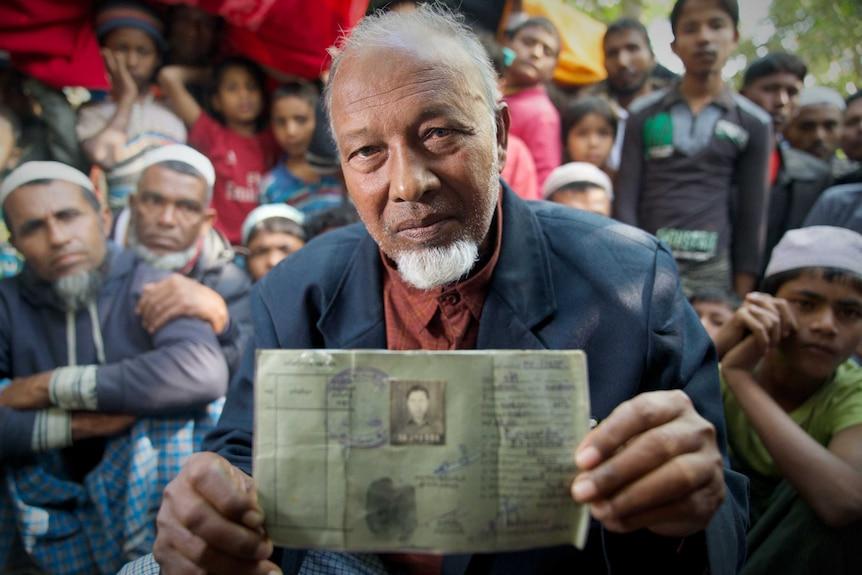
An NRC did not technically constitute conclusive proof of citizenship in every legal circumstance, and Rohipedia should continue acknowledging that distinction. But the documents demonstrated that Rohingya had been registered by the Burmese state within an earlier administrative system. They were not a population entirely unknown to government institutions.
The political significance of documentation nevertheless changed. Earlier documents that had helped Rohingya function within Burma increasingly lost their protective power as the state developed a more ethnicity-centred understanding of national membership.
Three Levels of Citizenship
The distinction between full, associate and naturalized citizenship created a hierarchy of belonging. Full citizenship was connected most securely to recognized national status and qualifying ancestry. Associate citizenship applied principally to people whose citizenship applications under the previous 1948 law remained pending when the new system took effect. Naturalized citizenship required applicants to satisfy additional requirements concerning residence, evidence, language and other criteria.
For Rohingya, these were not equivalent forms of membership. The community that had previously participated politically as part of Burma was increasingly placed in the position of seeking recognition through categories implying weaker or conditional belonging.
Human Rights Watch has emphasized that the law's practical application effectively prevented most Rohingya from obtaining Burmese citizenship. Even theoretically available routes became extremely difficult where applicants lacked documentation or where authorities rejected Rohingya ethnic identity.
Citizenship Became Conditional on Proving the Past
Naturalization presented another difficult route. The law required people seeking naturalized citizenship under certain provisions to provide conclusive evidence that they or their parents had entered and resided in Burma before independence on 4 January 1948. Applicants also faced requirements concerning age, language, character and mental capacity.
The phrase “conclusive evidence” was especially problematic for a population repeatedly affected by war and displacement. Rohingya families had experienced the 1942 massacres, internal displacement, later military operations and the 1978 exodus. Documents could be lost through flight, destruction or confiscation. A community could therefore possess deep historical roots while individual families lacked the paper trail required by the state to prove those roots.
The Law Did Not Operate in a Historical Vacuum
The 1982 law must be understood in the context created by the preceding twenty years of military rule. It did not suddenly appear in a political environment where Rohingya citizenship had never been questioned. Rather, it followed a sequence of progressive exclusion.
After 1962, parliamentary representation disappeared. The Mayu Frontier Administration was abolished. Rohingya-language broadcasting ended. Access to public institutions narrowed. Citizenship and immigration scrutiny intensified. Operation Nagamin then demonstrated that the question of citizenship could be enforced through military power, producing the flight of more than 200,000 Rohingya. The new citizenship regime therefore arrived after the Rohingya had already been politically weakened and subjected to mass scrutiny.
Who Made the Law?
The drafting history requires particular care because later political narratives sometimes attribute the law to individual ethnic or nationalist actors. The documentary record I have found does not support presenting a Rakhine extremist as the sole author of the Citizenship Law. Available archival material instead identifies the Burma Law Commission, appointed by the Council of State in 1979 and chaired by constitutional lawyer Dr. Maung Maung, as responsible for drafting the legislation. General Ne Win publicly defended the proposed citizenship law shortly before its passage, and the Third Pyithu Hluttaw approved it before promulgation on 15 October 1982.
This does not exclude the possibility that Rakhine nationalist lobbying or anti-Rohingya political narratives influenced the wider environment in which citizenship policy developed. That question deserves separate documentary research. But Rohipedia should distinguish evidence of influence from an unsupported claim that one Rakhine nationalist personally authored the law.
Ne Win's Political Justification
General Ne Win's own explanation provides important evidence about the ideology surrounding the law. In a speech on 8 October 1982, shortly before its enactment, Ne Win justified the citizenship legislation through a historical narrative concerned with colonial-era immigration and the protection of Burma from foreign influence. Recent historical scholarship examining this speech argues that the regime presented citizenship restriction as a defence against foreign and economic threats and that similar narratives were subsequently used by military governments to justify exclusion and violence against populations classified outside the accepted national-races framework.
For Rohingya, this language was particularly dangerous because anti-Rohingya narratives had already portrayed them as immigrants from Bengal. A citizenship system built around protecting the nation from foreigners could therefore operate against a population increasingly defined by the state as foreign.
From Political Identity to Administrative Suspicion
The transformation becomes stark when the parliamentary era is compared with the period after 1982. Earlier Rohingya leaders had argued politically over the administration of northern Arakan, representation, security and recognition. Their disputes with the government occurred within the political system.
After the military takeover and the later citizenship restructuring, Rohingya increasingly encountered the state as people required to establish their eligibility to belong. The relationship shifted from political participation toward administrative scrutiny. This transformation was essential to later persecution because a population deprived of secure citizenship possessed fewer mechanisms through which to resist discriminatory restrictions.
The Making of De Facto Statelessness
The consequences were enormous. Human Rights Watch has described the law and its implementation as effectively denying citizenship to most Rohingya. Academic legal research similarly concludes that earlier constitutional and citizenship arrangements had provided routes to citizenship for Rohingya, while subsequent laws progressively transformed their status until they were rendered effectively stateless.
This did not necessarily mean that every Rohingya instantly lost every document on 15 October 1982. The creation of mass statelessness was an administrative process as well as a legislative one. Implementation, document replacement, citizenship verification and official refusal to recognize Rohingya ethnicity developed over time. But the direction had fundamentally changed. A community that had participated within the state increasingly existed outside secure citizenship.
Statelessness Was Not Merely a Legal Problem
For Rohingya, citizenship exclusion affected almost every dimension of life. Without secure citizenship, movement could be restricted, government employment could become inaccessible, education opportunities could narrow and access to public services could depend increasingly upon administrative permission.
Later restrictions on marriage, family life, travel, property, education and livelihood would build upon this underlying vulnerability. Human Rights Watch has repeatedly identified denial of citizenship as a root cause enabling broader abuses against the Rohingya. Statelessness therefore became more than the absence of a passport. It became a mechanism through which the state could exercise extraordinary control over a population.
From Statelessness Toward Genocidal Vulnerability
Within the Rohingya understanding of a slow genocidal process, the 1982 citizenship regime occupies a central position because it weakened the legal relationship between the community and the state that governed its homeland. Political exclusion had already removed representation. Nagamin had demonstrated mass displacement. The citizenship regime now weakened the legal foundation upon which Rohingya could demand protection as members of the country.
This mattered enormously for what followed. A population portrayed as foreigners could be subjected to restrictions that might otherwise be recognized immediately as persecution of citizens. Movement controls could be framed as immigration regulation. Military operations could be justified through border security. Expulsion could be described as dealing with illegal migrants. The denial of belonging therefore became one of the mechanisms through which later physical persecution could be normalized.
The Rohingya Perspective: Citizenship Was Taken, Not Requested
One of the most important distinctions in Rohingya historical interpretation is that the community does not understand its struggle as an attempt by foreigners to acquire Burmese citizenship for the first time. The Rohingya argument is fundamentally different.They maintain that they were a historically rooted people of Arakan whose members had already participated in Burma's political and administrative institutions and possessed state documentation, but whose citizenship was progressively undermined by military governments.
This distinction explains why the 1982 law remains so deeply embedded in Rohingya political memory. From this perspective, Rohingya were not asking Burma to grant them a new homeland. They were attempting to prevent the state from legally excluding them from the homeland in which they already lived.
The Law as a Stage in the Genocide History
The historical significance of the 1982 Citizenship Law therefore lies not simply in its technical provisions. It lies in what those provisions meant when applied to a community already politically weakened, subjected to mass displacement and increasingly represented as foreign.
The law transformed citizenship from a contested political question into a much more durable structure of exclusion. It did not itself carry out the massacres that would come decades later. It did not itself burn villages. It did not itself produce the mass sexual violence documented in later military campaigns. But it helped create a population whose claim to protection by its own state had been profoundly weakened.
Within the Rohingya genocide history, that transformation was catastrophic. A people who had once sent representatives to parliament were increasingly rendered stateless in their own homeland. And once citizenship had been weakened, the state possessed far greater power to control almost every other aspect of Rohingya existence.
The next sections of Part V will examine how this legal exclusion was implemented in practice: the changing identity documents, the exclusion of Rohingya from national ethnic recognition, the 1983 census, the progressive denial of citizenship cards, and the restrictions that transformed statelessness into a system governing everyday Rohingya life.
Continue reading → Part II. The 1982 Citizenship Law: The Legal Foundation of Rohingya Statelessness