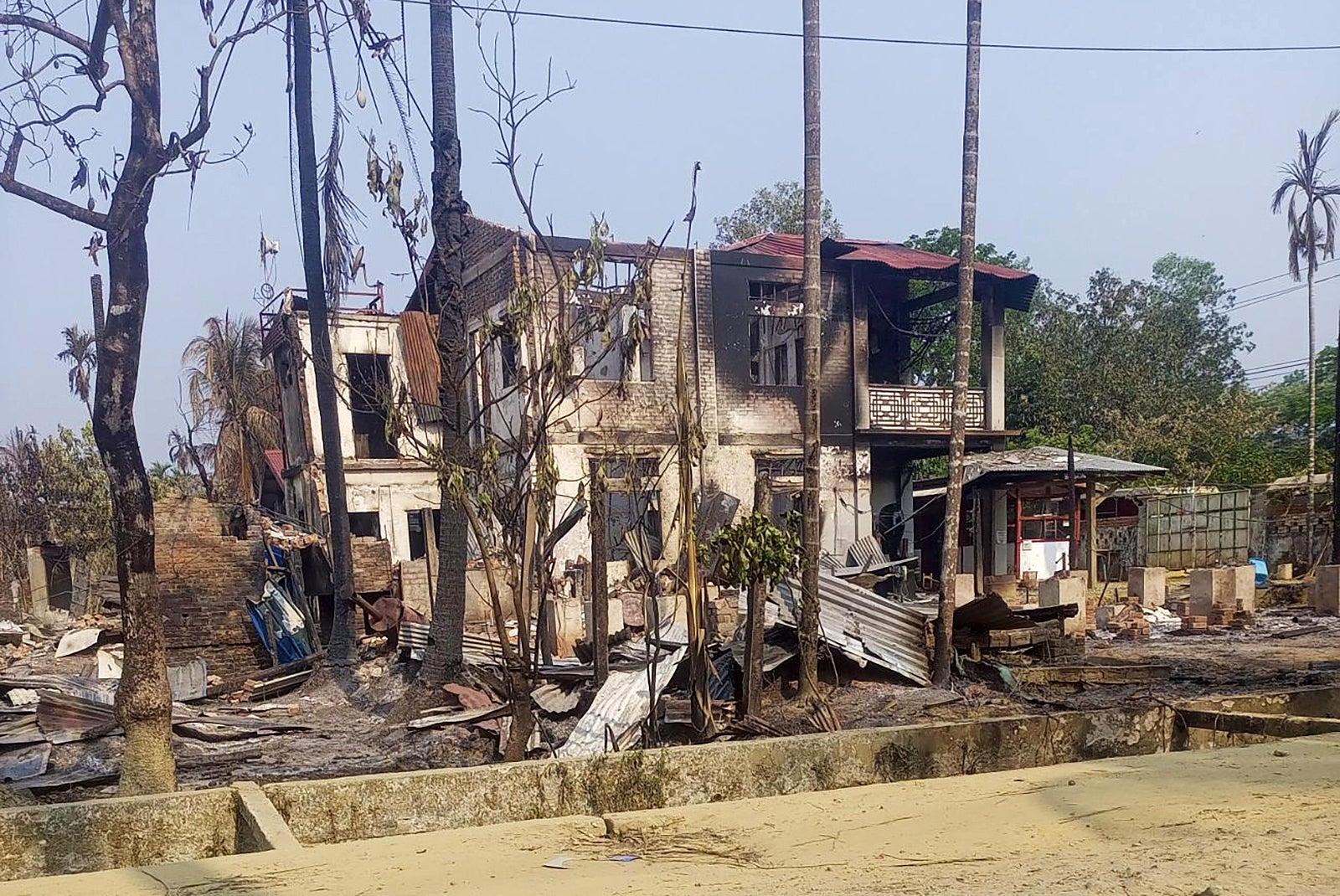
No universally established death toll
exists for the destruction of Buthidaung and the associated flight. Human
Rights Watch estimated that the capture of the town displaced approximately
70,000 people, predominantly Rohingya. Reuters later reported evidence
indicating that at least 45 people were killed during the destruction and
flight, while survivor accounts collected by the United Nations described
seeing dozens of bodies and other accounts alleged substantially larger losses.
Because investigators have not established a comprehensive final casualty
figure, Rohipedia records documented deaths, eyewitness estimates and
organizational claims separately rather than presenting an unresolved number as
a definitive death toll.
Buthidaung and its Rohingya population
Buthidaung is one of the principal
townships of northern Arakan. It lies east of the Mayu mountain range and
inland from Maungdaw Township, which extends to Myanmar's frontier with
Bangladesh. Buthidaung town historically functioned as an administrative and
commercial centre for a large rural population spread across numerous villages
and village tracts. The township had a substantial Rohingya population, while
ethnic Rakhine and other communities also lived in the area.
The Rohingya entered the renewed
conflict in an exceptionally vulnerable position. Decades of discriminatory
laws and administrative practices had deprived most Rohingya of recognized
citizenship and severely restricted their freedom of movement, education,
livelihoods, healthcare and access to public services. The Myanmar military's
2017 campaign had forced more than 700,000 Rohingya into Bangladesh, while
hundreds of thousands remained in Myanmar under severe restrictions. Human
Rights Watch estimated in 2024 that approximately 630,000 Rohingya remained in
Myanmar.
These conditions profoundly affected
civilians' ability to escape when fighting returned to northern Arakan. Travel
between townships was restricted, movement toward Bangladesh was dangerous and
politically constrained, and roads, bridges and waterways increasingly came
under the control of armed forces. As military front lines shifted, many
Rohingya families had few genuinely safe destinations.
Renewed war in Arakan
The immediate background to the
Buthidaung crisis was the resumption of large-scale fighting between the
Myanmar military and the Arakan Army in November 2023, ending an informal
ceasefire. The AA subsequently launched major offensives across Rakhine State
and neighbouring areas, capturing military positions and expanding its
territorial control. The Myanmar military responded with artillery, airstrikes,
ground operations and other attacks that repeatedly endangered civilians.
By early 2024, Buthidaung had become
one of the principal fronts in northern Arakan. The township contained
important Myanmar military bases, while its large Rohingya civilian population
lived close to military installations and contested transport routes. As AA
forces advanced, villages surrounding Buthidaung increasingly became
battlefields or staging areas.
The renewed war affected both Rohingya
and Rakhine civilians. Human Rights Watch documented that in mid-April Myanmar
military forces and allied Rohingya armed groups looted and burned ethnic
Rakhine areas of Buthidaung town and nearby villages. The later destruction of
Rohingya communities therefore occurred within a broader conflict in which
civilians from different communities suffered serious abuses.
Forced recruitment of Rohingya
A particularly consequential
development was the Myanmar military's forced recruitment of Rohingya men and
boys. Facing military setbacks across Myanmar, junta authorities began
recruiting Rohingya despite having long denied them full citizenship and subjected
them to severe restrictions. Human Rights Watch, Amnesty International, OHCHR
and other organizations documented coercive recruitment and deployment of
Rohingya in the conflict.
The recruitment policy placed Rohingya
civilians in an extraordinarily dangerous position. Some Rohingya armed
organizations were also operating alongside or in proximity to Myanmar military
forces. This contributed to rising tensions between communities and provided a
context in which Rohingya civilians risked being collectively perceived as
aligned with the junta regardless of their individual conduct.
The distinction between civilians and
combatants is therefore essential to understanding the events that followed.
The participation of Rohingya recruits or armed organizations in hostilities
did not turn the wider Rohingya civilian population into lawful military
targets. Similarly, crimes committed against Rakhine civilians by Myanmar
military forces or associated armed groups cannot establish collective
responsibility on the part of Rohingya civilians.
Burning of Rohingya villages east of Buthidaung
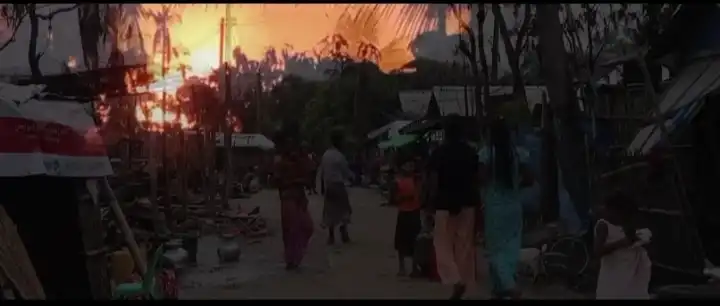
Human Rights Watch later documented
that villages and hamlets including Rongia Daung, known in Burmese as Ywet Nyo
Taung, Keya Zinga Para and U Hla Hpay were partially or completely destroyed
between approximately 21 and 30 April. A Rakhine witness told Human Rights
Watch that he had seen AA fighters burning houses in U Hla Hpay and Ywet Nyo
Taung and said the fighters characterized their actions as clearance operations
against the Arakan Rohingya Salvation Army.
Satellite imagery and thermal anomaly
analysis subsequently showed the scale of the broader destruction. Human Rights
Watch identified more than 40 villages and hamlets partially or completely
destroyed by fire between 24 April and 21 May, with thousands of structures
lost. The organization concluded that the pattern indicated deliberate arson
rather than merely incidental destruction caused by combat.
Flight from the villages
As villages east and south of
Buthidaung became unsafe, Rohingya civilians fled in successive waves. Many
moved toward Buthidaung town, believing that its schools, hospital, mosques,
government buildings and residential areas might provide greater protection
than exposed rural settlements.
This movement created an increasingly
large displaced population inside the town. Families arrived with few
possessions and often depended on relatives, community institutions or
temporary shelters. The concentration of displaced people would later become
critical because many were still inside Buthidaung when the final battle for
the town began.
The movement into Buthidaung was
therefore not simply ordinary urban migration. Many of those present in May
were already internally displaced people who had lost or abandoned homes
elsewhere in the township.
Capture of Military Operations Command 15
One of the decisive military
developments occurred when the Arakan Army captured the headquarters of the
Myanmar military's 15th Military Operations Command (MOC-15), approximately six
kilometres east of Buthidaung town. The AA announced the capture on 2 May 2024
after roughly two weeks of fighting.
Villages near MOC-15 had already
experienced extensive destruction. Human Rights Watch's satellite analysis
showed that Da Pyu Chaung, located less than 500 metres from the military
headquarters, had been reduced to ashes along with other nearby settlements.
The fall of MOC-15 weakened the
Myanmar military's defensive position around Buthidaung and accelerated the
movement of the front toward the town itself.
The Hoyyar Siri massacre
The same day, 2 May 2024, is
associated with the separate Hoyyar Siri (Htan Shauk Khan) massacre, which
occurred in Buthidaung Township as civilians attempted to escape the fighting.
OHCHR later documented allegations
from multiple sources that more than 1,000 Rohingya villagers fled Htan Shauk
Khan because of fears surrounding clashes. Witnesses described AA elements
stopping civilians, dividing them into groups in paddy fields and firing upon
them, killing scores. One survivor reported losing 20 relatives, including
three children. Human Rights Watch's subsequent 2026 investigation identified
more than 170 people killed or missing by name, including approximately 90
children, while stating that the actual number was probably substantially
higher.
Rohipedia documents Hoyyar Siri
separately because it constitutes a distinct alleged mass killing with its own
survivor testimony, locations, casualty evidence and investigative record. Its
inclusion here is necessary to explain the increasingly dangerous environment
surrounding Buthidaung immediately before the town's destruction.
Tens of thousands seek refuge in Buthidaung
By early May, tens of thousands of
Rohingya had taken refuge in Buthidaung town. OHCHR's later investigation found
that one school in downtown Buthidaung was reportedly sheltering more than
10,000 civilians.
The scale of displacement was also
visible from space. Human Rights Watch identified tents and temporary shelters
in the courtyard of Basic Education High School in Ward 1 from late April
onward. Thousands of people were sheltering in schools, houses, the hospital
and other buildings.
These civilians were particularly
vulnerable. Many had already fled burning villages and lacked alternative
shelter. Large numbers of women, children, elderly people and persons with
limited mobility were concentrated in locations that subsequently came under
attack.
Attacks on
displacement sites
OHCHR documented an artillery attack
on 6 May that reportedly struck the school sheltering displaced Rohingya.
According to OHCHR's later reporting, shelling attributed to the Arakan Army
killed four people and wounded 15.
Public buildings and other civilian
sites remained vulnerable as fighting intensified. Human Rights Watch later
received accounts concerning attacks involving the hospital, schools, a mosque,
a guest house and other locations where displaced people were present.
These incidents increased fears among
people who had already fled their villages but had few realistic options for
moving again.
Collapse of Myanmar military
control
By mid-May, Myanmar military control
of Buthidaung was collapsing. Junta forces withdrew from important positions
and the Arakan Army advanced into the town.
The chronology became central to later
investigations because the most extensive burning occurred after Myanmar
military forces had largely retreated. In its initial public reporting on 24
May, OHCHR stated that information indicated the burning had begun on 17 May,
two days after the military retreated and the AA claimed full control, while
emphasizing at that early stage that the Office was still corroborating
responsibility.
Later OHCHR investigations reached
firmer findings. Its September 2024 reporting stated that after driving the
military from Buthidaung, the Arakan Army set fire to buildings throughout the
town, including Rohingya homes and public buildings sheltering displaced
civilians.
This progression illustrates an
important feature of atrocity documentation: early reports may establish
destruction while responsibility remains uncertain; later investigations can
strengthen or revise attribution as additional testimony, imagery and other
evidence become available.
Evacuation orders
Rohingya survivors interviewed by
Human Rights Watch said AA personnel instructed residents to evacuate
Buthidaung by the morning of 18 May. Witnesses nevertheless reported that
burning and attacks began during the evening of 17 May, before many people had
been able to leave.
One witness interviewed by Human
Rights Watch said AA fighters had told residents they had until 10 a.m. the
following morning to vacate, but fighters began forcing people out and setting
houses on fire that night. An elderly resident similarly described preparations
to leave the following morning being overtaken by gunfire and fires during the
night.
The timing was especially
consequential because thousands of people in Buthidaung were already displaced.
They were not simply residents able to pack belongings and move from their own
homes. Many were sheltering temporarily in crowded buildings and had children,
elderly relatives or sick family members with them.
Burning of Buthidaung
town
During the evening of 17 May and the
period that followed, large parts of Buthidaung were destroyed by fire.
Human Rights Watch documented fire
damage across all seven wards of the town and found particularly extensive
destruction in several predominantly Rohingya areas. Thermal anomalies detected
on 17 May corresponded with widespread burning. Witnesses interviewed by the
organization described AA personnel setting fire to houses and other
structures, firing artillery, shooting as people fled and looting property.
Human Rights Watch reported that witnesses did not describe evident fighting
between the AA and Myanmar military forces at the locations and times when some
of these acts occurred.
OHCHR's subsequent investigation
documented the burning of Rohingya areas in Wards 1, 2, 3, 4, 6 and 7.
Interviewees described people being burned after being trapped inside houses,
summary executions, attacks on civilians attempting to flee and disappearances.
The physical destruction was extensive
enough to transform the urban landscape. Reuters later conducted its own
investigation and reported evidence that AA fighters had set fires during the
takeover, contradicting the AA's account that the destruction resulted
principally from Myanmar military attacks and other actors.
Attacks on civilians during the
flight
The danger did not end when civilians
escaped burning neighbourhoods. Survivors described gunfire, shelling and chaos
as people attempted to leave the town.
OHCHR documented accounts of people
being killed while fleeing and of civilians disappearing during the
displacement. Human Rights Watch likewise recorded allegations that AA fighters
fired on people who were fleeing or unable or unwilling to leave.
The circumstances were particularly
dangerous for elderly people, children, people with disabilities and families
already weakened by earlier displacement. Survivors described families becoming
separated amid the sudden mass movement.
Civilian deaths and the unresolved
death toll
No definitive total number of people
killed during the destruction and evacuation of Buthidaung has been
established.
In its initial May reporting, OHCHR
cited a survivor who described seeing dozens of bodies while fleeing the town.
Later OHCHR documentation recorded allegations of killings, summary executions,
people burned inside houses and disappearances but did not establish a
comprehensive final casualty figure.
Reuters subsequently reported that its
investigation indicated at least 45 people were killed during the destruction
and flight from Buthidaung. Other eyewitnesses and organizations reported
larger casualty estimates, but no comprehensive final death toll has been
independently established. Rohipedia therefore records documented deaths,
eyewitness estimates and organizational claims separately rather than
presenting an unresolved figure as definitive.
International
response
The destruction of Buthidaung
generated significant international concern. On 23 May 2024, the Independent
Investigative Mechanism for Myanmar (IIMM) announced that it was closely
monitoring the escalation of fighting in Rakhine State and assessing whether
crimes against humanity or war crimes had been committed. The Mechanism
specifically referred to reports of high-intensity fighting between the Myanmar
military and the Arakan Army, destruction of property in Buthidaung Township
and the displacement of thousands of predominantly Rohingya civilians. The IIMM
emphasized that its mandate covers serious international crimes regardless of
the identity or affiliation of the alleged perpetrators.
OHCHR also raised alarm about the
destruction of Buthidaung. In its initial public reporting in May 2024, the
Office said testimony, satellite imagery, videos and photographs indicated that
Buthidaung town had been largely burned. At that early stage, OHCHR stated that
it was still corroborating information concerning responsibility. Survivors
described seeing bodies while escaping and reported that tens of thousands of
displaced Rohingya attempting to travel west toward Maungdaw were blocked by
the Arakan Army. Later OHCHR investigations provided a more developed
evidentiary record and attributed the burning of buildings throughout
Buthidaung on 17 May, after the military had been driven from the town, to the
Arakan Army.
On 10 July 2024, the United Nations
Human Rights Council adopted a resolution concerning Rohingya Muslims and other
minorities in Myanmar that strongly condemned the 17 May attack in Buthidaung
Township and the continuing targeting of Rohingya. The resolution also called
on all parties to comply with applicable international law and referred to the
provisional measures previously ordered by the International Court of Justice
for the protection of the Rohingya. Human Rights Watch subsequently cited the resolution
as part of the growing international response to the violence in northern
Arakan.
Amnesty International also warned that
renewed attacks against Rohingya in northern Arakan bore disturbing
similarities to patterns of violence experienced during earlier crises. Amnesty
referred specifically to the Arakan Army's advance on Buthidaung and reports of
large-scale arson on 17 May that displaced thousands of Rohingya residents. At
the same time, Amnesty documented serious attacks by the Myanmar military
against civilians elsewhere in Rakhine State and called for allegations of war
crimes by all armed actors to be effectively investigated.
Arakan Army and ULA response
The United League of Arakan and Arakan
Army have rejected major allegations concerning their responsibility for
atrocities against Rohingya civilians during the capture of Buthidaung. In
public statements and responses to international allegations, the ULA/AA has
argued that fighting with Myanmar military forces, including artillery fire and
air attacks, contributed to destruction in the township and has disputed
accounts portraying the organization as deliberately targeting Rohingya
civilians.
The ULA/AA has also challenged
interpretations of satellite imagery that attribute individual fires to its
forces, arguing that satellite images can establish that destruction occurred
but cannot by themselves identify who caused a particular fire. That methodological
point is valid in isolation: satellite imagery generally establishes location,
timing and physical destruction rather than the identity of an individual
perpetrator. Investigative organizations have therefore sought to combine
satellite analysis with witness testimony, videos, photographs,
military-control information and the chronology of fighting when assessing
responsibility.
The competing accounts must
consequently be preserved in the historical record. The ULA/AA denies
deliberately carrying out widespread attacks against Rohingya civilians, while
Human Rights Watch and later OHCHR investigations attributed substantial burning
and other abuses during the capture of Buthidaung to AA forces. Rohipedia
records the denial alongside those investigative findings rather than treating
either an organizational denial or an allegation as sufficient evidence by
itself.
International humanitarian law
The fighting in Rakhine State is
governed by international humanitarian law applicable to non-international
armed conflicts. All parties to the conflict, including the Myanmar military
and the Arakan Army, are required to distinguish at all times between civilians
and combatants and between civilian objects and military objectives. Deliberate
attacks against civilians are prohibited, as are indiscriminate attacks that
fail to distinguish between military targets and civilians.
International humanitarian law also
prohibits pillage and requires parties to take feasible precautions to minimize
civilian harm. Civilians may not be forcibly displaced for reasons related to
an armed conflict unless their security or imperative military reasons require
evacuation. Even where an evacuation is legally justified, parties remain
responsible for taking appropriate measures to ensure that displaced civilians
have adequate shelter, hygiene, health, safety and nutrition.
These principles are particularly
relevant to Buthidaung because tens of thousands of civilians were concentrated
in the town after already being displaced from surrounding villages. Many were
sheltering in schools, hospitals, mosques, houses and temporary structures. The
presence of military forces or combatants in or near populated areas did not
remove the civilian population's protection under international humanitarian
law.
The International Commission of
Jurists, responding to the Buthidaung crisis on 24 May 2024, called on all
parties to cease unlawful attacks and comply with international humanitarian
law. It noted that widespread arson had destroyed large parts of Buthidaung and
forced tens of thousands of civilians, mainly Rohingya, to flee.
Possible war crimes and crimes
against humanity
Human Rights Watch concluded that
serious abuses committed during the conflict required investigation and
accountability. Deliberately attacking civilians, intentionally attacking
civilian objects, murder, pillage and certain forms of forced displacement can
constitute war crimes when the required legal elements are established.
Whether particular acts committed in
Buthidaung constitute crimes against humanity requires additional legal
elements, including proof that relevant acts formed part of a widespread or
systematic attack directed against a civilian population and that perpetrators
possessed the required knowledge. Rohipedia does not independently determine
criminal liability for particular commanders or fighters. Such determinations
require competent investigative and judicial processes.
The IIMM's intervention is therefore
particularly significant. Its mandate is to collect, preserve and analyze
evidence of the most serious international crimes committed in Myanmar and
prepare files that may assist criminal proceedings. Its announcement that it
was examining events in Buthidaung means that the episode entered an
international evidence-preservation process shortly after the destruction
occurred.
International Court of Justice
context
The events in Buthidaung also occurred
against the background of proceedings before the International Court of Justice
concerning Myanmar's obligations under the Genocide Convention. In January
2020, the Court indicated provisional measures requiring Myanmar, among other
things, to take measures within its power to prevent acts falling within
Article II of the Genocide Convention against members of the Rohingya group and
to preserve relevant evidence.
The provisional measures were issued
against Myanmar and concern Myanmar's international legal obligations. They
should therefore not be described as a judicial order directed at the Arakan
Army, which is not a state party before the Court. Nevertheless, the continuing
exposure of Rohingya civilians to killings, burning of homes, displacement and
deprivation has made the ICJ proceedings an important part of the wider
international context.
Human Rights Watch reported that the
UN High Commissioner for Human Rights concluded in June 2024 that actions by
parties that endangered Rohingya appeared inconsistent with the protections
contemplated by the ICJ's provisional measures. The Human Rights Council
subsequently urged all parties to the conflict to respect those protective
measures in addressing the situation of Rohingya civilians.
Humanitarian conditions after
displacement
For tens of thousands of people,
escaping Buthidaung did not mean reaching safety. Many displaced Rohingya moved
south or west with little food, shelter, medicine or clean water. Some families
were separated during the chaotic nighttime flight, while elderly people,
children, persons with disabilities and people injured during attacks faced
particular difficulties travelling long distances.
Survivors described reaching Rohingya
villages already hosting people displaced during earlier phases of fighting.
Families sometimes sheltered with people they did not know, placing severe
pressure on food supplies and accommodation. OHCHR reported accounts of
displaced Rohingya lacking sufficient food after being redirected toward
villages south of Buthidaung.
Human Rights Watch documented
similarly precarious conditions. Thousands who fled south reportedly sought
refuge in schools and temporary camps while facing movement restrictions and
very limited assistance. The onset of the monsoon season further increased
risks for people living without adequate shelter.
The humanitarian crisis was compounded
by restrictions on aid access. Conflict, checkpoints, insecurity and
administrative restrictions impeded the ability of humanitarian organizations
to reach affected communities. This meant that people who had lost homes,
possessions, food stocks and livelihoods during the fighting frequently had to
depend on already impoverished host communities.
From Buthidaung toward the Maungdaw
crisis
The fall and destruction of Buthidaung
shifted the centre of the conflict westward toward Maungdaw Township. This had
profound consequences for the Rohingya because Maungdaw contained another very
large Rohingya population and lay along the border with Bangladesh.
Some survivors of Buthidaung therefore
escaped one major battlefield only to move toward another. As AA forces
continued their offensive against Myanmar military positions, fighting around
Maungdaw intensified. Human Rights Watch noted in August 2024 that the conflict
had shifted west after Buthidaung and that reports of killings and other abuses
against Rohingya civilians continued as fighting intensified around Maungdaw.
The connection between Buthidaung and
Maungdaw is important for understanding the 2024 crisis as a continuous
displacement process rather than a series of completely isolated incidents.
Families fled villages for Buthidaung, fled Buthidaung toward other villages
and Maungdaw, and in some cases later attempted to reach the Bangladesh border
as fighting followed them westward.
Relationship to the Hoyyar Siri
massacre
The destruction of Buthidaung town and
the Hoyyar Siri massacre form part of the same wider military campaign but
should remain separate historical entries.
Hoyyar Siri, also known as Htan Shauk
Khan, was a Rohingya village situated between Myanmar military positions east
of Buthidaung. On 2 May 2024, as AA forces advanced after the fall of MOC-15,
groups of Rohingya civilians attempted to flee the area. Subsequent
investigations by OHCHR, Fortify Rights and Human Rights Watch documented
allegations and evidence that AA fighters fired on civilians at several
locations.
Human Rights Watch's extensive 2026
investigation identified more than 170 people killed or missing by name,
including approximately 90 children, while stating that the actual number was
probably substantially higher. The ULA/AA denied massacring civilians.
The two events are connected
geographically and chronologically. Hoyyar Siri occurred during the AA's
advance through eastern Buthidaung Township, while the burning of Buthidaung
town followed approximately two weeks later as the remaining Myanmar military
positions collapsed. Keeping separate entries allows each incident's witnesses,
casualty information, visual evidence and disputed claims to be documented
accurately while also allowing Rohipedia to link them within the broader
chronology.
Evidence limitations and unresolved
questions
Despite substantial documentation,
important aspects of the Buthidaung events remain unresolved. Independent
investigators did not have unrestricted physical access to the town immediately
after its capture. Communications were disrupted, civilians were dispersed
across a large area, and many witnesses remained in territory controlled by
armed actors. These conditions made immediate verification extremely difficult.
The final number of people killed
remains uncertain. Witnesses reported seeing bodies at multiple locations, and
some organizations documented specific deaths, but no comprehensive victim list
equivalent to a full forensic accounting has been established. Missing persons
further complicate the casualty record because disappearance does not
necessarily establish death.
Responsibility for every individual
fire also cannot be determined solely from satellite imagery. Satellite and
thermal data can establish the location, timing and scale of burning with
considerable precision, but attribution generally requires additional evidence.
Investigators therefore compare imagery with witness testimony, videos,
photographs, known troop movements, territorial control and the timing of
military operations.
Another difficulty is that destruction
occurred in several phases and involved different actors. In April, Human
Rights Watch documented junta forces and allied Rohingya armed groups carrying
out arson against Rakhine areas. From late April, HRW documented AA attacks
against Rohingya villages east of Buthidaung, followed by extensive destruction
of Rohingya areas during the capture of the town in mid-May.
For a permanent historical archive,
these distinctions are essential. “Buthidaung was burned” is factually
insufficient because it collapses different dates, locations, victims and
alleged perpetrators into a single event.
Chronology of the Buthidaung
crisis, April–May 2024
11–17 April 2024 — Arson attacks in
Rakhine areas of Buthidaung: During the first major phase of destruction
documented inside Buthidaung town, Myanmar military forces and allied Rohingya
armed groups were implicated in looting and burning predominantly ethnic
Rakhine areas. Human Rights Watch's analysis found fire damage in Rakhine,
Hindu and Khami areas across Wards 2, 3, 4, 5, 6 and 7, with Ward 4
particularly affected. The destruction occurred through numerous fires over
several days, which Human Rights Watch assessed as evidence of deliberate
arson. A Médecins Sans Frontières office and pharmacy were also burned on 15
April. This phase is important to distinguish from the later destruction of
predominantly Rohingya areas after the Arakan Army advanced into the town.
Late April 2024 — AA advances and
Rohingya villages begin burning: As the Arakan Army advanced against Myanmar
military positions east of Buthidaung, predominantly Rohingya settlements along
and near the Mayu River began suffering extensive destruction. Human Rights
Watch subsequently concluded that AA forces began burning Rohingya villages
east of Buthidaung in late April. Satellite imagery and thermal-anomaly
analysis documented extensive destruction in settlements including areas around
Ywet Nyo Taung, U Hla Pay and villages near MOC-15. Later Human Rights Watch
research found that villages surrounding Hoyyar Siri were partially or
completely destroyed between 21 and 30 April.
24 April–21 May 2024 — More than 40
villages and hamlets damaged or destroyed: Human Rights Watch's broader
satellite analysis identified more than 40 villages and hamlets in Buthidaung
Township that were partially or completely destroyed by fire during this
period. Thousands of structures were destroyed across the township. The
organization concluded that the geographical and temporal pattern of the fires
indicated deliberate arson. The individual perpetrators and circumstances
nevertheless need to be considered according to the particular location and
date rather than assigning every fire during this period to a single actor.
2 May 2024 — Fall of MOC-15: The
Arakan Army announced that it had captured the Myanmar military's Military
Operations Command 15 headquarters, approximately six kilometres east of
Buthidaung town, after around two weeks of fighting. Nearby Rohingya settlements
had suffered extensive destruction. Satellite imagery showed Da Pyu Chaung,
less than 500 metres from the headquarters, and other nearby settlements
reduced to ashes. The loss of MOC-15 represented a major weakening of Myanmar
military control east of Buthidaung and accelerated the movement of civilians
toward the town.
2 May 2024 — Hoyyar Siri killings: On
the same day, Rohingya civilians attempting to flee Hoyyar Siri, also known as
Htan Shauk Khan, were reportedly attacked. OHCHR later documented allegations
from multiple sources that more than 1,000 Rohingya had fled because of fears
of fighting and that AA elements stopped civilians, divided them into groups in
paddy fields and fired upon them, killing scores. Human Rights Watch's later
investigation identified more than 170 people killed or missing by name and concluded
that the actual number was probably substantially higher. The Hoyyar Siri
massacre is documented as a separate Rohipedia entry because it constitutes a
distinct incident with its own evidentiary record.
Early May 2024 — Tens of thousands
seek refuge in Buthidaung: As fighting and village destruction spread, large
numbers of Rohingya moved into Buthidaung town. OHCHR reported that tens of
thousands sought refuge there. A school in central Buthidaung was reportedly
sheltering more than 10,000 civilians, demonstrating how heavily displaced
people had become concentrated in urban shelters before the final assault on
the town.
6 May 2024 — Shelling of school
shelter: According to OHCHR, artillery shelling reportedly carried out by the
Arakan Army struck the school sheltering displaced Rohingya civilians. Four
people were reported killed and 15 wounded. The incident further demonstrated
the danger faced by civilians who had fled surrounding villages believing that
the town would provide greater protection.
Early to mid-May — Myanmar military
positions collapse: AA forces continued capturing military installations around
Buthidaung. Myanmar military forces destroyed the principal bridge providing
access to the town from the east after MOC-15 fell, according to Human Rights
Watch. This later affected civilian escape routes when large numbers of people
attempted to flee the town.
15–17 May 2024 — Final collapse of
Myanmar military control: Myanmar military forces withdrew from much of
Buthidaung as the Arakan Army moved against the remaining positions. Later UN
documentation placed the major destruction of the town after the military's
retreat and during the period in which AA forces established control. The
precise timing of control over individual locations remains relevant when
assessing responsibility for particular incidents.
17 May 2024 — Evacuation instructions
and beginning of the town burning: Rohingya witnesses interviewed by Human
Rights Watch said AA personnel instructed residents to leave Buthidaung by the
morning of 18 May, with some witnesses recalling a deadline of 10 a.m. However,
residents said AA forces began setting buildings on fire during the evening of
17 May, before many civilians had been able to evacuate. Thousands of displaced
Rohingya from surrounding villages were still sheltering in homes, schools, hospitals
and other buildings.
Night of 17–18 May — Extensive
destruction of Rohingya neighbourhoods: Human Rights Watch documented witness
accounts alleging that AA fighters burned buildings, fired artillery, shot at
fleeing civilians and looted houses. Satellite imagery subsequently confirmed
fire damage in all seven wards of Buthidaung, with Wards 1, 2, 3 and 6
particularly affected. Thermal anomalies were detected throughout the town on
17 May, and imagery from the following day confirmed widespread fire
destruction. Buildings around Basic Education High School, Buthidaung General
Hospital and Buthidaung market were among those destroyed.
17–18 May — Civilian flight from
Buthidaung: Thousands of Rohingya fled west and south as the town burned. With
the eastern bridge destroyed, escape routes were restricted. Videos later
examined by Human Rights Watch showed men, women and children travelling along
the Buthidaung–Maungdaw road during the night, carrying belongings while the
sky behind them was illuminated by fire. Some civilians became trapped around
Ward 5 and the Buthidaung jail area. Witnesses reported restrictions preventing
some Rohingya from continuing toward Maungdaw.
18 May 2024 — Displaced crowds around
Tat Min Chaung: Satellite imagery captured a large group of people in rice
fields near Tat Min Chaung east of the village during the afternoon. Human
Rights Watch also corroborated visual material showing crowds carrying
belongings near Buthidaung jail. Witnesses described civilians becoming caught
between retreating Myanmar military personnel and advancing AA forces, with
reports of gunfire, artillery attacks, deaths and arrests.
18 May — Reports of killings during
flight: Witnesses interviewed by Human Rights Watch described bodies along
escape routes and civilians killed by gunfire and shelling. Human Rights Watch
reported that OHCHR had confirmed at least four reported beheadings.
Establishing a comprehensive casualty figure remained difficult because
civilians were scattered across a large conflict area and independent
investigators lacked immediate access.
18 May 2024 — AA announces capture of
Buthidaung: The Arakan Army announced that it had seized Buthidaung town and
overtaken all remaining Myanmar military bases in the township. By this point,
large sections of the town had burned and a substantial proportion of the
Rohingya population had fled.
18–21 May 2024 — Burning follows
displacement routes: Destruction continued after the fall of the town. Human
Rights Watch's satellite analysis found that approximately 17 additional
villages south and northwest of Buthidaung were burned between 17 and 21 May,
including areas along routes used by displaced civilians. More than 70 percent
of structures in Tat Min Chaung were destroyed by fire according to satellite
comparison cited by Human Rights Watch.
By 21 May — Township-wide destruction:
By the end of the period analyzed by Human Rights Watch, more than 40 villages
and hamlets had been partially or completely destroyed by fire since 24 April,
in addition to extensive destruction within Buthidaung town. Thousands of
structures had been lost. The scale of destruction meant that many displaced
Rohingya had no intact homes to which they could immediately return.
23 May 2024 — International
investigative attention: As reports of the destruction emerged internationally,
the Independent Investigative Mechanism for Myanmar stated that it was closely
monitoring the escalation in Rakhine State and collecting evidence concerning
possible international crimes. The destruction and displacement in Buthidaung
consequently became part of a wider international evidence-gathering process.
Late May 2024 — Humanitarian crisis
deepens: Tens of thousands of displaced Rohingya remained scattered through
villages and rural areas with inadequate shelter, food, healthcare and
protection. Human Rights Watch later estimated that the capture of Buthidaung
had displaced approximately 70,000 people, predominantly Rohingya.
June 2024 onward — Conflict shifts
toward Maungdaw: After Buthidaung fell, the principal military confrontation in
northern Arakan increasingly shifted west toward Maungdaw Township. Rohingya
who had already survived village destruction and displacement from Buthidaung
consequently found themselves moving toward another major conflict zone. Human
Rights Watch later described the Buthidaung and Maungdaw crises as successive
stages of the escalating conflict affecting Rohingya civilians.
The chronology demonstrates that the
destruction of Buthidaung was not a single event confined to the night of 17
May. It developed through successive phases: Myanmar military and allied
Rohingya armed-group attacks on Rakhine areas in mid-April; the AA's advance
and destruction of Rohingya villages from late April; the fall of major Myanmar
military positions; the Hoyyar Siri killings on 2 May; the concentration of
tens of thousands of displaced Rohingya inside Buthidaung; the burning and mass
flight of 17–18 May; and further destruction along displacement routes through
21 May. Preserving these phases separately is necessary to distinguish the
conduct of different armed actors and avoid attributing all violence in
Buthidaung Township to a single episode or perpetrator.
Historical
significance
The destruction and mass displacement
of Buthidaung represented a major turning point in the 2023–2024 northern
Arakan conflict. Buthidaung had become a refuge for tens of thousands of
Rohingya fleeing surrounding villages. Its capture and destruction therefore
removed one of the remaining urban centres in which displaced Rohingya had
concentrated and forced civilians into another cycle of flight.
The events also demonstrated how
Rohingya civilians could become endangered by multiple armed actors. Myanmar
military forces had subjected Rohingya communities to decades of persecution
and, during the renewed conflict, forcibly recruited Rohingya men and boys
while continuing attacks affecting civilians. Rohingya armed groups
participated in parts of the conflict. As the Arakan Army expanded territorial
control, independent investigations subsequently documented serious abuses
against Rohingya civilians by AA forces as well. Human Rights Watch
characterized the situation as one in which Rohingya and Rakhine civilians were
bearing the consequences of abuses committed by opposing forces.
Buthidaung is also historically
significant because of the scale of physical destruction. More than 40 villages
and hamlets were partially or completely burned during the wider April–May
period documented by Human Rights Watch, while extensive areas of Buthidaung
town itself were destroyed. The destruction altered the demographic and
physical landscape of a township that had long been one of the principal
centres of Rohingya life in northern Arakan.
For survivors, however, the historical
significance cannot be reduced to destroyed structures or military control. The
crisis involved the loss of relatives, homes, possessions, livelihoods and
community networks; repeated displacement; separation of families; and
continuing uncertainty concerning missing people. Many survivors subsequently
faced another period of insecurity as the conflict moved toward Maungdaw.
Status of the historical record
The evidence concerning Buthidaung has
developed substantially since May 2024. Early reporting correctly reflected
uncertainty about responsibility because independent investigators had limited
access and the conflict was still unfolding. Later investigations incorporated
additional survivor testimony, satellite imagery, thermal data, photographs,
videos and information concerning territorial control. As a result, later
findings are more detailed than the initial reports issued immediately after
the town burned.
Rohipedia therefore treats the
historical record as evolving. Early reports are preserved for their
contemporaneous value, while later findings based on additional testimony,
satellite imagery, verified visual material and information about territorial control
are given appropriate weight. Where evidence remains incomplete or contested,
the uncertainty is stated explicitly.