1. Overview
Religion occupies a central place in Rohingya community life and has contributed substantially to the development and preservation of Rohingya social and cultural identity. The overwhelming majority of Rohingya are Muslims and follow Sunni Islam, with the Hanafi school of Islamic jurisprudence forming the principal legal tradition practiced within the community. Islamic belief and practice influence daily life, family relations, marriage, education, charity, community leadership, festivals, burial customs and understandings of moral responsibility.
Rohingya religious leadership traditionally included figures described through titles such as imam, moulvi or mawlana, mullah and hafez, although terminology and functions varied between communities. A hafez, a person who has memorized the Qur'an, traditionally commands considerable respect. Ethnographic material on Rohingya communities also documents the historical importance of mullahs, qualified religious teachers and village elders in community affairs. Religious authority therefore extended beyond leading prayer and could include education, advice, mediation and guidance concerning family and social questions.
Islam is closely intertwined with Rohingya cultural identity, but Rohingya and Muslim are not interchangeable identities. Myanmar contains Muslim communities with different ethnic, linguistic and historical backgrounds, while the history of Islam in Arakan itself includes populations that cannot automatically be identified retrospectively as Rohingya. Rohingya identity combines Islamic faith with a particular language, historical attachment to Arakan, village and kinship networks, cultural traditions and shared historical experiences.
This distinction is particularly important when studying Rohingya origins. The presence of Muslims in precolonial Arakan demonstrates an important historical foundation for later Muslim society, but identifying a Muslim individual in an early source does not automatically establish that the person possessed a modern Rohingya ethnic identity. Religious history and ethnic history overlap, but they are not identical.
At the same time, Islam became one of the most durable institutions through which Rohingya communities maintained continuity across political upheaval. Kingdoms disappeared, administrative boundaries changed, populations were displaced and political recognition fluctuated, but mosques, Qur'anic education, family religious practice and networks of religious teachers continued to transmit beliefs and social traditions between generations.
This role became particularly important under conditions of persecution and displacement. When communities lost villages, land and formal political institutions, religion remained portable. Families could continue prayer, Qur'anic recitation, fasting, marriage ceremonies and religious education even in refugee settlements or diaspora communities. Islamic institutions consequently became important not only to worship but also to the preservation of community cohesion.
Modern research among Rohingya refugees continues to document this importance. UNICEF's study of faith in Rohingya refugee communities in Cox's Bazar identifies the majority as Sunni/Hanafi Muslims and describes religious leaders as highly respected figures capable of influencing both individual and collective behaviour. Research on Rohingya religious identity in diaspora communities likewise finds that Islam continues to provide an important framework through which displaced Rohingya understand community, morality and belonging.
The religious history of the Rohingya should therefore be studied at several levels: the historical development of Muslim communities in Arakan; the Sunni and Hanafi traditions followed by the Rohingya; mosques, madrasas and religious leadership; family and village religious practice; festivals and life-cycle ceremonies; the effects of state restrictions on religious institutions; and the transformation of religious life through refugeehood and diaspora.
2. Historical Development of Islam among the Rohingya
The history of Islam among the Rohingya developed within the wider history of Arakan and its centuries-long connections with the Bay of Bengal. Arakan occupied a strategic coastal position between the Indian subcontinent and mainland Southeast Asia, while the Arakan Yoma separated the region geographically from the Irrawaddy valley. Maritime routes connected the Arakan coast with Bengal, India and the wider Indian Ocean. These connections existed before Islam and later provided routes through which Muslim merchants, sailors, religious figures and settlers could reach Arakan.
Early Muslim Contacts and Traditions
Rohingya historical writing places the beginnings of Islam in Arakan within the expansion of Arab and Persian maritime activity across the Indian Ocean. From the seventh century onward, Muslim merchants increasingly participated in commercial networks connecting the Middle East, India, Southeast Asia and China. Arakan lay close to these routes and maintained maritime connections with ports around the Bay of Bengal. Early Muslim contact with the Arakan coast is therefore consistent with the broader history of Indian Ocean commerce, although the precise date at which permanent Muslim communities first became established remains difficult to determine.
One of the best-known traditions concerns Muslim sailors whose ships were wrecked near Ramree Island. Later Arakanese historical accounts, subsequently repeated in British-era gazetteers and Rohingya historical writing, associate this episode with the reign of Maha Taing Candra, usually dated to approximately 788–810 CE. According to the tradition, surviving Muslim sailors were settled within Arakan and became part of the country's population. Mohammed Yunus and other Rohingya historians regard these settlers as an early component in the development of Muslim society in Arakan.
The historical significance of this tradition should be distinguished from the certainty of its chronology. The surviving accounts are later records concerning an earlier event rather than contemporary eighth- or ninth-century documents written by the settlers themselves. They therefore provide evidence of a longstanding historical tradition but do not independently establish the number of settlers or continuous settlement from a precisely identifiable year. This distinction allows the tradition to be preserved without presenting its chronology as archaeologically proven.
Badr Maqam and the Tradition of Early Arab Presence
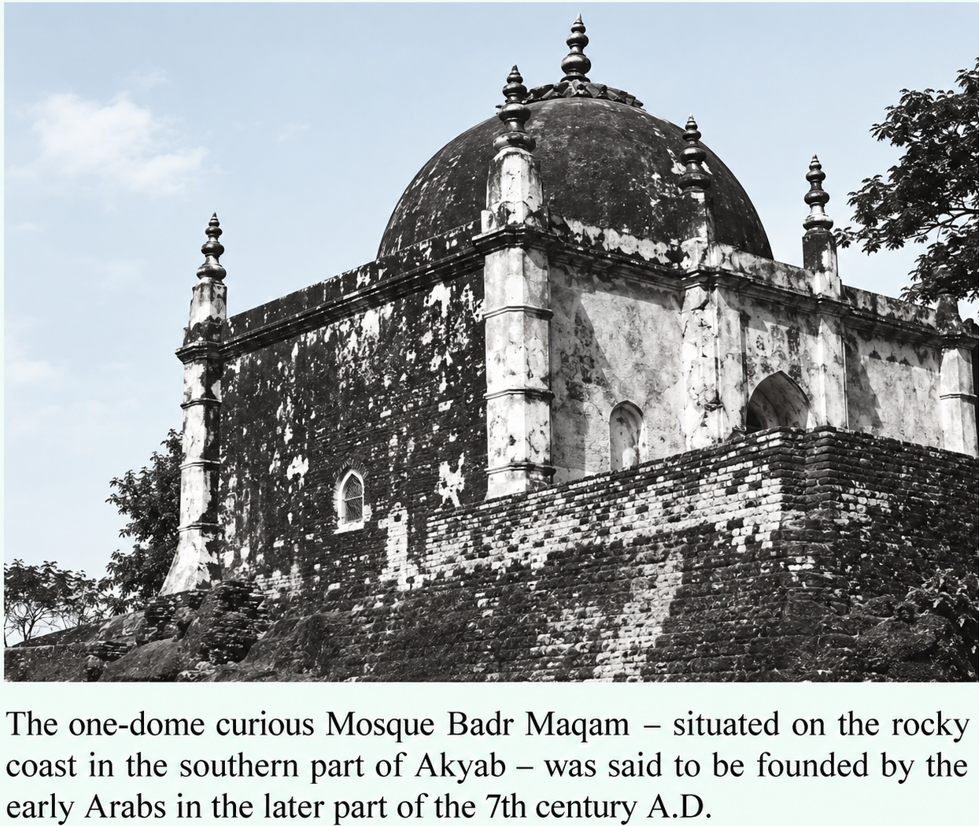
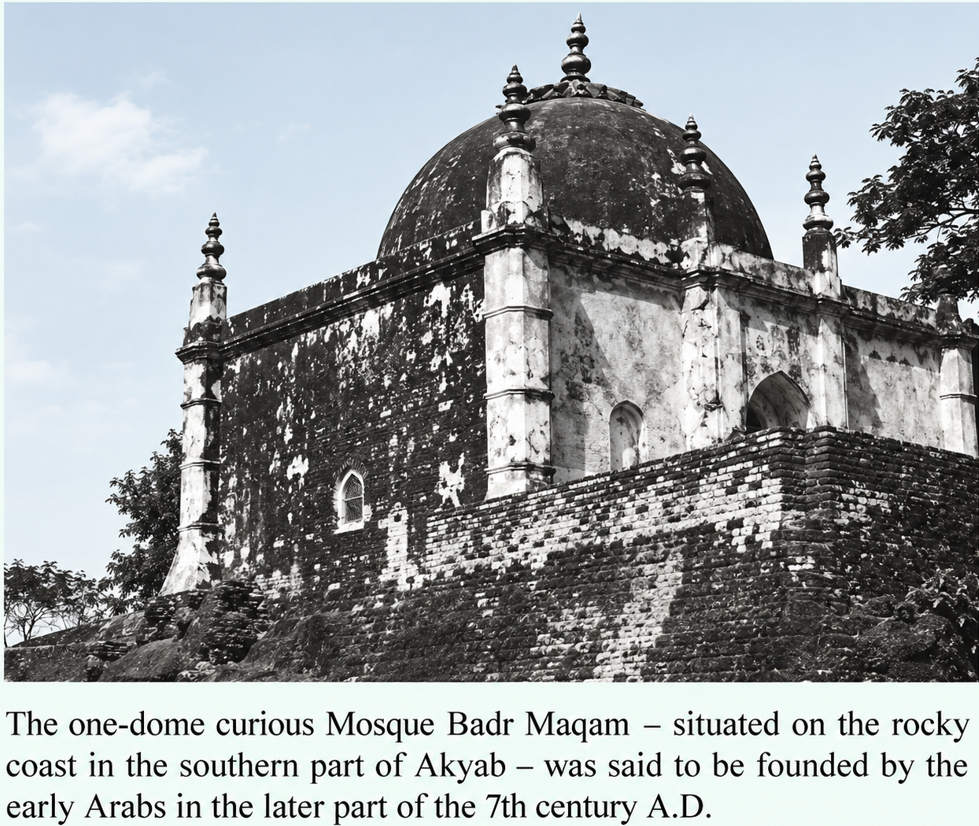
An important physical site associated with early Muslim history is Badr Maqam in Akyab, present-day Sittwe. Mohammed Yunus reproduces the structure as Plate No. 1 in A History of Arakan: Past and Present. He describes the one-domed Badr Maqam on the rocky coast of southern Akyab as traditionally founded by early Arabs in the later part of the seventh century. The site consequently occupies an important position in Rohingya historical memory concerning the early presence of Islam in Arakan.
Muslim Religious Presence before Mrauk-U
Rohingya historiography also preserves evidence associated with Muslim religious life before or around the beginning of the Mrauk-U period. Particularly important is the ruined structure identified by Mohammed Yunus as Musa Mosque at Patthari Qillah in Mrohaung, present-day Mrauk-U. Yunus reproduces the ruins as Plate No. 4 of his history and describes the mosque as having been built in the fourteenth century. If this dating is correct, it would place an established Muslim religious structure in Arakan before the foundation of the Mrauk-U dynasty in 1430.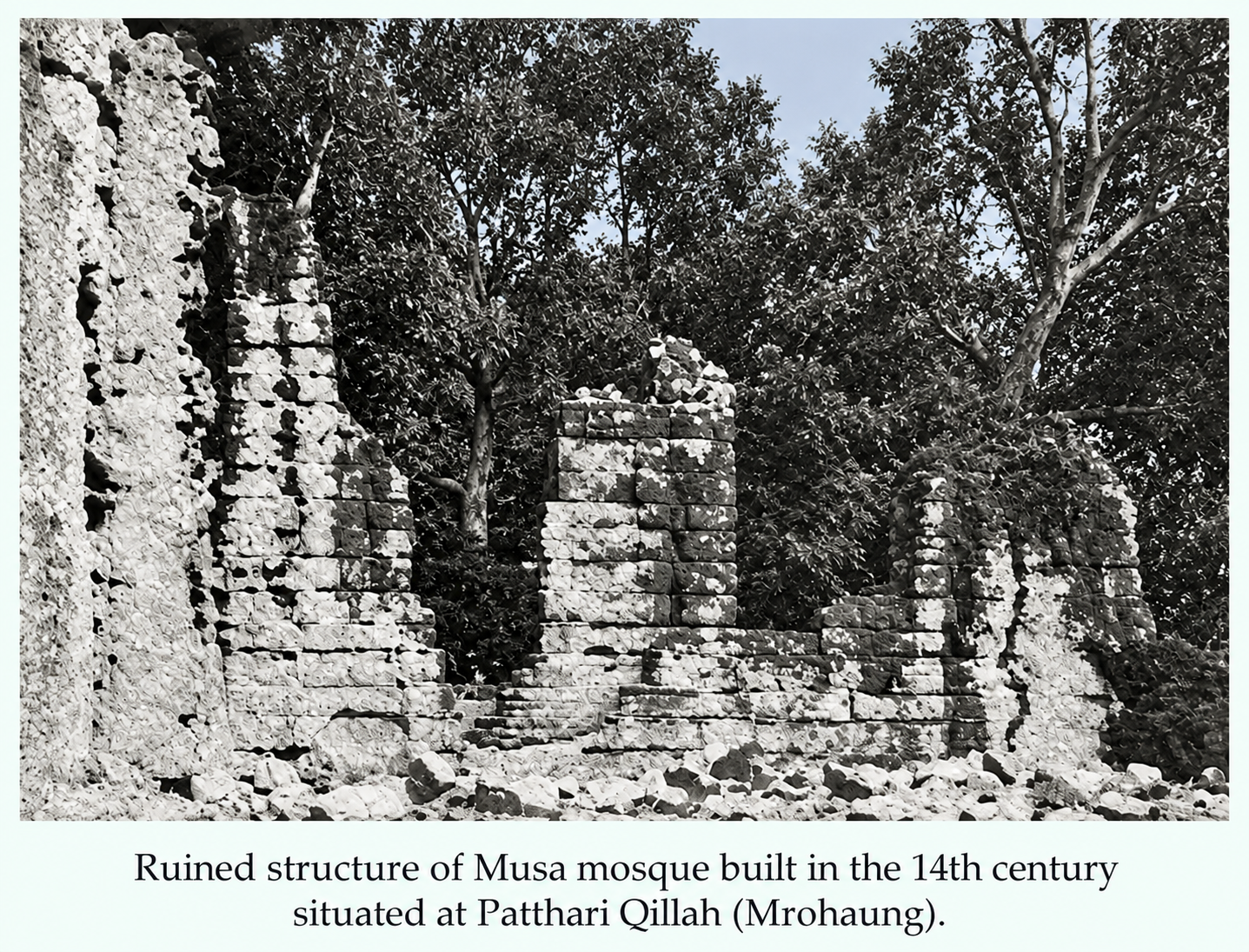
Islam and the Rise of Mrauk-U
The historical evidence becomes substantially richer with the establishment of Mrauk-U in the fifteenth century. Narameikhla, commonly known as Min Saw Mon, spent years in Bengal after losing his throne and eventually recovered his kingdom within the political environment of the Bengal Sultanate. Mohammed Yunus identifies him by the Muslim royal name Solaiman Shah. The establishment of Mrauk-U in 1430 consequently began a period of especially close interaction between the Arakanese monarchy and the Muslim political and cultural world of Bengal.
Historical traditions describe Muslim soldiers accompanying the restored ruler and some remaining in Arakan after the campaign. Muslim officials, military personnel, merchants and religious figures subsequently became increasingly visible within the kingdom. Political relationships with Bengal also exposed the Arakanese court to Persianate administrative practices and Muslim royal culture. These developments strengthened an Islamic presence that Rohingya historians understand as building upon earlier maritime contacts and settlements rather than beginning suddenly in the fifteenth century.
Muslim Royal Titles and Coinage
One of the most remarkable features of the Mrauk-U period was the use of Muslim or Persianate royal titles by successive Arakanese rulers. Mohammed Yunus gives this evidence particular importance. In his reconstruction, rulers possessed Arakanese or Pali royal names alongside Muslim names and titles, beginning with Solaiman Shah—Narameikhla and continuing across successive generations of the monarchy.
Among the rulers identified by Yunus are Ali Khan—Meng Khari, Kalima Shah—Ba Saw Phyu, Mathu Shah—Doulya, Mohammed Shah—Ba Saw Nyo, Nori Shah—Ran Aung, Sheikh Modullah Shah—Salingathu, Ili Shah—Meng Raza, Ilias Shah—Kasabadi, Jalal Shah—Meng Saw Oo and Ali Shah—Thatasa. Yunus interprets the persistence of these names as evidence of a substantial Islamic dimension within the political development of Mrauk-U. Other historians interpret the religious significance of the titles differently, but their appearance forms an important part of the historical record.
Royal coinage provides particularly significant material evidence. Coins associated with Mrauk-U rulers contain Muslim or Persianate titulature and inscriptions, demonstrating that such language formed part of official expressions of sovereignty rather than existing only in later historical narratives. Yunus draws particular attention to coins associated with Sultan Ilias Shah and Sultan Ali Shah, and he interprets their inscriptions as evidence concerning the Islamic identity of the rulers.
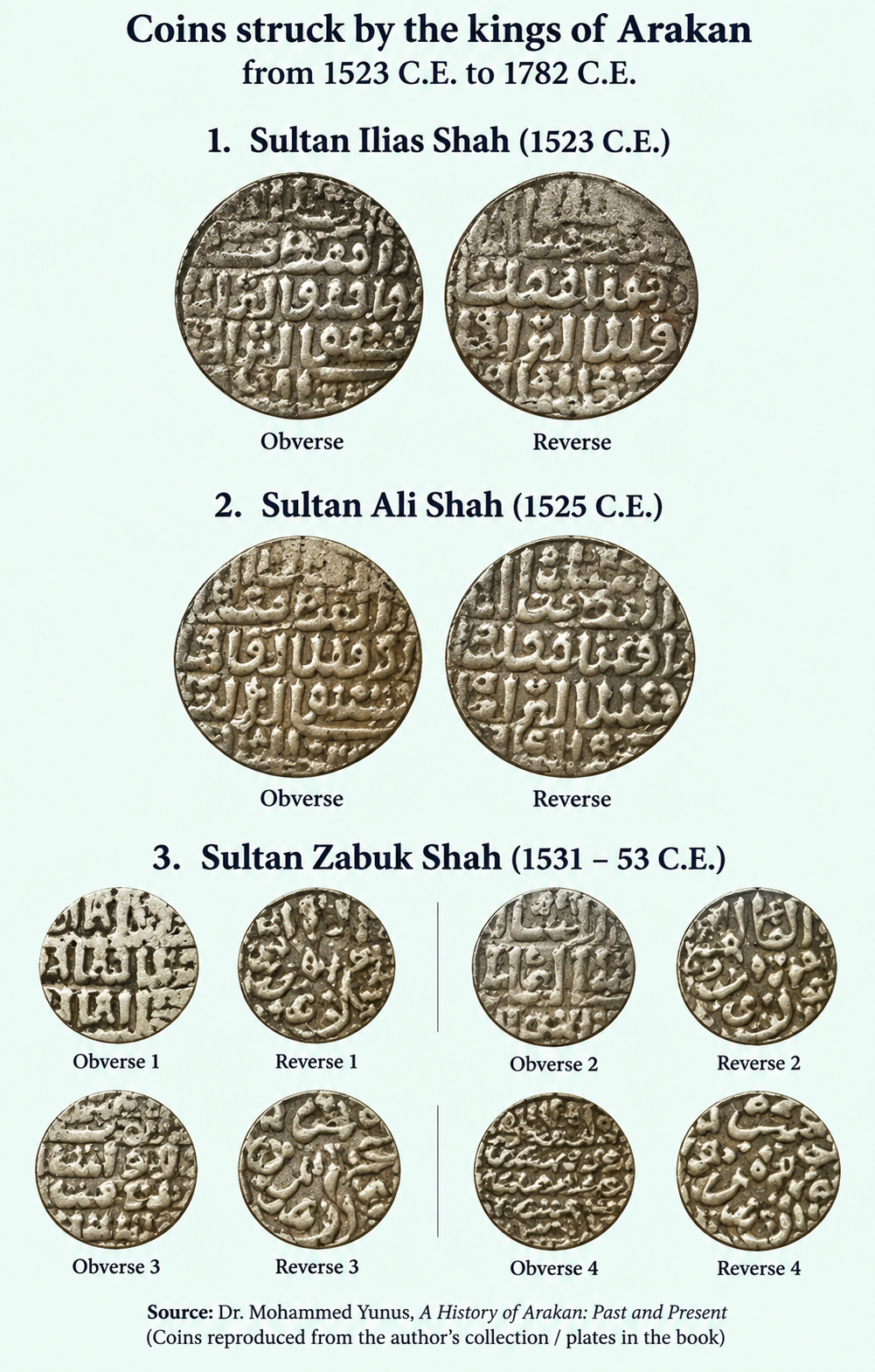
This evidence should be interpreted carefully. Yunus understands the Muslim titles, Islamic inscriptions, coinage, Muslim officials and religious institutions collectively as evidence of a profound Islamic dimension within Arakanese political civilization. Michael Charney places greater emphasis on the ability of Buddhist rulers to employ Islamicate political forms without necessarily converting to Islam. The disagreement concerns the interpretation of the evidence; it does not eliminate the documented presence of Muslim titles, Persianate political forms and Muslim communities within the kingdom.
Muslim Communities, Religious Institutions and Intellectual Life
Islamic life in Mrauk-U extended well beyond royal titles and coinage. Written sources identify Muslims among the subjects of the Arakanese king by the later sixteenth century, while subsequent evidence reveals Muslim officials, soldiers, merchants, religious figures and established communities. Mosques provided centres for congregational worship and religious instruction, while scholars and teachers transmitted Qur'anic knowledge and Islamic learning. Muslim participation therefore existed at several levels of Arakanese society.
Thibaut d'Hubert's research demonstrates that Bengali-speaking Muslim dignitaries operated within administrative and cultural networks associated with the Mrauk-U court. These patrons supported an important Bengali literary culture within Arakan. The celebrated Muslim poet Alaol, who reached Arakan from Bengal, became one of the most important literary figures associated with this environment. His career demonstrates that Muslim intellectual life in Mrauk-U possessed patrons, educated audiences and cultural networks capable of sustaining sophisticated literary production.
These developments contributed to the religious formation of Muslim communities over successive generations. Islam was transmitted not only through formal institutions but also through families, village life, mosques, religious teachers and community practices. Descendants of merchants, soldiers, officials, cultivators and other settlers could become locally rooted while maintaining their Islamic faith. Religious continuity consequently became one of the elements connecting populations of different historical origins within Arakan.
Historic Mosques and the Continuity of Religious Life
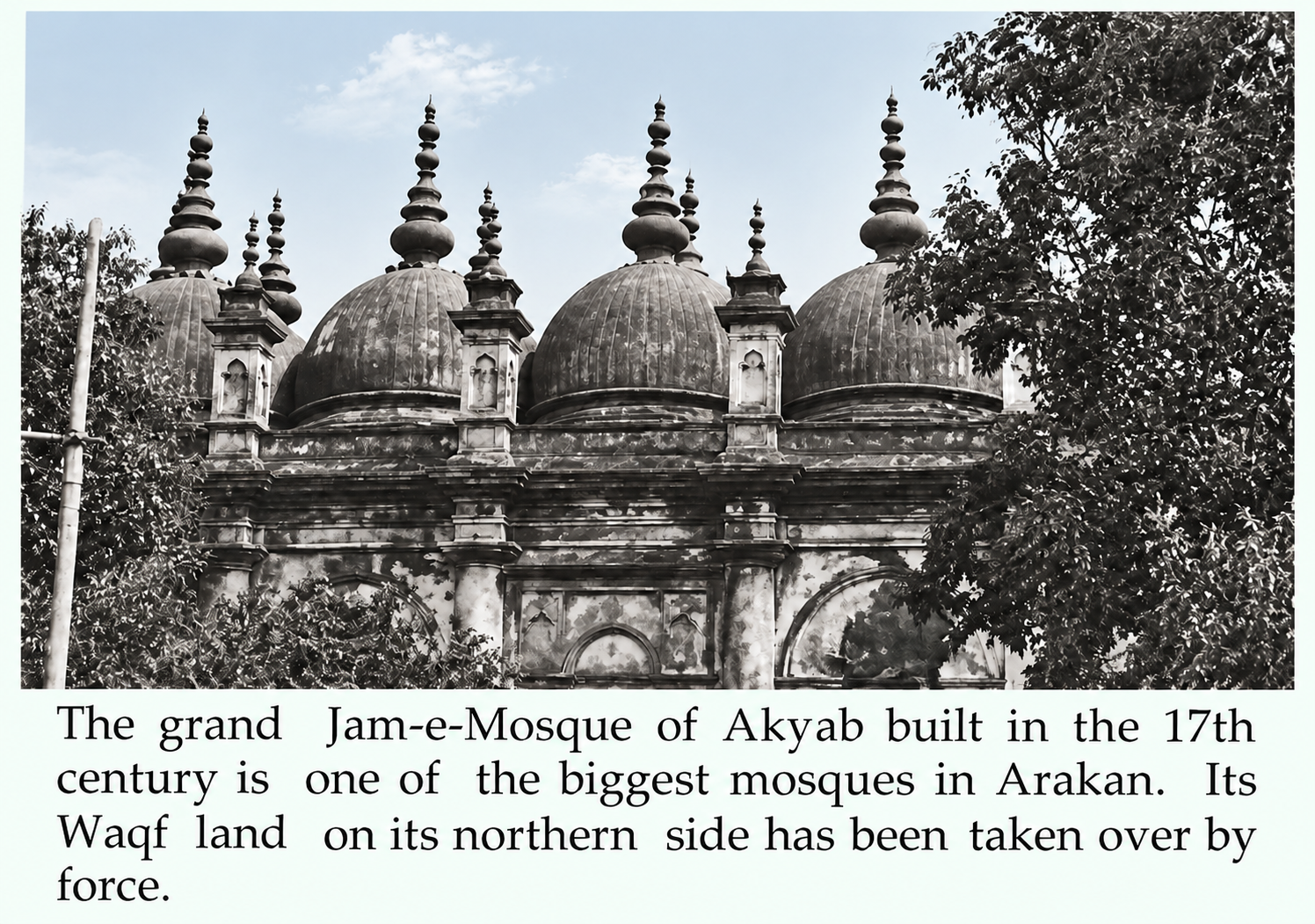
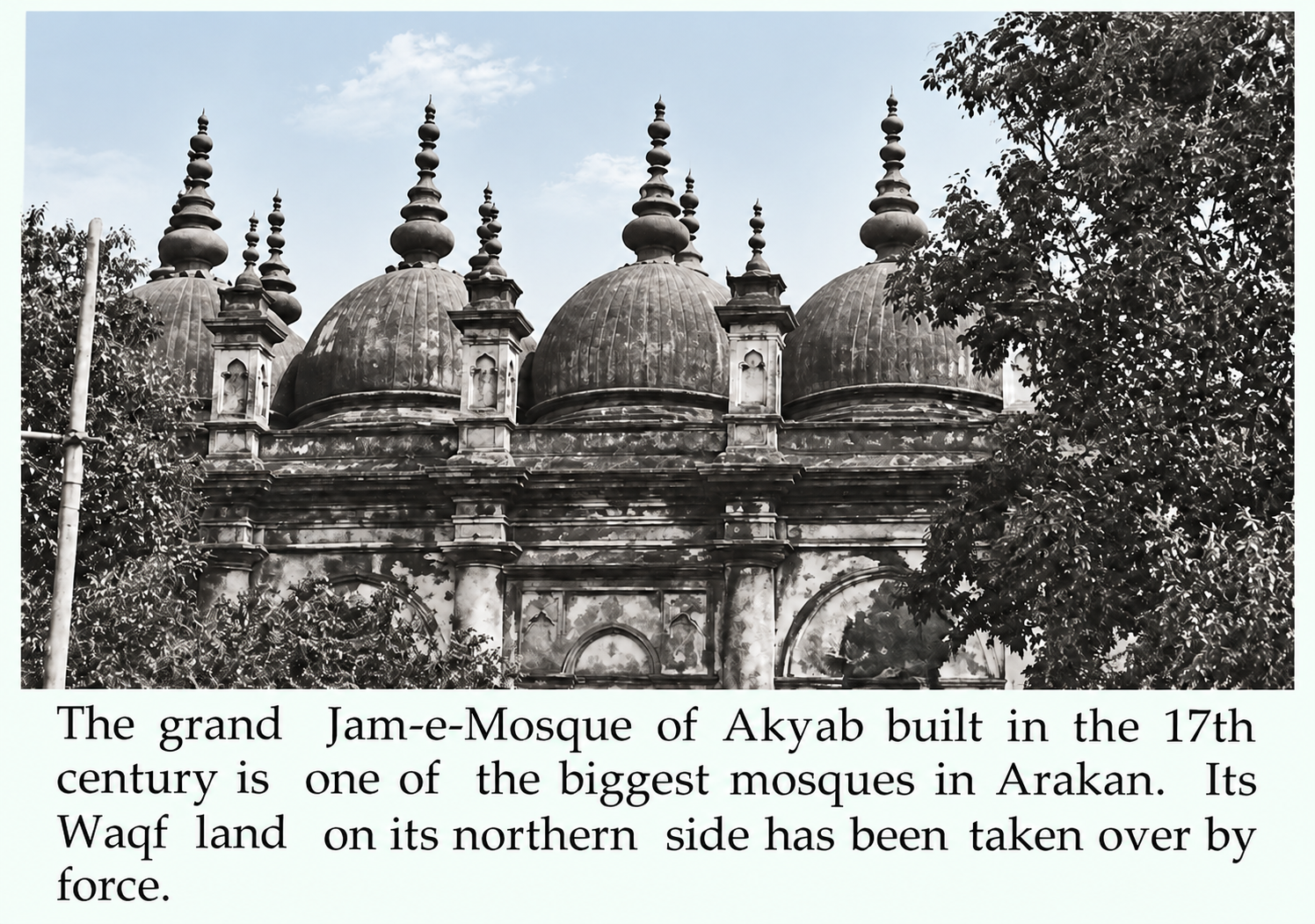
Historic mosques provide another important dimension of this religious history. Mohammed Yunus reproduces several such structures in his work, including the Grand Jam-e-Mosque of Akyab, which he describes as having been built in the seventeenth century and as one of the largest mosques in Arakan. He also discusses its waqf property, demonstrating that Muslim religious institutions could possess land and form established components of local community life.
From Independent Arakan to Burmese and British Rule
The Burmese conquest of Arakan in 1784–85 ended the independent Mrauk-U kingdom and caused extensive social disruption. Warfare, forced relocation and population flight affected communities throughout the country, with substantial numbers of Arakanese inhabitants moving westward toward Bengal. Muslim religious communities therefore experienced the same wider political rupture that transformed Arakanese society as a whole.
British annexation in 1826 introduced another major transformation. Substantial migration from Chittagong occurred during colonial rule, particularly as agricultural expansion created demand for labour. These migrants contributed additional Muslim populations to Arakan and interacted with communities already established there. The colonial period therefore expanded and altered Muslim society but did not mark the beginning of Islam in Arakan.
The religious life of the Rohingya subsequently developed from these different historical layers. Older Muslim communities, later settlers and their descendants increasingly shared mosques, religious education, family practices and common territorial experiences. Islam provided an important source of continuity while the population itself continued to develop through settlement, intermarriage and political change.
Religion and Rohingya Historical Formation
Islam consequently occupies an important place in Rohingya historical identity, but Rohingya ethnicity should not be reduced simply to religious affiliation. Muslims have lived among several ethnic and linguistic populations in Myanmar and the wider region, and being Muslim does not automatically make a person Rohingya. Rohingya identity developed specifically within the historical environment of Arakan through the interaction of religion, language, territorial attachment, ancestry and shared political experience.
At the same time, Islam became one of the strongest institutions through which Rohingya communities maintained continuity. Mosques, Qur'anic education, religious scholars, family traditions, festivals and burial practices transmitted religious and cultural knowledge across generations. During periods of displacement and political upheaval, these institutions also helped preserve community networks when other forms of social organization were disrupted.
The historical development of Islam among the Rohingya should therefore be understood as a long and layered process rather than a single event. Early maritime traditions, medieval religious heritage, the Muslim and Persianate dimensions of Mrauk-U, established Muslim communities, later migration and generations of locally born inhabitants all contributed to this development. Some details of the earliest chronology remain disputed, but the broader evidence demonstrates that Muslim religious life formed part of Arakan's history centuries before British colonial rule.
This historical development provides the background for understanding the religious tradition practiced by the overwhelming majority of Rohingya today: Sunni Islam, with the Hanafi school of Islamic jurisprudence forming the principal traditional legal framework within the community.
3. Sunni Islam and Religious Tradition
The overwhelming majority of Rohingya are Sunni Muslims, and Islamic belief and practice occupy an important place in Rohingya family and community life. Religious identity is expressed through daily prayer, Qur'anic recitation, fasting, religious education, charity, congregational worship and the observance of major Islamic occasions. These practices connect Rohingya Muslims with the wider global Muslim community while also being expressed through local customs and institutions that developed within Arakan over generations.
Traditionally, Rohingya Sunni religious practice has been associated predominantly with the Hanafi school of Islamic jurisprudence (madhhab), the school historically widespread across Bengal and much of South Asia. Hanafi jurisprudence provides guidance concerning prayer, fasting, marriage, inheritance, commercial dealings, purification, burial and many other areas of religious and social life. Religious scholars traditionally transmitted this knowledge through mosques, madrasas, maktabs, study circles and personal instruction. For many ordinary families, however, religious practice was learned primarily through parents, grandparents, village religious teachers and participation in community life rather than through formal study of jurisprudence.
The five daily prayers (salah) form the foundation of regular religious practice. Men traditionally gather at village mosques when circumstances permit, particularly for the Friday congregational prayer, while prayers are also performed within the home. Women commonly perform their daily prayers at home, although practices concerning women's participation in mosque worship may differ between communities and circumstances. Children are gradually taught prayer, Qur'anic recitation and basic Islamic beliefs as part of their religious upbringing.
The Friday prayer (Jumu'ah) has particular communal importance. In villages with a congregational mosque, Friday brings worshippers together not only for prayer but also for the sermon (khutbah) and religious instruction. The mosque consequently functions as more than a building for individual worship. It provides a regular meeting place through which religious knowledge, community concerns and relationships between families can be maintained.
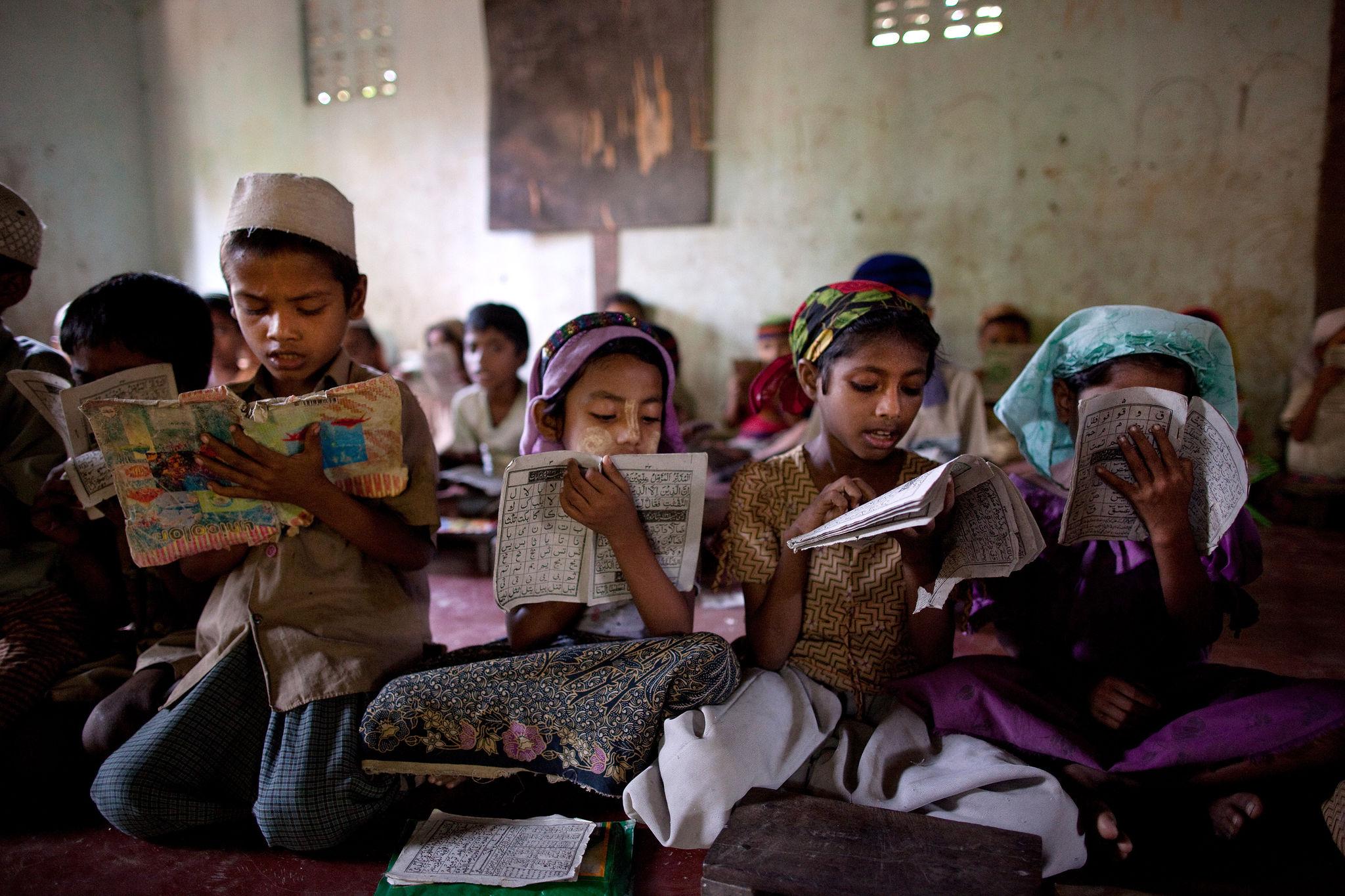
Qur'anic education traditionally begins during childhood. Many Rohingya children first learn the Arabic alphabet and Qur'anic recitation in a maktab, mosque school or under a local religious teacher. Students may begin with elementary reading before progressing to recitation of the Qur'an and basic instruction concerning prayer, purification, fasting, Islamic manners and essential beliefs. Children pursuing more advanced religious education may continue in a madrasa or study with recognized scholars.
The ability to memorize the Qur'an has traditionally been highly respected. A person who memorizes the entire Qur'an is known as a Hafiz, and huffaz may lead special prayers, teach children and participate prominently in religious occasions. Other religiously educated figures may be known within Rohingya communities by titles such as Moulvi, Mawlana, Imam or Mufti, depending upon their education and role. These titles do not necessarily represent identical levels of scholarly training, and their use can vary between communities.
The imam traditionally occupies an important position in village religious life. In addition to leading congregational prayer, an imam may teach religious knowledge, officiate at marriages, advise families and participate in funeral and burial rites. More highly trained scholars may be consulted on questions of Islamic jurisprudence or disputes involving religious principles. Religious authority has therefore historically operated through a combination of formal scholarship, mosque leadership and community recognition.
Islamic education has also traditionally emphasized adab, or proper moral and social conduct. Respect for parents and elders, care for relatives and neighbours, honesty, modesty, hospitality, charitable assistance and responsibility toward vulnerable members of society are taught as religious as well as social obligations. Such values are transmitted within families as well as through formal religious teaching. Consequently, the boundary between religious education and ordinary community upbringing has often been closely connected.
The month of Ramadan occupies a central place in Rohingya religious life. Adults who are able to fast abstain from food and drink between dawn and sunset, while families gather for the evening meal of iftar. Mosques may become particularly active during the month, with increased Qur'anic recitation, congregational worship and the special nightly Tarawih prayers. Charity and assistance to poorer households also receive particular emphasis during Ramadan.
The two principal Islamic festivals, Eid al-Fitr and Eid al-Adha, combine religious worship with family and community gathering. Eid al-Fitr marks the completion of Ramadan, while Eid al-Adha commemorates the tradition of Prophet Ibrahim's willingness to sacrifice in obedience to God. Families prepare food, wear suitable or new clothing when possible, visit relatives and neighbours and provide assistance to people in need. Eid prayer traditionally brings large numbers of worshippers together in mosques or open prayer grounds.
Zakat and other forms of charity are also important components of Islamic religious life. Those meeting the religious requirements for zakat are expected to give a prescribed portion of eligible wealth to appropriate recipients. In addition, voluntary charity (sadaqah) may be given to poor families, widows, orphans, religious institutions and people facing hardship. Within village society, assistance has also traditionally taken informal forms through food, labour and support between relatives and neighbours.
Marriage is understood both as a family institution and as an Islamic contract. The nikah establishes the religious marriage, normally in the presence of witnesses and with an agreed mahr for the bride. Religious figures may conduct or assist with the ceremony, while Rohingya families also maintain social and cultural wedding customs surrounding the religious contract. It is useful to distinguish such local customs from requirements of Islamic law because not every practice associated with a Rohingya wedding is itself a religious obligation.
Death and burial similarly combine universal Islamic practices with local community traditions. The deceased is ordinarily washed, shrouded and prepared for the Janazah funeral prayer before burial. Relatives, neighbours and community members participate in assisting the bereaved family and accompanying the deceased to burial where circumstances permit. Qur'anic recitation, supplication and remembrance of the deceased also form part of community responses to death, although particular practices can differ according to family and scholarly tradition.
Rohingya religious life has never been completely uniform. Levels of religious education, patterns of mosque attendance and particular devotional customs have varied between villages, families, generations and religious teachers. Contact with religious movements and institutions in Arakan, Bengal and the wider Muslim world has also influenced community practice at different times. Rohipedia should therefore avoid presenting every local custom as though it were practiced identically by all Rohingya Muslims.
Religion should likewise not be confused with ethnicity. Islam is central to the identity of most Rohingya, but being Muslim alone does not make a person Rohingya. Muslims belong to many different ethnic communities in Myanmar, Bangladesh and elsewhere. Rohingya identity developed within the particular historical, linguistic, territorial and social environment of Arakan, while Islam became one of its most important sources of religious and cultural continuity.
For Rohingya communities affected by displacement, religious practice has also travelled beyond Arakan. Mosques, madrasas, Qur'anic schools and religious teachers have been re-established in refugee settlements and diaspora communities wherever circumstances allow. Families continue to teach prayer, Qur'anic recitation and Islamic values to children born outside their ancestral homeland. Religion therefore remains one of the institutions through which community knowledge and relationships are transmitted across generations and geographical separation.
The Sunni-Hanafi tradition provides the broad religious framework within which these practices developed, but understanding Rohingya religious life requires looking beyond doctrine alone. The mosque and madrasa, in particular, have historically served as important institutions of worship, education and community organization. Their role in Rohingya society deserves separate examination.
4. Mosques and Religious Institutions
The mosque has historically been one of the central institutions of Rohingya village and community life. It is first and foremost a sacred place established for the worship of Allah, particularly the five daily prayers and the Friday congregational prayer. At the same time, the mosque became closely connected with the social organization of Rohingya villages, bringing neighbours together regularly and providing a shared institution around which religious and communal relationships developed. Its importance therefore cannot be understood solely through architecture; the mosque formed part of the everyday religious landscape of Rohingya society.
In the Rohingya language, a mosque is commonly called a mosoit. The Rohingya Cultural Memory Centre records the mosoit as an institution central to Rohingya Muslim community life and describes traditional villages as having at least one mosque. An imam leads the congregation in prayer, while a muezzin gives the Azaan, or call to prayer. Men and boys gather especially for the Friday Jumu'ah prayer and sermon, while women have traditionally performed most prayers within the home. These practices remain recognizable across Rohingya communities even though particular arrangements differ between villages and diaspora settings.
Village Mosques
The traditional village mosque was closely connected with the physical organization of the Rohingya settlement. Small villages might possess one principal mosque, while larger villages and towns could contain several neighbourhood mosques. Population size, distance between neighbourhoods and the resources available to residents influenced the number and size of religious buildings. A larger congregational or Jama/Jumu'ah mosque could serve worshippers from a wider area for Friday prayer.
Mosques were commonly built and maintained through community contributions. Families might provide money, construction materials or voluntary labour according to their means. Maintenance of the building was therefore a collective responsibility rather than solely the responsibility of the imam. Local trustees, respected elders or a mosque committee could oversee practical matters such as repairs, donations and maintenance of the property.
The architectural appearance of Rohingya mosques varied according to period, location and available resources. Village mosques could be relatively simple structures, while important urban and historic mosques were substantially larger and more elaborate. The Rohingya Cultural Memory Centre describes the traditional mosoit as containing a large prayer room and a veranda, reflecting one form familiar within Rohingya cultural memory. Historic structures elsewhere in Arakan demonstrate considerably greater architectural diversity.
The Mosque and the Rohingya Samaj
The mosque existed within a wider Rohingya institution of village social organization traditionally known as the Samaj. Rohingya historical and community sources describe the Samaj as a social bond operating within villages through which families maintained collective responsibilities toward one another. Religious leaders, elders and respected community members could participate in this system, although its organization and leadership were not necessarily identical in every locality.
The Samaj helped coordinate assistance to families experiencing hardship and contributed to the organization of important community events. Rohingya sources associate it with assistance to poor families, widows and orphans, the distribution of Qurbani meat, marriage arrangements and support surrounding death and funerals. These activities combined religious obligations with the traditional Rohingya principle of collective community responsibility.
The relationship between mosque and Samaj was therefore close without making the two institutions identical. The mosque was a sacred institution centred upon worship, while the Samaj represented the broader social organization of the community. The regular gathering of worshippers at the mosque nevertheless allowed information to circulate and gave religious leaders and elders opportunities to discuss matters affecting village life.
This traditional structure is important to Rohingya social history because it demonstrates that religious life was embedded within locally organized communities. Islam was not practiced only individually within households. Worship, charity, family obligations, assistance to vulnerable people and community relationships developed within institutions that connected families across the village.
Imam, Muezzin and Mosque Leadership
The imam occupies the principal religious leadership position within the mosque. He leads congregational prayers and normally delivers or oversees the Friday sermon. Depending upon his education and community standing, he may also be consulted concerning religious questions, marriage, family matters and disputes involving Islamic principles. The respect given to an imam traditionally depends substantially upon his religious learning, conduct and reputation within the community.
The muezzin performs another important function by giving the Azaan announcing the time for prayer. The sound of the Azaan traditionally marks the rhythm of daily religious life around the mosque. Five times each day, worshippers are reminded of prayer, while the Friday congregation brings a much larger section of the male community together.
Other respected religious scholars may also be associated with a mosque or village. Rohingya communities use titles including Moulvi, Mawlana, Hafiz, Qari and Mufti for people possessing different forms and levels of religious learning. Their specific educational roles belong more appropriately to the history of Rohingya education, but their relationship with the mosque remains important because mosques provide an institutional setting in which religious leadership operates.
Religious authority among the Rohingya has traditionally been decentralized. There was no single Rohingya ecclesiastical institution controlling every mosque throughout Arakan. Village communities recognized their own religious leaders, while more difficult questions could be referred to scholars possessing greater learning. This locally rooted structure allowed religious institutions to remain closely connected with particular villages and communities.
Charity and Mutual Assistance
Charity is a fundamental Islamic obligation and has historically been closely connected with Rohingya community institutions. Zakat, voluntary sadaqah, Qurbani meat and other forms of assistance could be directed toward poor households, widows, orphans and people facing hardship. The mosque and Samaj provided networks through which communities could identify need and organize assistance.
During Ramadan and the two Eids, charitable activity acquired particular importance. Families with sufficient resources assisted poorer neighbours and relatives, while religious leaders reminded worshippers of their obligations toward vulnerable members of society. During Eid al-Adha, Qurbani meat was distributed among relatives, neighbours and people in need. Rohingya accounts specifically associate the Samaj with organization of this distribution.
Such assistance was not limited to money. Food, labour, shelter and participation in family events could all form part of community support. When a family experienced death, neighbours helped with the funeral and burial arrangements and supported the bereaved household. The strength of these networks was particularly important in rural communities where formal state welfare institutions were limited or inaccessible.
Historic Mosques of Arakan
The historic mosques of Arakan occupy an important place in Rohingya historical memory because they provide physical evidence of organized Muslim religious life before British colonial rule. Mohammed Yunus gives considerable attention to this architectural heritage in A History of Arakan: Past and Present. His account identifies a series of Muslim religious structures extending from traditions of early Arab presence through the Mrauk-U period and into later centuries.
Among the earliest is Badr Maqam in Akyab, which Yunus associates with early Arab Muslims and traditionally dates to the later seventh century. As discussed previously, this precise early date should remain attributed to Yunus and the tradition he records unless independently confirmed archaeologically. The importance of the site nevertheless extends beyond the dating dispute because it preserves a longstanding Muslim religious tradition associated with the Arakan coast.
Yunus also identifies the ruined Musa Mosque, or Magya Mosque, near Mrohaung/Mrauk-U as a fourteenth-century structure. He locates it on a hill near present-day Maung Tha Gon village northeast of Mrohaung. If the proposed date is correct, it would represent particularly important evidence for Muslim religious life before the establishment of the Mrauk-U dynasty in 1430. The surviving photograph should therefore be preserved while its date is clearly attributed to Yunus.
Another important structure in Yunus's account is the Sandikhan Mosque, which he states was constructed in 1433 by General Sandi Khan at Patthari Qillah near Mrauk-U. Its attributed date places it very close to the establishment of the Mrauk-U kingdom and the restoration of Min Saw Mon. The mosque therefore occupies an important place in the Rohingya historical interpretation of the connection between Muslim military participation, Bengal and the early Mrauk-U political order.
Yunus further records the Shuja Mosque, which he associates with Prince Shah Shuja and dates to 1661 at Mintayabyin in Mrauk-U. He identifies the Alam Lashkar Mosque at Pan Mraung near modern Minbya as dating to 1668. His account also mentions Qazi mosques associated with Minbya and Zaliyapara in Kyauktaw Township. Together, these references present a geographical distribution of Muslim religious institutions extending beyond northern Arakan alone.
Yunus also identifies Musa Dewan Mosque in Akyab as a major seventeenth-century mosque. His photographic plates separately reproduce what he describes as the Grand Jam-e-Mosque of Akyab, identifying it as one of the largest mosques in Arakan and associating it with the seventeenth century. These records demonstrate the importance Yunus gives to mosque architecture as evidence for established Muslim communities within Arakan.
Arabic and Persian Inscriptions
Mosques are not the only physical evidence associated with Muslim religious heritage in Mrauk-U. Yunus reproduces stone plates bearing Arabic inscriptions from Patthari Qillah. One was reportedly found inside the Theingyitaung pagoda, while another was recorded in a wall at Nanragone. Such material is potentially important because inscriptions can provide information concerning language, religious expression, individuals and institutions that ordinary narrative histories may not preserve.
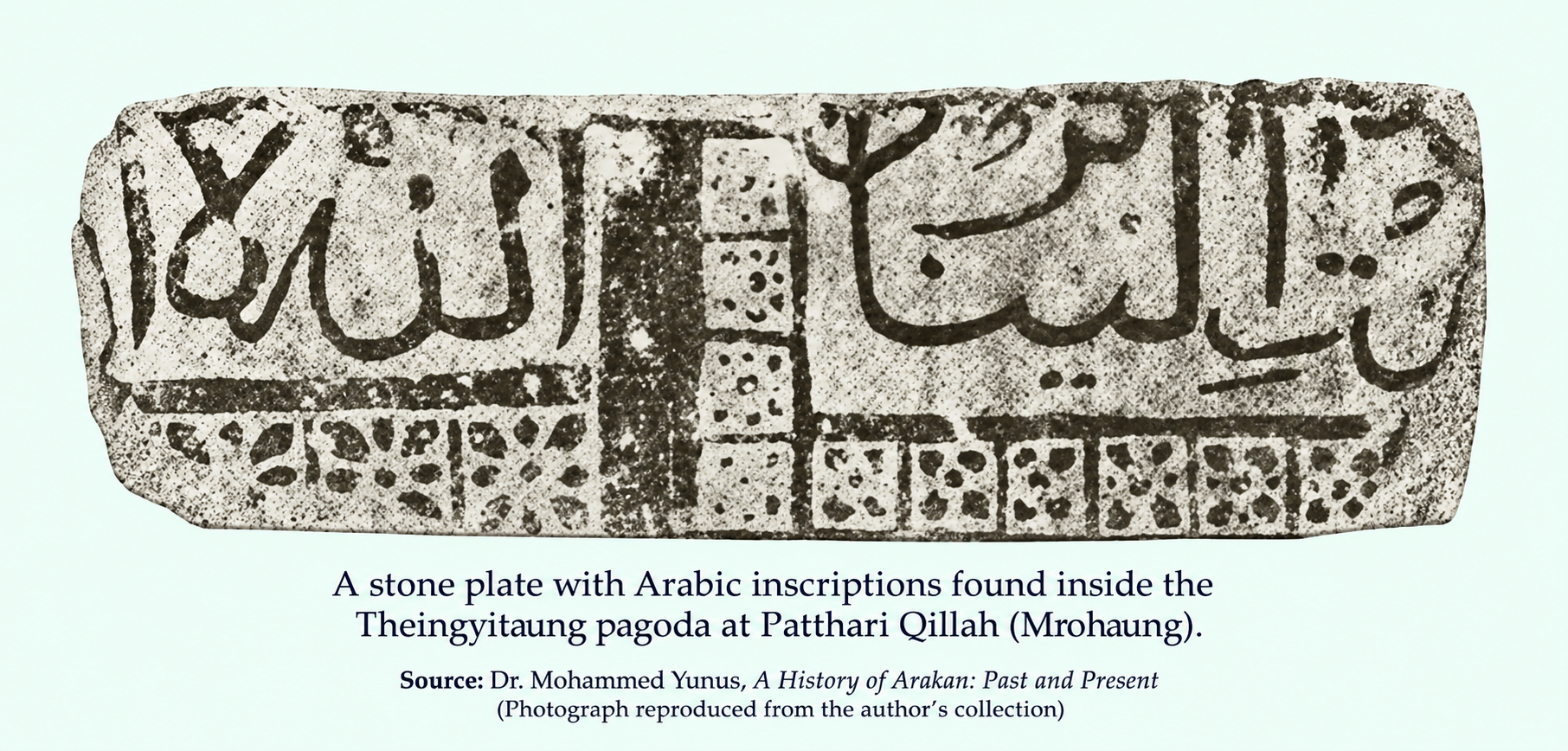
The preservation of these materials is particularly important because warfare, redevelopment, neglect and political conflict have damaged or transformed many historic sites in Arakan. Older photographs and printed records may therefore preserve information concerning structures or inscriptions that are difficult to study today.
Waqf and Mosque Property
The Islamic institution of waqf historically provided a means of preserving property for continuing religious or charitable purposes. Land or other property could be dedicated to support a mosque and its activities. Income from endowed property could contribute to maintenance and other religious or charitable functions according to the terms of the endowment.
Yunus's description of the Grand Jam-e-Mosque of Akyab specifically refers to waqf land on its northern side and states that the land had been taken over. Whatever further documentation can be recovered concerning that particular property, the reference itself demonstrates the importance of land endowment within Rohingya and Arakan Muslim institutional memory. Mosque history consequently includes not only buildings but also the land and economic resources that sustained them.
Future Rohipedia research should seek surviving waqf deeds, land records, mosque committee records and family documents. Such material could provide valuable evidence concerning the age, administration and economic foundations of historic Muslim institutions. It could also help reconstruct the history of religious properties that were later confiscated, occupied or destroyed.
Restrictions on Mosques
The ability of Rohingya communities to maintain their mosques became increasingly restricted under military rule. Rohingya testimony and human-rights documentation describe requirements for official permission to construct, expand or even repair religious buildings. By the 2000s, these restrictions had become highly detailed and intrusive.
Testimony collected by the Arakan Project in 2007 described government surveys of mosques and madrasas throughout northern Arakan. Officials reportedly recorded building dimensions and construction materials, photographed structures and displayed information intended to reveal any later alteration. Mosque committees were reported to have faced substantial payments for repairs, while individuals were detained for carrying out renovations without authorization.
Restrictions also affected congregational worship. The same documentation reported difficulties assembling for Friday prayer, while later official religious-freedom reporting documented closures of mosques and restrictions affecting Rohingya congregational prayer and Eid observances. Following the violence of 2012, Rohingya Muslims in several areas were prevented from accessing mosques or conducting ordinary congregational worship.
These restrictions affected more than physical buildings. Preventing a community from repairing a mosque can eventually render the structure unusable, while restrictions on gatherings undermine Jumu'ah prayer and community religious life. Loss of access to a mosque also weakens the social networks historically connected with the institution.
The detailed history of religious persecution and restrictions deserves its own later section in this article. Here it is sufficient to recognize that the mosque changed from being a locally maintained village institution into an institution increasingly subject to surveillance, permission requirements, closure and, in some places, destruction or confiscation.
Mosques after Displacement
Mass displacement did not end the importance of the mosque. Rohingya refugees reconstructed places of worship in Bangladesh using the materials and space available to them. Research in the refugee camps describes mosque compounds occupying central positions within camp blocks, with imams continuing to exercise significant religious and social influence.
The physical form changed dramatically. Historic stone and brick mosques of Arakan were replaced in many refugee settlements by structures made from bamboo, timber, tarpaulin and corrugated materials. Yet the fundamental functions remained recognizable: daily prayer, Jumu'ah, religious leadership, communication and community gathering.
This continuity is historically significant. The mosque was not simply an architectural feature left behind in Arakan. Rohingya communities recreated it after displacement because it remained an institution necessary to their religious and communal life. The same pattern can be observed in diaspora communities where Rohingya worshippers join existing mosques or establish new religious associations.
Mosques as Rohingya and Arakan Heritage
Historic mosques should finally be understood as part of the cultural heritage of Arakan itself. Badr Maqam, Musa Mosque, Sandikhan Mosque, the mosques associated with Mrauk-U, the historic mosques of Akyab and other surviving or documented structures preserve evidence of Muslim communities that formed part of Arakan's social landscape over different periods.
For Rohingya, these sites carry additional significance because destruction and displacement have separated much of the population from its ancestral villages and religious landmarks. Photographs of old mosques are therefore not merely illustrations of architecture. They preserve memories of places, communities and institutions from which many Rohingya are now physically separated.
Rohipedia should document this heritage systematically. Historical photographs, mosque names, village locations, inscriptions, waqf records, oral histories, architectural descriptions and documentary sources should be collected wherever possible. Claims concerning dates should be attributed according to the available evidence rather than discarded merely because they originate in Rohingya historical sources.
The history of Rohingya mosques is consequently a history of worship, community, heritage and continuity. From the old mosques recorded by Mohammed Yunus to the village mosoit remembered by Rohingya communities and the temporary mosques reconstructed in refugee camps, the institution has remained one of the principal physical expressions of Rohingya Muslim religious life.